9 min read
On 3 August 2026, Beacon CRM sent a notification that thousands of charity supporters across the UK had been dreading: a cyberattack had compromised its systems, and every record stored on the platform should be assumed copied. Names, addresses, email addresses, phone numbers, dates of birth, donation histories—all of it, held by a single software provider, potentially in the hands of an unauthorised third party.
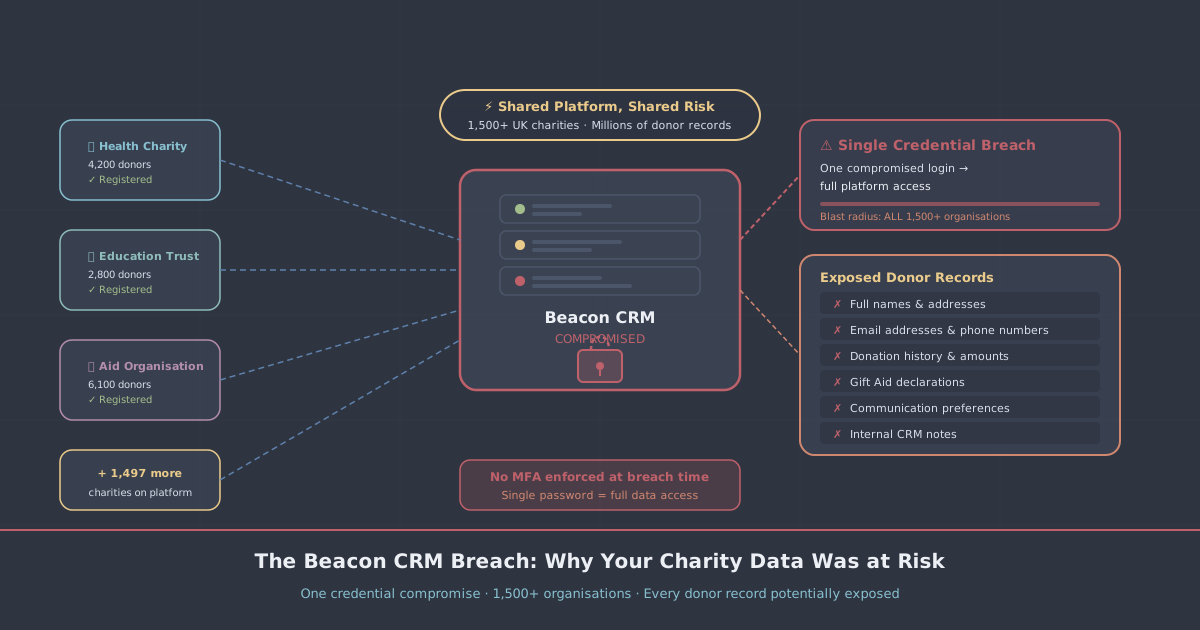
Beacon provides customer relationship management (CRM) software to more than 1,500 UK charities. That concentration matters. This was not a breach at one organisation with one database. It was a breach at the infrastructure layer—the place where donor data from hundreds of organisations sits together, managed centrally, accessible through a single set of systems.
This article explains what happened, why breaches of this type are structurally different from single-organisation incidents, and what you can do when you have no direct relationship with the company that lost your data.
What happened at Beacon
Beacon detected the attack on 29 July 2026. It notified affected charities five days later, on 3 August. The Charity Commission published guidance on 7 August 2026 confirming it was actively monitoring the situation alongside the Information Commissioner's Office (ICO), which confirmed it had received breach reports from multiple impacted organisations.
The attack was credential-based. An attacker—or group of attackers—obtained valid login credentials and used them to access Beacon's systems without triggering an obvious intrusion. This is a fundamentally different threat profile from, say, exploiting an unpatched vulnerability. Credential attacks look legitimate right up until someone notices the anomaly, which is precisely why they are so effective and so common.
Forensic evidence pointed to database backups as the primary target. Beacon acknowledged that although stored data was encrypted, attackers may have had the ability to decrypt it. That caveat is significant. Encryption protects data only if the attacker cannot also access the keys—and in a credential-based breach where an attacker moves laterally through systems, key access is often achievable.
Why the scale is unusual
Most data breaches affect one organisation. A retailer loses customer payment details. A hospital exposes patient records. The damage is serious, but it is bounded by that organisation's own data holdings.
The Beacon breach works differently because Beacon is a platform—a centralised repository of data submitted by many independent organisations. Supporters who donated to a local hospice, a food bank, a mental health charity, and a youth sports club may have had data held by all four of those organisations inside the same Beacon system. A single successful attack touches all of them simultaneously.
This is the defining risk of third-party platforms. When you hand your personal data to a charity, you are implicitly also handing it to every software provider that charity has contracted with. That chain is rarely visible to the individual supporter, and the contracts governing it—data processing agreements under UK GDPR—are written between organisations, not between you and the platform.
What data was at risk
Beacon's notification to customers was explicit about the categories of data potentially affected:
- Full names
- Home addresses
- Email addresses
- Phone numbers
- Dates of birth
- Donation histories
Donation history deserves particular attention. Knowing that someone donates regularly to, say, a domestic abuse charity or an addiction recovery service is sensitive in a way that a name and email address alone is not. Combined with contact details, it creates a profile that could be used for targeted social engineering—crafting phishing messages that reference real organisations the recipient genuinely supports.
Dates of birth paired with addresses are also a classic combination used in identity verification by banks and utility providers. This is not abstract risk. It is usable data for fraud.
The credential compromise problem
Credential-based attacks succeed because passwords are reused, phished, purchased from prior breaches, or simply guessed. Once an attacker has a valid username and password for a system, they are operating inside the trust boundary. Firewalls, intrusion detection, and perimeter controls are largely irrelevant at that point.
This is why multi-factor authentication (MFA) is not optional for systems holding sensitive data. A credential alone should not be sufficient to authenticate. Whether Beacon had MFA enforced across all accounts with access to production data is not publicly confirmed, but the fact that compromised credentials were sufficient to gain access and exfiltrate database backups suggests the controls in place were insufficient to contain the breach.
For individuals, the lesson is straightforward: your data's security depends on the security practices of every organisation that holds it. You cannot audit those practices directly, which is why minimising what you share—and with whom—is the most reliable form of personal data protection available to you.
Your rights and what you can do now
If you have donated to or supported a UK charity in recent years, there is a meaningful probability that some of your data passed through Beacon. Here is what you can reasonably do:
- Watch for phishing. Expect emails referencing charities you support, asking you to update payment details, confirm a donation, or verify your account. These may arrive quickly, while the data is fresh. Do not click links in unsolicited emails—navigate directly to the charity's website instead.
- Check whether your email address has appeared in known breach data. Services such as the ICO-referenced tools and breach-notification platforms can tell you if your address has been seen in circulated datasets.
- Review your email account for unusual activity. If attackers have your email address and other identifying details, they may attempt account takeover via password reset flows.
- Use unique passwords. If you use the same password across multiple services and one of those services has your email address from a breach dataset, every account sharing that password is at risk.
- Contact the charities you support. Under UK GDPR, you have the right to ask any data controller whether they hold your data, what they hold, and how it is processed. If an organisation used Beacon, it is the data controller; Beacon is the processor. Your rights are against the charity, not the platform.
The ICO has confirmed it is engaged with this incident. If you believe your rights have been breached and the organisation involved is not responding appropriately, you can raise a complaint directly with the ICO.
What this means for how we think about data sharing
Breaches like this one are a useful prompt to reconsider what personal information is actually necessary to share when donating or registering with an organisation. Date of birth, for instance, is rarely required by a charity for operational purposes—yet it is routinely collected and retained.
UK GDPR's data minimisation principle exists precisely to address this. Organisations should collect only what they need. In practice, many collect more than they need, for longer than they need it, with the result that a single breach exposes data that was never necessary to hold in the first place.
As a supporter, you can push back. If a charity's sign-up form asks for your date of birth and you cannot see why they would need it, ask. If a field is optional, leave it blank. The data that does not exist cannot be breached.
This also applies to how you think about your online activity more broadly. Tools that reduce the amount of identifying information you expose—whether to websites, advertisers, or trackers—incrementally reduce the data available to be collected, aggregated, and eventually breached. A VPN will not prevent a CRM provider from being compromised, but reducing your data footprint across the web means there is less of you in those aggregated datasets to begin with. If that kind of protection is relevant to you, our no-log policy explains how we approach data minimisation on our own side.
A note on the charity sector specifically
UK charities operate under tight resource constraints. CRM software is expensive to build and maintain in-house, which is why sector-specific platforms like Beacon exist and why they attract such large customer bases. Consolidation of this kind creates concentration risk that individual charities have limited power to mitigate once they have committed to a platform.
The Charity Commission's guidance following this breach is a recognition that the sector needs support in understanding and managing third-party data risk. Data processing agreements, supplier audits, and contractual security requirements are all mechanisms that help—but they require resource and expertise that many smaller charities simply do not have.
This is not a reason to distrust charities. It is a reason to understand that when you share your data, you are entering a supply chain, and the security of your information is only as strong as its weakest link.
Summary
The Beacon CRM breach exposed how a single credential compromise at a platform provider can simultaneously affect the data of supporters across more than 1,500 organisations. The data at risk—names, addresses, dates of birth, donation histories—is specific and usable enough to enable phishing and identity fraud. The ICO and Charity Commission are engaged, but the practical steps available to affected individuals are limited to vigilance, exercising data rights, and reducing what personal information they share going forward.
The broader lesson is structural: third-party platforms aggregate risk. Every organisation you trust with your data extends that trust to its own suppliers. Understanding that chain, minimising what you share, and staying alert after a confirmed breach are the most effective responses available to individuals who had no say in how their data was stored or secured.