9 min read
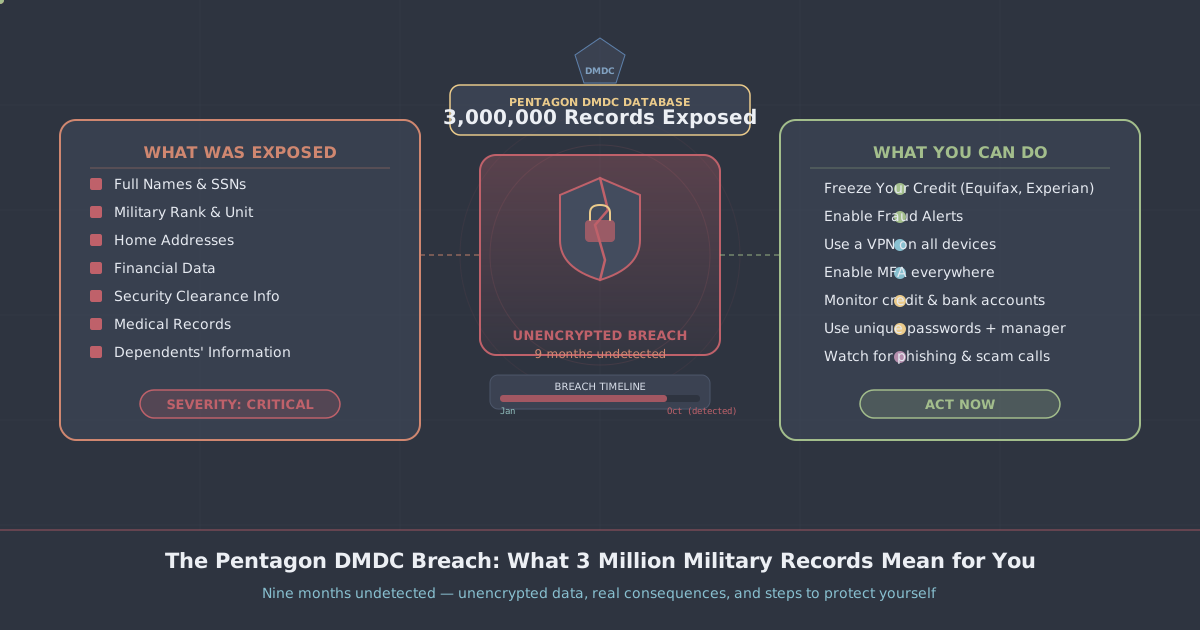
In July 2026, the US Defense Manpower Data Center (DMDC)—the Pentagon's central repository for military personnel records—confirmed that unauthorised users had been quietly inside its systems since October 2025. By the time the breach was discovered and patched, roughly nine months had passed. In that window, the personal data of approximately 2.76 million living individuals and 294,000 deceased people was exposed, totalling more than 3 million records.
The breach is significant not just for its scale but for what it reveals about how government institutions handle sensitive data—and what individuals can reasonably expect from the institutions that hold it. If you are an active-duty service member, reservist, veteran, military retiree, civilian DoD employee, contractor, or a family member of any of the above, this article is worth reading carefully.
We will cover what was exposed, why this breach is particularly dangerous, what the DoD's response actually gives you, and what practical steps you should take now—regardless of whether you receive a notification letter.
What Was Actually Exposed
The compromised system was a file-sharing platform used within the DMDC infrastructure. The data sitting on that server was stored unencrypted. That detail matters enormously. Encryption does not prevent a breach, but it does render stolen data far less useful to an attacker. Without it, anyone who accessed those files received the information in plain, readable form.
Exposed fields varied by individual but included:
- Social Security numbers (SSNs)
- Full names and dates of birth
- Contact details including addresses
- Demographic data
- Military occupational specialties (MOS)—the codes describing a service member's role and skills
The combination of SSN, date of birth, and full name is the trifecta for identity fraud. Add a home address and a military occupational specialty, and you also have a profile that can be used for targeted phishing, social engineering, or—in more serious scenarios—identifying individuals whose roles carry operational sensitivity.
Why Nine Months Undetected Is the Real Story
The DoD has confirmed the breach ran from October 2025 to 16 July 2026. That is not a brief intrusion caught quickly. Nine months of undetected access to a database of this sensitivity points to systemic failures in monitoring and anomaly detection—not a one-off oversight.
For the people whose data was exposed, this timeline has a practical consequence: any attacker who accessed this data nine months ago has had nine months to act on it. The DoD's current position—that it has found no evidence of misuse so far—is not the same as saying no misuse has occurred. Identity fraud can be slow and deliberate. Fraudulent credit applications, tax return interceptions, and synthetic identity schemes often take months to surface, and victims frequently discover the problem only when the damage has already been done.
The absence of detected misuse now is not reassurance. It is simply the current state of knowledge.
Who Is in the Affected Population
The DMDC's remit covers an unusually broad population. The affected group includes:
- Active-duty service members across all branches
- National Guard and reserve personnel
- Military retirees and veterans
- Civilian employees of the Department of Defense
- DoD contractors and their personnel
- Family members of the above
This is not a narrow database. The DMDC issues military ID cards, manages benefits eligibility, and maintains records across the entire lifecycle of military service. If you have had any formal relationship with the US military or DoD—as a service member, employee, contractor, or dependent—your records may have been in scope.
What the DoD's Response Actually Gives You
The standard institutional response to a breach of this type is to offer one year of credit monitoring and identity-restoration services, which is precisely what the DoD is providing. Credit monitoring is better than nothing, but it is worth being clear about what it does and does not do.
Credit monitoring will:
- Alert you when new credit enquiries or accounts appear in your name
- Notify you of significant changes to your credit file
- Provide some assistance if you become a victim of identity fraud
Credit monitoring will not:
- Prevent fraud from occurring
- Cover you after the one-year window expires—while the data remains exposed indefinitely
- Detect fraud that does not touch your credit file, such as tax fraud or benefit fraud
- Protect against phishing or social engineering attacks enabled by the leaked data
One year of monitoring is a gesture. The data that was exposed does not expire after twelve months.
Concrete Steps to Take Now
Do not wait for a notification letter before acting. If there is any reasonable chance your records were held by the DMDC, treat your SSN and personal details as compromised and respond accordingly.
Place a credit freeze with all three bureaus
A credit freeze (also called a security freeze) prevents new credit from being opened in your name without your explicit authorisation. It costs nothing in the US and is more powerful than credit monitoring alone. Contact Equifax, Experian, and TransUnion individually—a freeze with one bureau does not apply to the others. You can temporarily lift the freeze when you need to apply for credit yourself.
File an IRS Identity Protection PIN
If your SSN has been exposed, tax fraud is a meaningful risk. The IRS offers an Identity Protection PIN (IP PIN) programme that requires a six-digit code on your tax return that only you know. This prevents someone from filing a fraudulent return using your SSN. Enrolment is available through the IRS website.
Review your existing accounts
Go through your bank and credit card statements, benefits accounts, and any DoD-related portals for unusual activity. Change passwords on any account that uses your name, date of birth, or SSN as a verification method—these can now be answered by anyone who accessed the breach data.
Be sceptical of inbound contact
With full names, addresses, and military occupational specialties in hand, attackers can craft convincing phishing emails or phone calls that reference your service history, benefits, or employment. Be suspicious of any unsolicited contact that references your military service or DoD employment, even if the details sound accurate. Accurate personal details are no longer evidence that the caller is legitimate.
Consider your digital privacy posture more broadly
A breach like this is a reminder that personal data circulates far beyond the accounts you control. Reducing your overall digital footprint—using a VPN on public or untrusted networks, being deliberate about what information you share with online services, and keeping software up to date—reduces the attack surface available to anyone working from a stolen dataset. Our no-log policy and the IP leak test tool are worth reviewing if you want to understand what a VPN does and does not protect against in this context.
Why Government Databases Are High-Value Targets
The DMDC breach is not an isolated incident in a long list of government data failures—it is consistent with a structural reality. Government databases aggregate records at a scale that no commercial entity typically matches. A single successful intrusion can yield millions of complete, verified identities in one operation. The data is accurate because it is maintained for administrative purposes. And critically, individuals have no meaningful choice about whether their data is held there.
When you take out a credit card, you choose the provider and accept the terms. When you serve in the military or work for the DoD, your personnel data goes into DMDC whether you consider that a good idea or not. You cannot opt out, cannot request deletion, and cannot audit who has accessed your records. The asymmetry between institutional data collection and individual control is the central problem—and breaches like this make it visible.
This is not an argument against government record-keeping. It is an argument for accepting that you cannot fully delegate the protection of your identity to any single institution, however large or well-resourced.
What a VPN Does—and Does Not—Help With Here
To be direct: a VPN could not have prevented this breach. The DMDC breach was a server-side vulnerability in a file-sharing system. The problem was on the institution's infrastructure, not on individual users' connections.
What a VPN does address is the ongoing risk environment that a breach like this creates. When your personal details are in circulation, attackers may attempt to correlate them with other data—your browsing behaviour, your IP address, your location patterns—to build fuller profiles or identify high-value targets. Routing your traffic through an encrypted tunnel, as a VPN does, removes your real IP address from that correlation and encrypts the traffic between your device and the VPN server, making passive surveillance on your connection significantly harder.
For those who travel frequently, use public Wi-Fi, or work remotely—all common situations for military personnel and contractors—a remote work VPN is a sensible baseline. If you are operating in a region with restrictive network monitoring, PremierVPN's VLESS+REALITY protocol via PremierVPN X for Windows or PremierVPN X for macOS offers additional protection against deep packet inspection.
Summary
The DMDC breach exposed more than 3 million records—including SSNs, dates of birth, and military service details—stored unencrypted, for nine months before anyone noticed. The affected population is broad, the data is highly sensitive, and the risk does not end when the one-year credit monitoring period does.
The practical steps are straightforward: freeze your credit at all three bureaus, enrol in the IRS IP PIN programme, review your accounts, and treat unsolicited contact referencing your military service with scepticism. Beyond those immediate actions, this breach is a useful prompt to think carefully about your broader digital privacy posture—not out of panic, but because the data that institutions hold about you is outside your control, and reducing your exposure elsewhere is the one lever you do have.