8 min read
Russian Websites Are Now Blocking VPN Users
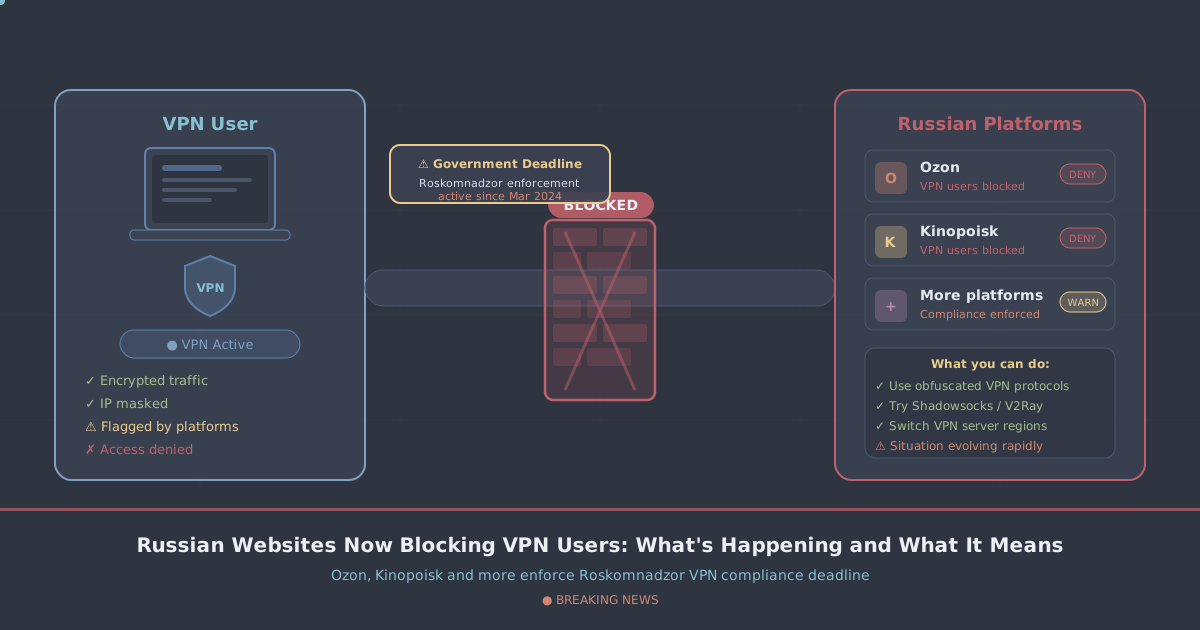
Several major Russian websites have started refusing access to visitors who are connected via a VPN. The e-commerce giant Ozon and the streaming platform Kinopoisk are among the confirmed cases, with users encountering "access denied" messages or similar errors when attempting to connect through a VPN. Disruptions have also been reported on banking and ride-sharing apps, though not all platforms have followed suit — VKontakte and Wildberries, for instance, were still accessible via VPN at the time of writing.
The changes appear to be linked to a deadline reportedly set by Russia's Digital Development Ministry, which instructed more than 20 major platforms to actively curb VPN usage by 15 April. Digital Development Minister Maksut Shadayev confirmed last month that his agency had been tasked with "reducing the use of VPNs", citing what he described as lengthy and ultimately unsuccessful negotiations with foreign technology companies over compliance with Russian law.
Why Is Russia Doing This?
Russia has been tightening its grip on internet access for years, but this latest move marks a notable shift in approach. Rather than simply blocking VPN providers at the network level — which Roskomnadzor, the country's telecoms regulator, has long attempted — the government appears to be pressing domestic platforms themselves to enforce the restrictions. This is a more distributed model of censorship: instead of one central chokepoint, dozens of popular services become their own gatekeepers.
The minister's reference to failed negotiations with foreign tech firms suggests that pressure on international platforms has not produced the compliance Moscow wanted. Targeting homegrown services that are more directly subject to Russian law is a logical next step from the government's perspective.
It is worth noting that the companies themselves have not issued official statements explaining the blocks. Whether they are acting under direct legal obligation, informal pressure, or pre-emptive caution is not yet clear.
What Does This Mean for VPN Users?
For people inside Russia, this creates a more complicated picture. A VPN remains useful — and in many cases essential — for accessing blocked foreign content and maintaining privacy. But certain Russian-language services that people rely on daily may now push back against VPN connections.
For people outside Russia who use a VPN to access Russian content — expats keeping up with local services, journalists, researchers, or businesses with Russian operations — these blocks could disrupt access in a similar way. The issue is not that VPNs stop working; it is that specific destination services are now detecting and refusing VPN traffic.
The practical implication is that protocol choice and obfuscation matter more than ever. Standard VPN protocols are relatively straightforward to detect using deep packet inspection (DPI). More advanced approaches that disguise VPN traffic as ordinary HTTPS traffic are harder to block at the destination-service level, though no method is guaranteed.
How PremierVPN Approaches High-Restriction Environments
PremierVPN has always taken seriously the challenge of operating in countries with aggressive internet controls. Our PremierVPN X for Windows and PremierVPN X for macOS applications use the VLESS + REALITY protocol stack, which is specifically designed to make VPN traffic indistinguishable from normal encrypted web traffic. This makes it substantially harder for both network-level filters and destination services to identify and block the connection.
You can read more about how this protocol works in our VLESS + REALITY explainer, and if you are looking for guidance tailored to Russia specifically, our guide to VPNs in censorship-heavy environments covers many of the same principles that apply there too. We also publish a dedicated Iran VPN guide for similar reasons — the technical challenges in Iran, Russia, and China share significant overlap.
A Note on What VPN Blocking at the Service Level Actually Does
It is worth being precise about what is happening here, because the terminology can get muddled.
- Network-level VPN blocking — the ISP or regulator prevents your device from establishing a VPN connection in the first place. This is what countries like China and Iran have historically focused on.
- Service-level VPN blocking — your VPN connection works fine, but when you reach a particular website or app, that service detects you are coming from a VPN IP address (or exhibits other VPN traffic characteristics) and refuses to serve you.
What Russia's platforms appear to be implementing is the second type. Your VPN still connects; it is the destination that turns you away. This is technically similar to what some streaming services do when they detect VPN usage — the platform itself enforces the block, not the underlying network.
Countering this is a different technical challenge from countering network-level blocks. It often involves rotating IP addresses so that VPN exit nodes do not appear on block lists, using residential or less-flagged IP ranges, or — as in the VLESS + REALITY approach — making the traffic pattern itself less identifiable.
The Broader Trend
Russia's move is part of a wider global pattern. Governments in a growing number of countries are seeking greater control over what their citizens can access online, and VPNs — as one of the primary tools for circumventing such controls — are an obvious target. The methods are becoming more sophisticated on both sides.
What stands out about the current Russian approach is its use of domestic commercial platforms as enforcement agents. If this model proves effective, it could be replicated. Rather than fighting a technical arms race at the network level, authorities simply require popular services to police their own users. The effect on ordinary people who rely on VPNs for legitimate purposes — privacy, security on public networks, accessing content while travelling — can be significant.
Staying Connected: Practical Steps
If you are affected by these restrictions, here are some practical considerations:
- Use an obfuscated protocol. Standard WireGuard or OpenVPN traffic is detectable. VLESS + REALITY is specifically engineered to evade this kind of inspection. PremierVPN X provides this on both Windows and macOS.
- Try different server locations. Some exit IP addresses will be on block lists; others will not. Switching server can sometimes resolve access issues. You can see PremierVPN's available locations on our server locations page.
- Keep software up to date. VPN providers respond to new blocking techniques, and updates often include changes to how traffic is handled.
- Understand what you are trying to access. If you need to reach Russian domestic services from abroad, the technical challenge is somewhat different from the challenge of reaching blocked foreign content from within Russia. Both are solvable, but different tools may be better suited to each.
Our Position on No-Logs and Privacy
As a UK-based independent provider, PremierVPN operates under a strict no-logs policy. We do not record connection timestamps, IP addresses, or browsing activity. In environments where VPN use itself may draw attention, the question of what your VPN provider knows about you matters. Our answer is: as little as technically possible.
Staying Informed
The situation in Russia is developing quickly. The April 15 deadline has passed, but the full picture of which services are blocking and how consistently they are doing so is still emerging. We will continue to monitor developments and update our guidance accordingly.
If you have questions about which PremierVPN setup is right for your situation — whether you are in Russia, travelling to Russia, or simply want to understand your options — the PremierVPN support team is available to help.