8 min read
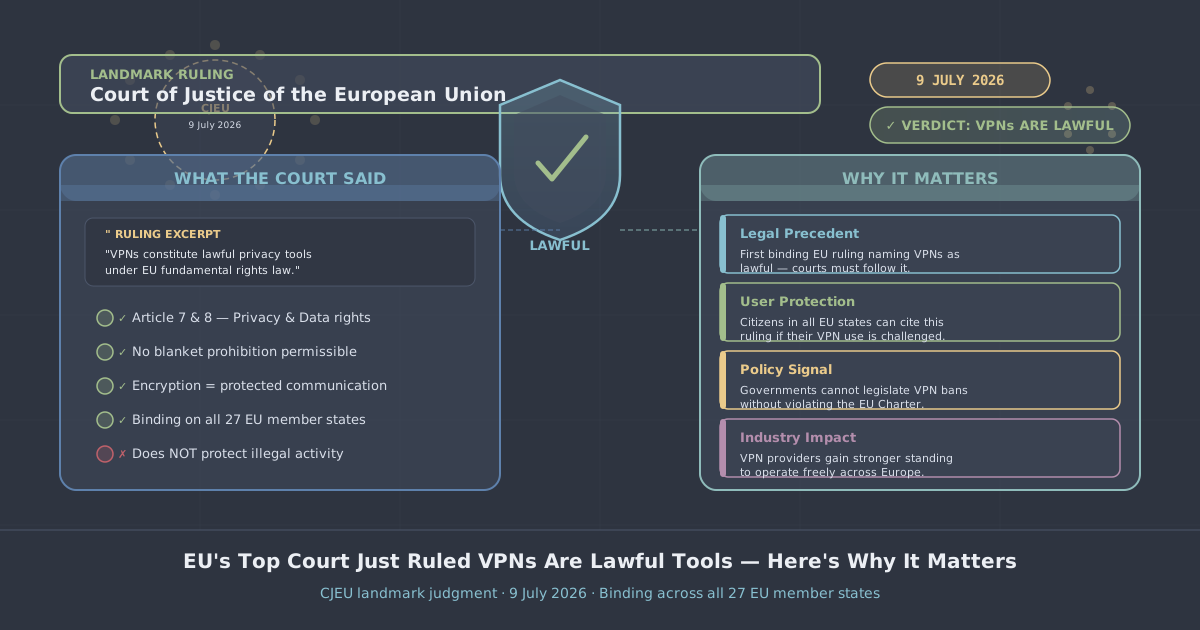
On 9 July 2026, the Court of Justice of the European Union handed down a judgment that will be cited for years. The case—officially Case C-788/24, Anne Frank Fonds v Anne Frank Stichting—began as a copyright dispute between two organisations over the publication of the Diary of Anne Frank. It ended with the EU's highest court placing VPNs firmly on the right side of European law.
The ruling does several things at once. It clarifies what counts as an "effective" technical protection measure under EU copyright law. It limits the liability of publishers who use geo-blocking. And—most significantly for anyone who uses or provides a VPN—it explicitly describes VPNs as "lawful technical tools which users may legitimately use." That phrase is not incidental language. It is a direct legal characterisation, and it matters.
This article unpacks what the CJEU actually decided, why the VPN question arose in the first place, and what the practical consequences are for European users and VPN providers operating under EU jurisdiction.
What the Case Was Actually About
The dispute arose when a Belgian scholarly website published the Diary of Anne Frank online. The Anne Frank Fonds—the Swiss foundation that holds the copyright—argued this was an infringement. The Belgian site countered that it had put geo-blocking in place, restricting access by country, and that this constituted a reasonable technical measure to comply with territorial licensing arrangements.
The Anne Frank Fonds pushed back on that argument. Their position, in essence, was that geo-blocking is not truly effective because anyone with a VPN can defeat it. If the measure can be circumvented so easily, they argued, it should not qualify as adequate protection under EU copyright law—and the publisher should bear liability for any infringement that occurs as a result.
The CJEU disagreed. Comprehensively.
What the Court Actually Ruled
The judgment rests on a straightforward principle: a technical protection measure does not need to be impenetrable in order to be legally effective. The court found that geo-blocking qualifies as an adequate measure under EU law, even though users can circumvent it with a VPN, because the mere possibility of circumvention cannot alone render a protection measure inadequate.
To hold otherwise would set an impossible standard. No technical measure is completely undefeatable. If a protection mechanism could be invalidated simply because a determined user could work around it, publishers and rights-holders would have no practical way to demonstrate compliance with territorial licensing obligations at all.
The court's reasoning on this point was clear: geo-blocking is directed at ordinary access, not at users who deliberately deploy technical tools to bypass it. When a user chooses to circumvent a geo-block, responsibility for any resulting infringement shifts—it rests with that user or, where relevant, with a publisher who has published without appropriate safeguards, not with the tool used to bypass the block.
The Explicit Statement on VPNs
The most significant passage in the judgment for VPN users is the court's direct characterisation of VPNs themselves. In addressing the circumvention argument, the CJEU described VPNs as "lawful technical tools which users may legitimately use."
This is not boilerplate. Courts at this level choose their language carefully. By framing VPNs in this way, the CJEU has done something no EU legislative instrument had previously done with such directness: it has placed VPN use within the category of legitimate user behaviour under EU law.
The judgment also makes clear that VPN providers themselves bear no liability when their users bypass geo-blocks. The tool is neutral. Liability for copyright infringement rests with whoever published the infringing content without proper safeguards—not with the network that carried the traffic.
Why This Matters Now
The timing of this ruling is not incidental. VPN use has faced growing regulatory pressure across Europe over the past several years. Proposals in various member states have raised questions about whether geo-circumvention tools could be restricted or made subject to additional obligations. The broader debate about online privacy tools has, in some quarters, blurred the line between legitimate privacy software and tools used for illegal purposes.
Against that backdrop, a direct statement from the EU's highest court—that VPNs are lawful tools which users may legitimately use—is a meaningful anchor. It does not resolve every legal question about VPN use across all contexts. But it provides a clear precedent that regulators, courts, and legislators in EU member states will need to account for.
For ordinary users, it reinforces something that has always been true but was rarely stated so plainly in case law: using a VPN to protect your privacy, secure your connection, or access content is not inherently unlawful behaviour under EU law. Understanding your rights as a VPN user starts with knowing what a VPN actually is and does—and now EU case law has something concrete to say on the matter.
What It Does Not Mean
It is worth being precise about the limits of this judgment, because overstating it would be unhelpful.
- It does not legalise copyright infringement. The court was not saying that bypassing a geo-block to access infringing content is lawful. It was saying that the existence of VPNs does not automatically make a publisher's geo-blocking inadequate. The responsibility question still matters—it is just allocated differently.
- It does not apply universally outside the EU. This is an EU judgment. It has weight in EU member states and will influence EU-level policy debates. It does not govern VPN law in the UK, the US, or elsewhere, though it may be cited persuasively in comparable cases.
- It does not address all uses of VPNs. The ruling arose in a copyright context. It does not speak directly to, for example, how national security legislation in individual member states may treat VPN traffic, or to obligations on providers under the EU's digital regulatory frameworks.
- It does not override national laws that restrict specific activities. If a user employs a VPN to carry out activity that is independently unlawful, the VPN tool does not provide a shield. Lawful tool does not mean consequence-free tool for unlawful conduct.
What It Means for VPN Providers
For VPN providers operating under EU jurisdiction, the liability clarification is significant. The judgment confirms that a VPN service does not become a party to copyright infringement simply because a user employs it to circumvent geo-blocking. That protection rests on the provider operating a general-purpose network service, not one specifically designed to facilitate infringement.
PremierVPN is a UK-based provider with a strict no-logs policy. We do not monitor what users do on our network, and we do not retain connection logs that could be used to identify user activity. That approach is consistent with the principle—now reinforced by EU case law—that the network tool and the user's choices are legally distinct.
The ruling also carries implications for how EU regulators might approach future attempts to mandate VPN blocking or impose obligations on VPN providers in the name of copyright enforcement. Any such proposal would now need to contend directly with the CJEU's characterisation of VPNs as lawful tools. That is not an insurmountable obstacle, but it raises the bar considerably.
A Practical Note for Users in Europe
If you use a VPN for privacy, security on public networks, remote work, or to access services while travelling, this ruling simply confirms what responsible use has always looked like: a legitimate exercise of a lawful technical tool.
If you are based in Europe and want a VPN that operates with transparency about what it logs (nothing), where it is based (the UK), and what protocols it supports, PremierVPN's Premium VPN is a straightforward starting point. For those who need to operate on restrictive networks, our PremierVPN X app for Windows and PremierVPN X for macOS support VLESS+REALITY, a protocol designed to resist deep packet inspection on networks that actively block VPN traffic.
You can also check whether your current connection has any DNS or IP leaks using our IP leak test tool—a useful baseline wherever you are connecting from.
The Bigger Picture
Legal clarity about technology tools matters. Vague or inconsistent legal status creates uncertainty for users and chilling effects on legitimate behaviour. The CJEU ruling in Anne Frank Fonds v Anne Frank Stichting is, at its core, a copyright case about a Belgian website and a geo-block. But the language the court chose to resolve that case has produced something broader: a clear, authoritative statement that VPNs are lawful tools under EU law, and that their users are acting legitimately when they use them.
That precedent will not prevent every future attempt to restrict or regulate VPN use in Europe. But it gives users, providers, and policymakers a concrete reference point—and that is more than existed before 9 July 2026.