9 min read
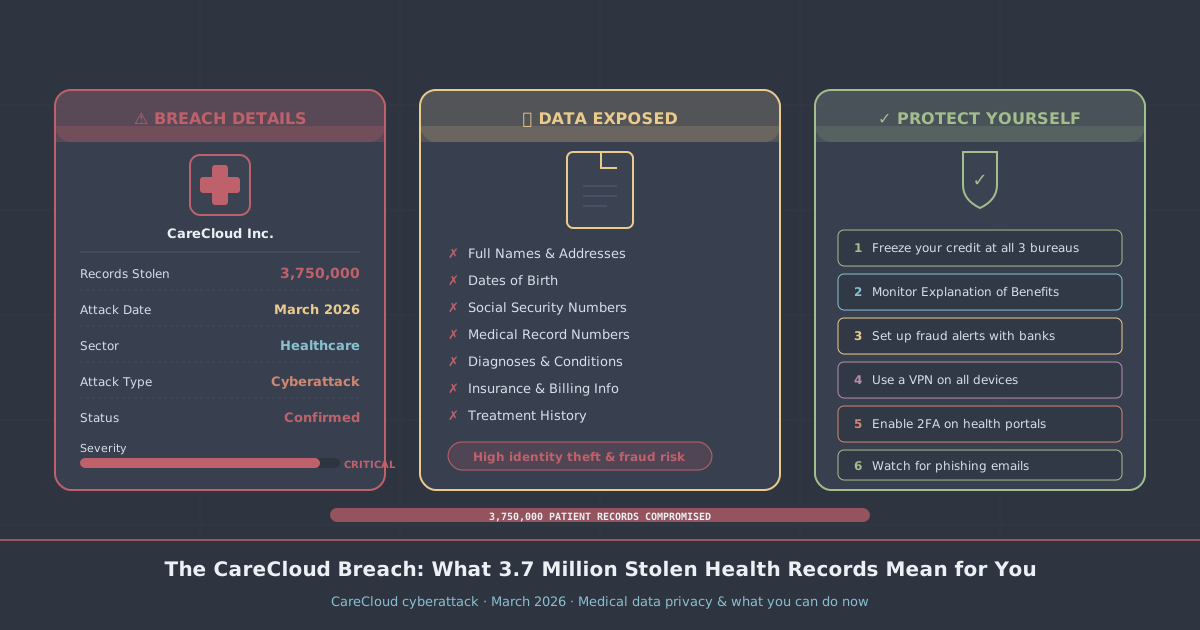
On 19 August 2026, US healthcare IT firm CareCloud confirmed what investigators had suspected for months: a cyberattack carried out between 10 and 16 March 2026 had compromised the personal and medical records of 3,756,469 patients. It is the fifth-largest healthcare data theft in the United States this year alone. The company did not begin notifying affected individuals until late July 2026—more than four months after the incident occurred.
For most of those nearly 3.8 million people, CareCloud is a name they will never have encountered. That is precisely what makes this breach so unsettling. You do not need to have signed up for a service, accepted its terms, or even been aware it existed to have your most sensitive personal data sitting inside its cloud infrastructure. Your GP, specialist, or billing provider may have used CareCloud's software without mentioning it to you—and without you having any say in the matter.
This article explains what happened, what kind of data was exposed, why healthcare records are particularly dangerous in the wrong hands, and what practical steps you can take to reduce the damage and limit your exposure going forward.
What CareCloud actually does—and why so many people are affected
CareCloud provides cloud-based electronic health records (EHR), billing software, and practice management tools to healthcare providers across all 50 US states. The company serves between 40,000 and 45,000 healthcare providers—clinics, specialists, billing departments—who use its platform as the operational backbone of their practices.
This is the architecture of modern health-tech: a relatively small number of software platforms sit behind an enormous number of care providers, which means a single breach can cascade through the entire supply chain of patients those providers serve. When an attacker successfully penetrates one of CareCloud's AWS environments, they are not breaking into one clinic. They are potentially accessing records aggregated from thousands of them.
Patients in this system are passive participants. They interact with their doctor or hospital, not with the EHR platform underneath. The result is that millions of people had detailed personal and medical information stored by a company they had no direct relationship with, had never agreed terms with, and could not have opted out of.
What data was taken
Attackers accessed one of CareCloud's AWS environments and are reported to have exfiltrated data from databases within it. While the full scope of compromised fields varies by provider and patient, healthcare EHR systems of this type typically hold:
- Full legal name, date of birth, and home address
- Social Security numbers or national identification numbers
- Health insurance policy details and member IDs
- Diagnosis codes, treatment histories, and medication records
- Billing information and payment records
- Referral and appointment data
Medical records are not merely sensitive—they are permanently sensitive. A stolen credit card number can be cancelled. A stolen diagnosis, a documented mental health history, or a record of a past prescription cannot be erased from whoever now holds it. The information does not expire, and its potential for misuse spans decades.
The four-month notification gap
The attack window was 10–16 March 2026. Affected individuals only began receiving notifications in late July 2026. That is, at minimum, four months during which stolen data could be traded, sold, or used—while patients had no idea their records had been compromised.
This is not unusual in healthcare breaches, and that fact should concern everyone. Breach detection and disclosure timelines in the healthcare sector frequently stretch to months, sometimes longer. The gap between an attacker exfiltrating data and a victim being told about it represents a window of maximum risk: the attacker has the data, knows what it contains, and can act on it, while the victim has no reason to monitor for misuse or take protective action.
CareCloud is offering affected individuals 12–24 months of identity protection coverage, redeemable until December 2026. That is a standard response, and it is worth taking up if you are contacted. It is not, however, a complete solution.
A pattern, not an isolated incident
The CareCloud breach does not stand alone. It is the fifth-largest US healthcare data theft of 2026, sitting alongside:
| Organisation | Approximate records affected |
|---|---|
| DentaQuest | 15 million |
| TriZetto | 3.4 million |
| CareCloud | 3.75 million |
All three are health-tech SaaS platforms—companies whose entire value proposition is aggregating and managing patient data at scale on behalf of providers. That aggregation is also precisely what makes them attractive targets. The risk is systemic, not accidental. When sensitive data is centralised in large cloud platforms, the potential reward for a successful attack scales with the platform's reach.
This does not mean cloud infrastructure is inherently reckless. It means that any organisation holding millions of sensitive records has an obligation to treat security as a foundational concern rather than a compliance checkbox—and that patients should understand the structure of risk they are operating within.
Why medical records fetch more than financial data
On underground markets, complete medical records have historically commanded higher prices than credit card details, for a straightforward reason: they are more useful for more types of fraud, and they cannot be invalidated.
With a detailed medical record, an attacker can potentially:
- Commit medical identity fraud—using your identity to claim benefits, prescriptions, or procedures
- Conduct insurance fraud by billing under your policy
- Build a convincing phishing profile using your treatment history as a hook
- Leverage sensitive diagnoses or medication histories as leverage in targeted social engineering
Medical identity fraud is particularly difficult to detect and resolve. Fraudulent claims may sit on your insurance record for years before you become aware of them, and disputing them involves navigating healthcare systems, insurers, and credit agencies simultaneously.
What you can do now
If you receive a notification from CareCloud or any affected provider, take it seriously. But the response to healthcare breaches needs to go beyond waiting for a letter.
Claim the identity protection coverage
If you are eligible for CareCloud's 12–24 month identity protection offer, register for it before the December 2026 deadline. These services monitor for fraudulent use of your details across credit files, dark web databases, and public records. They do not prevent misuse, but they can detect it earlier than you would on your own.
Place a credit freeze
In the US, you can place a credit freeze with the three major bureaus—Equifax, Experian, and TransUnion—at no cost. A freeze prevents new credit accounts from being opened in your name. It is one of the most effective steps you can take against identity theft derived from a data breach, and it can be lifted temporarily when you need to apply for credit.
Review your insurance explanation of benefits
Request records from your insurer of all claims made under your policy in the past year. Any unfamiliar procedure, prescription, or provider is worth querying. Medical identity fraud often goes unnoticed because people do not think to audit their insurance history.
Be alert to spear-phishing
Stolen medical data enables highly personalised phishing attempts. An email referencing your specific condition, your doctor's name, or a recent procedure is far more convincing than a generic scam. If you receive unexpected healthcare-related communications—by email, phone, or post—verify them independently before responding or clicking anything.
Reduce your digital footprint where you can
You cannot control which platforms your healthcare providers use. You can, however, limit what other digital traces you leave. Using a VPN when accessing patient portals, online pharmacies, or health-related accounts prevents your browsing activity from being logged by your ISP or intercepted on shared networks. It also masks your IP address from the services you connect to—a small but meaningful reduction in the data points that accumulate around your identity. PremierVPN's strict no-logs policy means your activity is not recorded on our end either. If you are new to VPNs and want to understand how they fit into a broader privacy picture, our introduction covers the fundamentals.
The harder problem: data you cannot control
The CareCloud breach illustrates a limitation that is worth being honest about: a significant portion of your sensitive data is held by organisations you have no direct relationship with and no power to audit. Healthcare providers contract with EHR vendors, billing processors, and cloud infrastructure providers—and patients are rarely informed of those relationships in any meaningful way.
Regulatory frameworks like HIPAA in the US impose obligations on these third parties, but compliance requirements have not prevented incidents at this scale. The practical implication is that data minimisation—limiting what you share voluntarily, controlling what you can, and keeping your other digital activity private—matters more, not less, when the systems around you are imperfect.
Protecting your network-level privacy through a VPN is one lever you control directly. PremierVPN supports WireGuard (the default protocol) as well as OpenVPN, and runs across Windows, macOS, iOS, and Android, so the same protection follows you across devices. If you access sensitive health accounts on a laptop at home and a phone on the go, consistent VPN use on both is more useful than occasional use on one.
Summary
The CareCloud breach is not a story about one company's failure in isolation. It reflects how health-tech infrastructure works: concentrated platforms holding disaggregated patient data at scale, serving as high-value targets precisely because of that concentration. Nearly 3.8 million people had detailed personal and medical records stolen—most of them unaware their data was held by CareCloud at all—and they waited four months to be told.
If you receive a notification, claim the identity protection coverage, place a credit freeze, and audit your insurance history. More broadly, treat the CareCloud breach as a reminder that the most effective privacy protection combines awareness of how your data flows with practical steps to limit the additional exposure you can control. The data already held by third parties is beyond your reach; the data you generate today is not.