9 min read
When you connect to a VPN, the encryption and the tunnelling are only part of the privacy picture. The other part is legal: what is the company providing that VPN required by law to record about you? The answer depends almost entirely on where that company is based and which laws apply to it.
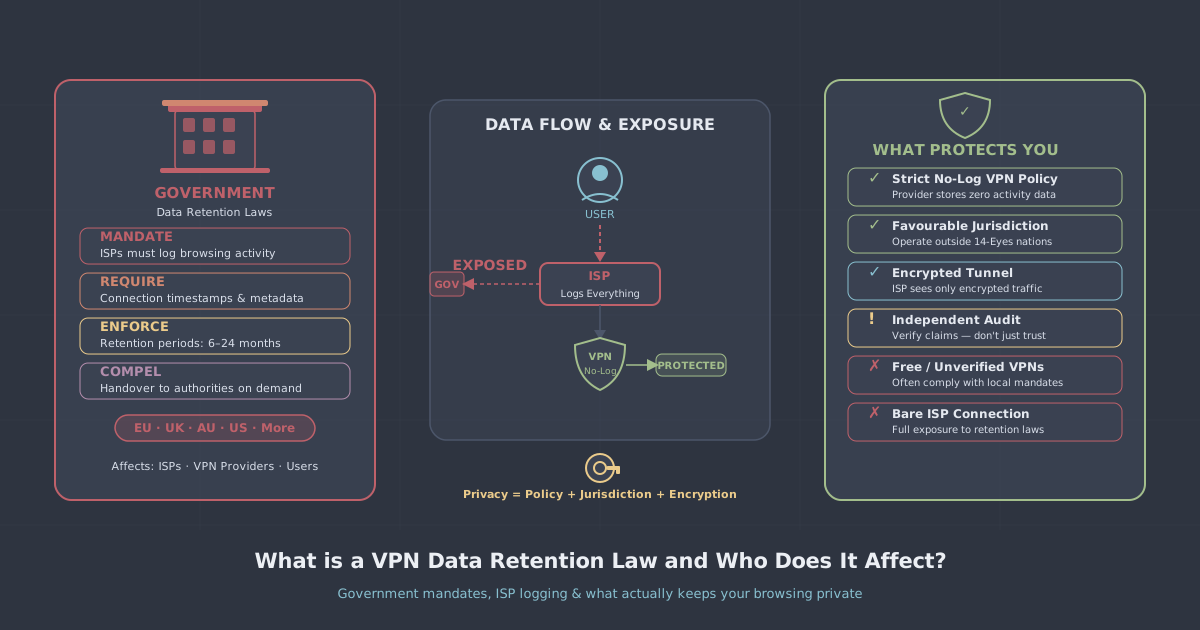
Data retention laws are government mandates that compel telecommunications providers—and in some jurisdictions, VPN providers—to collect and store records of user activity for a set period, making those records available to law enforcement on request. Understanding how these laws work helps you make a genuinely informed decision about what a VPN can and cannot protect you from.
This article explains what data retention legislation looks like in the UK and EU, how it affects your ISP, how it can affect VPN providers, and what the meaningful protections actually are.
What data retention laws actually require
Data retention legislation does not typically require the recording of the content of communications—the text of your messages or the pages you read. What it requires is metadata: records that show who communicated with whom, when, for how long, and from which IP address. In aggregate, metadata is extraordinarily revealing, even without content.
The kinds of records a retention mandate might require include:
- Source and destination IP addresses
- Timestamps of connections
- Volume of data transferred
- Domain names or URLs accessed (in some regimes)
- Device identifiers
- Account identifiers linked to connections
Retention periods vary by country and by data category, but six months to two years is common. During that window, the stored records can be requested—or in some regimes, accessed directly—by law enforcement, intelligence agencies, or other government bodies.
The UK: Investigatory Powers Act 2016
The UK's primary data retention framework is the Investigatory Powers Act 2016, sometimes called the Snoopers' Charter in press coverage. Under this legislation, the Secretary of State can issue Data Retention Notices to telecommunications operators, requiring them to retain specified communications data for up to twelve months.
Internet Service Providers in the UK operating under such a notice must retain what the Act calls Internet Connection Records (ICRs)—essentially a log of which internet services a device connected to and when, though not the full content of those connections. Authorities can access these records through a variety of legal mechanisms depending on purpose, with varying levels of judicial or investigatory oversight.
The Act also contains bulk powers allowing intelligence agencies to collect data at scale, though those provisions are subject to separate authorisation requirements. For most people, the relevant concern is the routine retention of connection metadata by their broadband or mobile provider.
Crucially, these obligations attach to telecommunications operators providing services in the UK. Whether a VPN provider counts as a telecommunications operator under UK law is a matter of legal interpretation and has not been definitively resolved for all business models, but any provider with a significant UK-facing presence should be considered potentially in scope.
The EU: a turbulent history
The EU's relationship with data retention law has been contested for years. The original Data Retention Directive of 2006 required member states to mandate retention of communications metadata for between six months and two years. The Court of Justice of the European Union (CJEU) struck it down in 2014, ruling it incompatible with fundamental rights to privacy and data protection.
Individual member states then passed their own national retention laws, and the CJEU has repeatedly revisited those in subsequent rulings—most significantly in 2020, when it ruled that general and indiscriminate retention of metadata is incompatible with EU law except in the context of serious threats to national security. Targeted retention, linked to a genuine threat, remains permissible.
In practice, the picture across EU countries is inconsistent. Some states retain expansive retention regimes, others have scaled back or are in legal limbo. The direction of travel from the CJEU is clearly towards limiting general retention, but enforcement and compliance vary considerably by country.
For users based in the EU, this means your ISP's retention obligations depend heavily on which member state you are in. For a VPN provider incorporated in an EU country, the same applies—the laws of that member state govern what they can be compelled to store.
How this affects your ISP
Your ISP sits at the most exposed point in this framework. It sees your traffic before encryption, it knows your real IP address, and it is subject to the laws of the country where it is licensed to operate. In the UK, under an active Data Retention Notice, your broadband provider may be storing twelve months of connection metadata about every device on your account.
A VPN does not change what your ISP is legally required to retain. What it changes is what that retained data shows. Without a VPN, your ISP's logs contain a detailed record of which services and sites you connected to. With a VPN, those logs show a persistent connection to a VPN server IP address—nothing more. The ISP cannot see beyond the encrypted tunnel.
This is one of the genuine, concrete privacy benefits of a VPN: it limits the intelligence value of your ISP's legally mandated logs. Your ISP knows you used a VPN. It does not know what you did while connected to it.
How this affects VPN providers
This is where jurisdiction becomes the decisive factor. A VPN provider incorporated in the UK could, in principle, receive a Data Retention Notice requiring it to log connection metadata for its users. A provider incorporated elsewhere operates under whatever laws apply in its home jurisdiction.
There is, however, a second and equally important factor: architecture. A retention notice only compels a provider to retain data that its infrastructure is capable of collecting. A provider that has genuinely built its systems so that no per-user connection logs are generated has, as a matter of engineering, very little to hand over—regardless of the legal demand.