9 min read
"No logs" has become one of the most repeated phrases in VPN marketing. It appears on landing pages, in app store descriptions, and in comparison articles—often without explanation. The problem is that the term covers a wide spectrum of practices, from genuinely comprehensive privacy protection to policies that simply omit the most obvious forms of tracking while quietly retaining others.
This article explains what logging actually means in the context of a VPN, which types of data matter most, what third-party audits can and cannot verify, and how to read a privacy policy critically rather than taking a badge at face value. The goal is not to make you paranoid—it is to give you a clear framework for evaluating any provider's claims, including ours.
What a VPN could log—and why it matters
When you connect to a VPN, several categories of data pass through or are generated by the provider's infrastructure. Understanding these categories is the starting point for evaluating any logging policy.
Connection logs
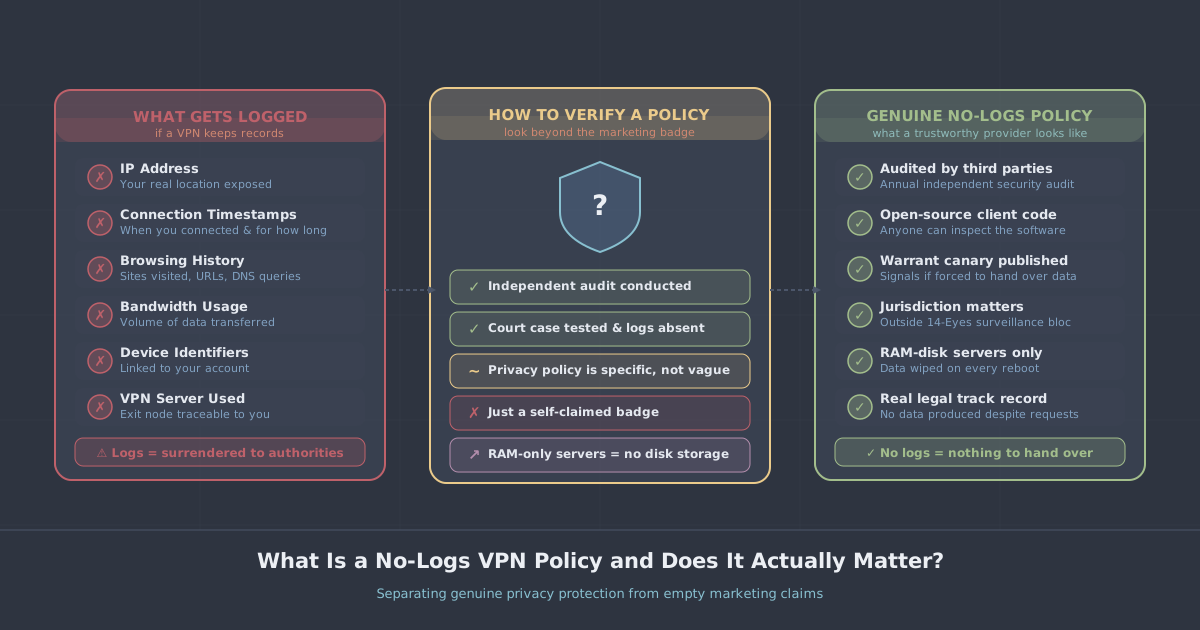
Connection logs record metadata about your VPN sessions: when you connected, from which IP address, to which server, and how long the session lasted. This data does not include the content of your traffic, but it is still sensitive. A connection log can place you at a specific server at a specific time—enough to correlate your activity with external records if someone were seeking to identify you.
Usage logs
Usage logs go further. They record which websites or services you accessed, how much data you transferred, and sometimes application-level information about what generated that traffic. This is the category most people instinctively think of when they worry about a VPN watching what they do. A provider retaining usage logs essentially has a browsing history associated with your account.
Account and billing logs
These are different from connection or usage logs and almost every provider retains some form of them—they need to know you have a paid subscription and when it renews. A provider can legitimately claim "no logs" while still holding your email address and payment records. This is not necessarily deceptive; it is simply a different category. What matters is whether those account records can be linked back to specific browsing sessions.
Aggregated or diagnostic data
Some providers collect anonymised, aggregated statistics—total bandwidth used across a server, connection success rates, crash reports. Whether this constitutes "logging" is debatable. At a genuinely aggregated level it cannot identify individuals, but the definition of "anonymised" is doing a lot of work and deserves scrutiny.
What "no logs" should actually mean
A meaningful no-logs policy commits to not retaining connection logs or usage logs in any form that could identify an individual user's activity. It means that if a government or law enforcement body presented the provider with a valid legal demand, the provider would have nothing of substance to hand over—not because they refused, but because the data does not exist.
That last point is important. A no-logs policy is not primarily about defiance of legal processes. It is about architecture: if the data is never written to persistent storage in identifiable form, no court order, no server seizure, and no data breach can produce it. The protection is structural, not a promise of non-cooperation.
This is also why "we don't share your logs" is not the same thing as "we don't keep logs." A provider can have a genuine policy of never voluntarily sharing data while still retaining logs that could be obtained through compulsion. These are two separate questions.
The role of third-party audits
Because providers cannot credibly audit themselves, third-party audits have become the standard mechanism for external verification. An independent security firm examines the provider's servers, configuration files, and code to check whether logging is technically possible given the current setup—and whether practice matches the published policy.
Audits are valuable, but they come with real limitations worth understanding.
- They are point-in-time assessments. An audit verifies the state of infrastructure on the day the auditors had access. A provider could, in principle, change configuration afterwards. Reputable providers address this by commissioning repeat audits, but gaps between them remain.
- Scope matters enormously. An audit that reviews one server in one location is not the same as a comprehensive infrastructure audit. Always check what the audit actually covered, not just that one was conducted.
- Auditors can only verify what they can see. If a provider has undisclosed infrastructure or a third-party data processor outside the audit scope, that element remains unverified.
- Publication is not mandatory. Some providers commission audits but publish only a summary or a passed/failed verdict. The more detail that is made public, the more credible the result.
A published, scoped, detailed audit from a credible firm is genuinely meaningful evidence—it is simply not absolute proof in perpetuity. Treat it as an important data point rather than a final answer.
How to read a privacy policy critically
Most people do not read privacy policies, and providers know this. Here is a practical checklist for evaluating what you actually find in one.
- Look for specificity about what is not collected. Vague language like "we respect your privacy" is meaningless. A credible policy names the data types it does not collect: originating IP addresses, connection timestamps, DNS queries, traffic contents, session durations.
- Find the jurisdiction. Where is the company incorporated, and where are its servers? These determine which legal frameworks apply and who can compel disclosure. A UK-incorporated provider, for example, operates under UK law—different from a provider incorporated in a country with more aggressive data-sharing treaties.
- Check what is collected and why. Every provider collects something. A policy that claims to collect nothing at all—not even an email address—is likely not being fully transparent. Look for a clear account of what is collected, for what purpose, and for how long it is retained.
- Look for third-party data processors. Does the provider use third-party payment processors, analytics platforms, or infrastructure providers? Each introduces a separate data-handling relationship that the main privacy policy may not fully cover.
- Check the date. A privacy policy last updated in 2019 may not reflect current technical infrastructure or legal requirements. Frequent, dated updates are a better sign than a static document.
Warrant canaries and transparency reports
Some providers publish warrant canaries—statements confirming that, as of a given date, no secret government orders or gag orders have been received. If the canary statement stops being updated, readers can infer (though not confirm) that such an order may have been received. The legal status of warrant canaries varies by jurisdiction and they are not a guarantee, but they add a layer of transparency.
Transparency reports are more directly useful. A provider that publishes how many legal requests it received in a given period, and how many it complied with, gives you concrete information about how often their no-logs policy is actually tested—and what happens when it is.
What happens when no-logs claims are tested in practice
The most credible real-world evidence for a no-logs policy is what happens when infrastructure is seized or a provider faces a genuine legal demand. Several providers over the years have had servers seized by authorities in various countries—and in cases where genuine no-logs policies were in place, the resulting forensic analysis found nothing of investigative value. These incidents, while difficult for the providers involved, served as unplanned proof of concept.
Conversely, there have been cases where providers claiming no logs were able to produce identifying information when compelled to do so. These are the incidents worth reading about carefully, because they illustrate the gap between policy language and technical reality.
You can read more about how PremierVPN approaches this on our no-log policy page, which sets out specifically what we do and do not retain.
Does it matter for your threat model?
The honest answer is: it depends on why you are using a VPN.
If your primary concern is stopping your broadband provider from inspecting your traffic, or accessing content that is geo-restricted, or securing a connection on public Wi-Fi, a no-logs policy is relevant but not the single most critical factor. Protocol security, server locations, and connection reliability will affect your day-to-day experience more directly.
If your concern is protecting your identity in a genuinely adversarial environment—journalism, activism, operating in a country with aggressive internet surveillance—then the logging policy, jurisdiction, and audit history of your provider become significantly more important. In those cases, it is also worth looking at whether the provider supports protocols designed to resist deep packet inspection, such as VLESS+REALITY, which is built to be harder to detect and block on restrictive networks.
For most users, a well-documented no-logs policy from a provider with a clear jurisdiction and at least one credible independent audit is a reasonable baseline. It will not protect you if you are logged into accounts that identify you, or if your device is compromised—a VPN operates at the network layer, not across your entire digital footprint. Understanding what it actually does, rather than treating it as a catch-all privacy solution, is the more useful starting point. Our introduction to VPNs covers that broader picture if you want more context.
Summary
A no-logs policy means nothing without specifics. The key questions to ask of any provider are: which data types are explicitly not collected, where is the company incorporated, has the policy been independently audited and to what scope, and is there any real-world evidence of the policy holding under legal pressure?
"No logs" as a marketing badge tells you very little. "No logs" backed by a detailed published policy, a recent scoped audit, clear jurisdiction disclosure, and a record of handling legal requests transparently—that is a meaningful signal. Use those criteria to evaluate providers, and apply the same standard to us as to anyone else.
If you want to check whether your current setup is leaking identifiable information regardless of logging policy, our IP leak test is a practical first step. And if you are comparing approaches to privacy more broadly, our comparison of VPNs, proxies, and Tor covers the trade-offs between different tools in more detail.