9 min read
You may have come across the phrase "warrant canary" while reading through a VPN's privacy policy or transparency page. It sounds significant—a kind of silent alarm that tells you whether a service has received secret government demands. But warrant canaries are widely misunderstood, and the reality is more nuanced than the reassuring language around them tends to suggest.
This article explains what a warrant canary is, how it works in practice, what its legal limits are, and how to weigh it against the other things that actually matter for VPN privacy. The goal is not to dismiss warrant canaries entirely, but to help you read them clearly rather than take them at face value.
The Origin of the Term
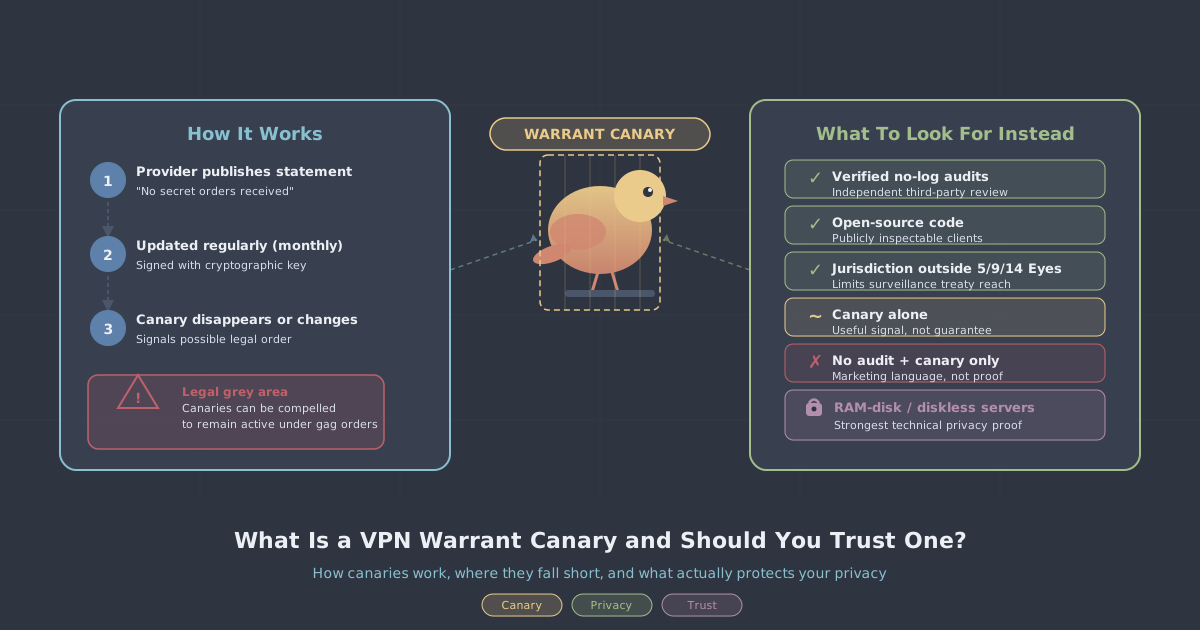
The name comes from the practice of taking canaries into coal mines. If dangerous gases were present, the canary would die before the levels became lethal to humans—giving miners an early warning. A warrant canary works on the same principle: a service publishes a statement saying it has not received certain types of legal demands. If that statement disappears, or stops being updated, the implication is that something has changed.
The concept was popularised in tech and internet communities as a way to work around gag orders. In many jurisdictions, including the United States under the Foreign Intelligence Surveillance Act (FISA) and National Security Letters (NSLs), a company can be legally prohibited from telling users it has received a government request. It may even be prohibited from confirming the existence of the gag order itself. The theory behind a warrant canary is that while a company might be compelled to stay silent, it cannot be compelled to lie—so removing a previously published statement acts as an indirect signal.
What a Warrant Canary Typically Says
A standard warrant canary statement might look something like this:
As of [date], we have not received any national security letters, FISA court orders, or gag orders. We have not been required to provide any government with bulk data, metadata, or real-time surveillance access to our systems.
Some canaries are brief and generic. Others are detailed, specifying the types of legal instruments they cover—NSLs, FISA orders, Mutual Legal Assistance Treaty (MLAT) requests, court orders under local law, and so on. The more specific a canary is, the more informative its disappearance would be.
Most canaries are published with a date and updated periodically—monthly, quarterly, or annually. Some are cryptographically signed, meaning the company uses a private key to produce a digital signature that proves the statement was genuinely issued by them and has not been altered.
Where the Legal Theory Gets Complicated
The logic behind warrant canaries is creative, but it rests on assumptions that have never been definitively tested in most jurisdictions.
Can removing a canary actually be compelled?
The core assumption is that a government cannot force a company to remove a true statement—because that would amount to compelled speech or compelled deception. In the United States, the legal picture is genuinely murky. The Electronic Frontier Foundation has written about this uncertainty, and while some legal scholars find the argument persuasive, no court has definitively ruled that a company is free to remove a warrant canary without interference once a gag order is in place.
In practice, if a company received a gag order alongside a demand, the safest response for the company's legal team might be to do nothing at all—which could mean the canary simply stops being updated rather than being explicitly removed. That is a subtler signal and easier to miss.
Jurisdiction matters enormously
A UK-based company operates under UK law. A US-based company operates under US law. The legal instruments available to governments, and the obligations they impose on service providers, differ significantly between jurisdictions. A canary that covers FISA orders and NSLs is largely relevant to US-based services or services with US infrastructure. If a provider is based elsewhere, different legislation applies, and a canary should ideally reference the specific legal framework in its home country.
The canary says nothing about capability
A warrant canary only tells you about legal demands the provider has received. It says nothing about what the provider could hand over if compelled. A service that logs your connection timestamps, IP addresses, and session data could have a perfectly intact warrant canary and still represent a significant privacy risk—because if a demand did arrive, there would be useful data to surrender. The canary and the no-logs policy are separate questions, and the latter is arguably more important.
How to Evaluate Whether a Canary Is Meaningful
Not all warrant canaries carry the same weight. Here are the factors worth examining.
Specificity
A canary that says "we have not received any government requests" is vague. A canary that lists specific legal instruments—NSLs, FISA Section 702 orders, MLAT requests, production orders under the Investigatory Powers Act, and so on—is more informative. Specificity also makes the canary's disappearance more meaningful.
Update frequency and datestamps
A canary that was last updated two years ago tells you very little. Regular updates with clear dates show the company is actively maintaining it. If you check a canary and it has not been updated in an unusually long time, that is worth noticing—though it could also simply be an administrative oversight.
Cryptographic signing
A canary that is cryptographically signed with a verifiable public key is harder to tamper with silently. If a third party were to alter it, the signature would no longer validate. This does not protect against the company simply removing the statement, but it does add integrity to the statement while it exists.
Independent audits and transparency reports
A warrant canary is a self-reported statement. An independent security audit, while expensive and logistically complex, provides external verification of technical claims—whether a provider actually has the capacity to log what it says it does not log, for instance. Transparency reports that include aggregate data on legal requests received (even where specific cases are covered by gag orders) are another useful data point.
What Matters More Than the Canary
A warrant canary is a transparency signal, not a privacy mechanism. The following factors have a more direct bearing on whether a VPN actually protects you.
- No-logs architecture: If a provider genuinely does not log connection data, there is nothing useful to hand over even if a valid legal demand arrives. This is the more fundamental question. You can read about PremierVPN's approach on the no-log policy page.
- Jurisdiction: Where the provider is incorporated, where its servers are hosted, and which legal systems it falls under all affect what demands it might receive and under what circumstances it must comply.
- Protocol security: The encryption and tunnelling protocol in use affects whether intercepted traffic is readable. WireGuard, OpenVPN, and more obfuscated protocols like VLESS+REALITY each have different properties depending on the threat model.
- Technical controls: Features like a kill switch, DNS leak protection, and the ability to test for IP leaks affect whether your real identity is ever exposed, regardless of what legal demands a provider may or may not have received.
A Note on Scepticism Without Cynicism
It would be easy to conclude from all of this that warrant canaries are worthless. That is too strong a position. A well-maintained, specific, cryptographically signed canary from a provider with a clear no-logs architecture and a reasonable jurisdiction is a positive signal. It reflects a degree of deliberate transparency and suggests the provider has thought carefully about its obligations to users.
The problem is not with the concept—it is with canaries that are vague, rarely updated, or published in isolation without any of the supporting architecture that would make them meaningful. A canary on a service that logs everything and is based in a surveillance-friendly jurisdiction is close to useless as a privacy guarantee.
Treat a warrant canary the way you would treat any single data point: useful in context, insufficient on its own.
Summary: What to Actually Look For
| Factor | What to check |
|---|---|
| Warrant canary | Specific, recently dated, ideally cryptographically signed |
| No-logs policy | Clearly defined, ideally verified by independent audit |
| Jurisdiction | Where the company is incorporated and what laws apply |
| Protocol | Strong encryption; obfuscation available for restrictive networks |
| Technical controls | Kill switch, DNS leak protection, IP leak testing |
| Transparency reports | Aggregate data on legal requests, even where cases are sealed |
A warrant canary is worth reading, but it is one item in a longer checklist. If you are evaluating a VPN's privacy credentials, start with the no-logs architecture and jurisdiction, then treat the canary as supporting context. If you want to understand how PremierVPN approaches privacy more broadly, the no-log policy and the what is a VPN guide are good places to start.