9 min read
Most people think a VPN connection is nearly instantaneous—you tap a button, a padlock appears, and you're protected. What actually happens in those opening milliseconds is considerably more interesting, and considerably more important. Before your device sends a single byte of real data, it goes through a structured negotiation with the VPN server called a handshake. Get that process wrong, or use a protocol that handles it poorly, and the security of everything that follows is compromised.
This article explains what a VPN handshake is, how it works across different protocols, what it establishes and why, and what you should look for when evaluating whether a VPN connection is genuinely trustworthy. No cryptography degree required.
The basic idea: why a handshake is necessary
When your device connects to a VPN server, neither side automatically knows whether the other is legitimate. Your device needs to confirm it is talking to the correct server—not an impostor. The server needs to confirm you are an authorised client. Both sides need to agree on which encryption algorithms to use and generate shared secret keys that nobody else can know. All of this must happen before any of your actual traffic is transmitted.
A handshake is the protocol-defined sequence of messages that accomplishes exactly this. It is a back-and-forth exchange that establishes:
- Authentication—verifying the identity of the server (and sometimes the client)
- Key exchange—generating encryption keys that are unique to this session
- Algorithm negotiation—agreeing on which cipher suites, hash functions, and protocols to use
- Session parameters—setting the ground rules for the encrypted tunnel that follows
Only once all four are complete does the encrypted tunnel open and your traffic begin to flow through it.
The TLS handshake: the foundation for OpenVPN
OpenVPN, one of the most widely deployed VPN protocols, relies on TLS (Transport Layer Security) for its handshake. TLS is the same protocol that secures HTTPS connections in your browser, which is worth noting—it is mature, extensively audited, and very well understood.
What happens step by step
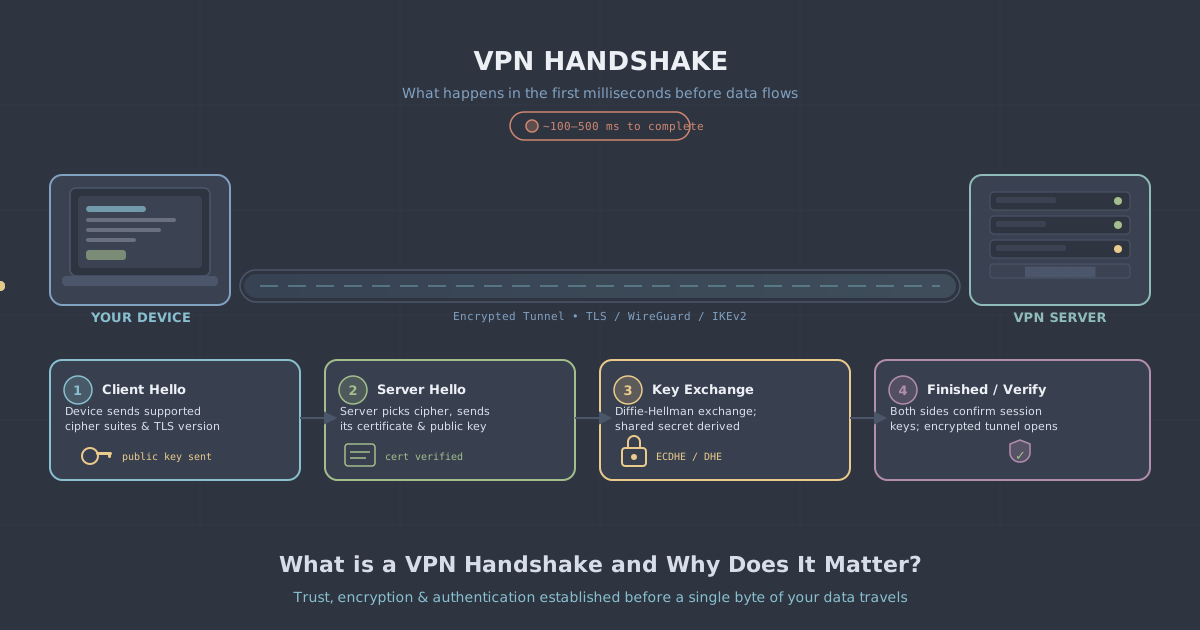
A TLS handshake between an OpenVPN client and server follows a sequence roughly like this:
- ClientHello—your device sends a message listing the TLS versions it supports, the cipher suites it can use, and a random value.
- ServerHello—the server picks a cipher suite and TLS version from the offered options and sends back its choice, along with its own random value.
- Certificate—the server presents its digital certificate, which contains its public key and is signed by a Certificate Authority (or a private CA in a VPN context).
- Key exchange—both sides use the exchanged information to independently compute the same session keys. Modern TLS uses Diffie-Hellman key exchange so that the actual keys never travel across the network.
- Finished—each side sends a message encrypted with the newly established keys, proving the keys work and the handshake is complete.
The whole process typically takes one or two round trips. On a low-latency connection, that is measured in tens of milliseconds. On a high-latency or congested connection, it is the first thing you will notice as a delay before your VPN connects.
What TLS handshakes protect against
A correctly implemented TLS handshake protects against several serious attacks. Man-in-the-middle attacks are defeated because an attacker cannot forge the server's certificate without access to the corresponding private key. Replay attacks are defeated because the random values exchanged during the handshake mean each session is unique. Downgrade attacks—where an attacker tries to force both sides to use a weaker, older protocol—are defeated because the Finished messages cover all the handshake content, so any tampering is detected.
WireGuard's approach: a different philosophy
WireGuard handles the initial handshake very differently from TLS. Rather than a flexible negotiation where both sides propose and agree on algorithms, WireGuard is opinionated: it specifies exactly which cryptographic primitives it uses, and there is no negotiation at all. This is a deliberate design choice.
WireGuard uses the Noise Protocol Framework for its handshake, specifically the Noise_IKpsk2 pattern. The handshake consists of just two messages:
- The initiator (your device) sends a handshake initiation message containing an ephemeral public key and an encrypted payload derived from both sides' static keys.
- The responder (the server) sends back a handshake response, completing the key exchange.
Two messages. That is it. The shared session keys are derived immediately and traffic can flow. This is one reason WireGuard connections feel faster to establish than OpenVPN connections—there is simply less back-and-forth.
Because there is no algorithm negotiation, there is also no downgrade attack surface. You cannot trick WireGuard into using a weaker cipher because there is only one cipher: ChaCha20-Poly1305 for encryption, Curve25519 for the key exchange, BLAKE2s for hashing. Modern, fast, and non-negotiable.
WireGuard also builds in perfect forward secrecy by default. Ephemeral keys are generated per session, and WireGuard rotates them every few minutes during an active connection. Even if a long-term private key were somehow compromised in future, past session traffic would remain protected.
PremierVPN uses WireGuard as its default protocol. If you want to see what that looks like in practice, the Windows app and macOS app both connect via WireGuard by default, with WireGuard Stealth available for networks that attempt to block standard WireGuard traffic.
What perfect forward secrecy actually means
The term perfect forward secrecy (PFS) comes up in any serious discussion of handshakes, and it deserves a clear explanation rather than a passing mention.
Without forward secrecy, a VPN session's encryption keys are derived from long-term keys that stay the same across many sessions. If an attacker records your encrypted traffic today and later obtains those long-term keys—through a breach, a legal order, or any other means—they can decrypt everything they recorded. The compromise is retroactive.
With perfect forward secrecy, each session generates fresh ephemeral keys that are discarded after the session ends. The long-term keys are used only to authenticate the handshake, not to derive the session encryption keys. There is nothing to decrypt later, because the keys that protected the session no longer exist.
Both modern TLS (version 1.3) and WireGuard provide perfect forward secrecy. If you are using a VPN that relies on older key exchange mechanisms without ephemeral keys, your past traffic is only as safe as the server's long-term private key remaining secret indefinitely—which is not a comfortable position.
Handshake speed and what affects it
The handshake adds latency before your tunnel opens. For most users on most connections, this is imperceptible—a fraction of a second. But it becomes relevant in specific situations:
- Mobile networks with variable latency can stretch a multi-round-trip TLS handshake noticeably.
- Long-distance connections to servers on the other side of the world increase round-trip time, multiplying the cost of each handshake message.
- Reconnections—when your device switches between Wi-Fi and mobile data, for example—trigger a fresh handshake each time. A faster handshake means the tunnel re-establishes more quickly.
- Restrictive networks that inspect or throttle certain traffic types can interfere with handshakes, causing failed connections or timeouts.
WireGuard's two-message handshake has an inherent speed advantage over TLS-based handshakes in all these scenarios. Choosing a server location geographically close to you further reduces the round-trip cost.
When handshakes are deliberately obscured: stealth and VLESS+REALITY
In countries where VPN traffic is actively identified and blocked, the handshake itself becomes the target. Deep packet inspection systems can recognise the fingerprint of a WireGuard or OpenVPN handshake and drop the connection before the tunnel even opens.
This is the problem that WireGuard Stealth and, more comprehensively, VLESS+REALITY are designed to solve.
VLESS+REALITY, available through PremierVPN X for Windows and PremierVPN X for macOS, makes the VPN handshake appear indistinguishable from a standard TLS 1.3 handshake to a legitimate, publicly known HTTPS server. An inspection system examining the traffic cannot tell it apart from ordinary encrypted web browsing. The handshake is real TLS—the obfuscation is in how the VPN session is embedded within it. You can read more about how this works in our article on the VLESS+REALITY protocol.
What a secure handshake cannot do
A strong handshake is necessary but not sufficient for overall VPN security. It is worth being clear about what it does and does not protect.
The handshake establishes an encrypted tunnel. Everything inside that tunnel depends on what happens next: the VPN server's logging practices, the jurisdiction it operates in, whether DNS queries are handled inside or outside the tunnel, and whether there is a kill switch to prevent traffic leaking if the tunnel drops.
You can verify your connection for DNS or IP leaks using our IP leak test, which checks whether your real IP address or DNS resolver is visible outside the tunnel. A successful handshake does not guarantee there are no leaks—it simply means the cryptographic establishment of the tunnel was sound.
Similarly, the handshake does not protect you from a VPN provider that logs your activity. Encryption in transit is meaningless if the endpoint keeps records. PremierVPN operates under a strict no-logs policy—nothing is retained that could identify what you did or when you did it.
Summary
The VPN handshake is the foundation everything else is built on. It authenticates the server, establishes session keys through a process that prevents future compromise even if long-term keys are later exposed, and—depending on the protocol—does all of this in anywhere from two to several message exchanges.
WireGuard's Noise-based handshake is fast, minimal, and leaves no room for algorithm negotiation to be exploited. TLS-based handshakes used by OpenVPN are mature and well-understood, offering flexibility at the cost of slightly more complexity. In restrictive environments, protocols like VLESS+REALITY go further by disguising the handshake itself so it cannot be identified as VPN traffic at all.
For everyday use, you do not need to think about any of this in detail—a well-implemented VPN handles it automatically. But understanding what happens in those first milliseconds tells you something real about why one protocol might suit you better than another, and why the claims a VPN provider makes about security either hold up or they do not.