9 min read
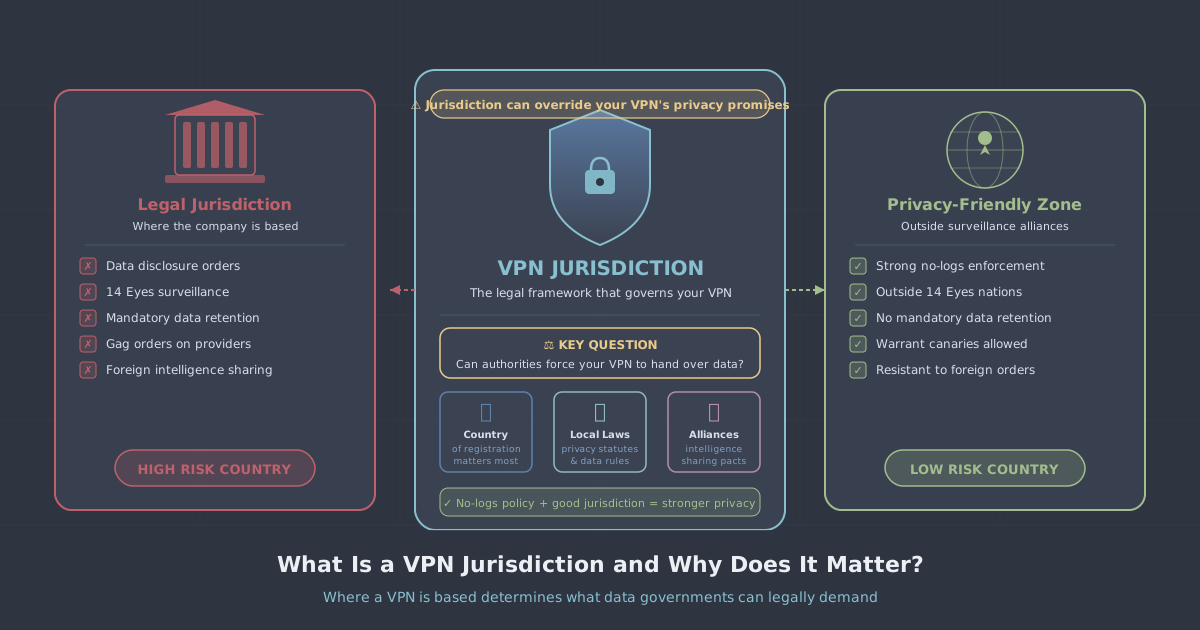
Most people choosing a VPN focus on speed, price, and server count. Jurisdiction—where the VPN company is actually incorporated and legally operates—rarely makes the shortlist. That is a mistake worth correcting, because no amount of strong encryption protects you if the company behind the VPN is legally obliged to hand your data to authorities on request.
This article explains what VPN jurisdiction means in plain terms, how it interacts with surveillance alliances and data-retention laws, and what you should look for when evaluating a provider's legal position. None of this requires a law degree—just a willingness to ask one question before you sign up: where does this company actually live?
What Jurisdiction Means for a VPN Provider
Jurisdiction is the legal authority a government holds over a company or individual. When a VPN provider is incorporated in a particular country, that country's courts, law enforcement agencies, and data-retention legislation apply to it. If a court in that country issues a valid order demanding user data, the provider must comply—or face legal consequences.
This matters even if the VPN's servers are physically located elsewhere. The company's legal home determines who can compel it to act, not where its hardware sits. A provider incorporated in a country with aggressive surveillance laws cannot simply route its servers through privacy-friendly locations and consider itself exempt from domestic obligations.
There are three broad questions worth asking about any provider's jurisdiction:
- Does the country have mandatory data-retention laws that require the provider to collect and store user activity logs?
- Does the country participate in international intelligence-sharing alliances?
- How easy is it for domestic or foreign law enforcement to obtain a court order against a company registered there?
Data Retention Laws
Some countries legally require telecommunications and internet service providers to retain connection logs—timestamps, IP addresses, session durations—for a defined period, sometimes up to two years. The intent is usually to support criminal investigations, but the scope varies significantly by country.
If a VPN provider falls under such a regime, it may be legally prevented from operating a genuine no-logs policy, regardless of what its marketing says. The provider might genuinely want to collect nothing, but the law could require otherwise. This is why jurisdiction and logging policy are inseparable topics: a no-logs claim is only as credible as the legal environment in which it operates.
The European Union's Data Retention Directive was struck down by the Court of Justice of the EU in 2014 as incompatible with fundamental rights, but individual member states have since passed their own national equivalents with varying scope. The UK, post-Brexit, operates under the Investigatory Powers Act 2016, which contains broad provisions around data collection and access. Understanding what is on the statute books in a provider's home country takes a few minutes of research and is worth doing.
Intelligence Alliances: Five Eyes and Beyond
The Five Eyes alliance—comprising the United States, United Kingdom, Canada, Australia, and New Zealand—is an intelligence-sharing arrangement under which member nations share signals intelligence with one another. The Nine Eyes extends this to include France, Denmark, the Netherlands, and Norway. The Fourteen Eyes adds Germany, Belgium, Italy, Sweden, and Spain.
Being headquartered in a member country does not automatically mean a provider will betray its users. What it does mean is that intelligence agencies within the alliance have legal mechanisms—and historical practice—for requesting data from companies in partner nations, sometimes without the target being notified. The practical risk depends heavily on whether the provider actually holds any data worth requesting. A genuine no-logs provider in a Five Eyes country has far less to hand over than a logging provider in a country with no surveillance alliances whatsoever.
Treat alliance membership as one data point rather than a disqualifying factor on its own. The more important question is always: what data does this provider actually hold?
No-Logs Policies and Why Jurisdiction Shapes Their Credibility
A no-logs policy means the provider does not retain records that could identify what you did online or when you were connected. If no such records exist, a court order demanding them produces nothing useful—regardless of jurisdiction.
The problem is that logging policies are easy to claim and difficult to verify. Jurisdiction gives you a useful cross-check. If a provider claims a strict no-logs policy but is incorporated in a country with mandatory data-retention laws, those two facts are in direct tension. Either the provider has found a legal exemption (possible but worth confirming), or one of those claims is inaccurate.
Conversely, a provider incorporated in a jurisdiction with no mandatory retention laws, no alliance obligations that would capture VPN traffic, and a published and audited no-logs policy presents a much more coherent picture. The pieces fit together rather than contradict one another.
PremierVPN is UK-based and operates under a strict no-logs policy—we do not retain records of your browsing activity, connection timestamps, or IP addresses. The UK's legal framework is worth understanding clearly: the Investigatory Powers Act does contain broad surveillance powers, but those powers apply to data that is held. A provider that holds nothing cannot produce what does not exist.
Server Location vs. Company Location
This distinction trips up a lot of people. When you connect to a VPN server in, say, the Netherlands, your traffic exits through that server and websites see a Dutch IP address. But the company operating that server may be incorporated in an entirely different country—and it is the company's home jurisdiction, not the server's physical address, that determines legal obligations.
Servers can be seized by local authorities, which is a separate concern. But a server seizure without logs produces no meaningful data. The more significant question is always about the company's legal home and what it is required to record and retain there.
If you want to understand which countries PremierVPN operates server infrastructure in, the full list is available on our server locations page.
What to Look For When Evaluating a Provider's Jurisdiction
Here is a practical checklist rather than a set of hard rules. No single factor is decisive on its own—it is the combination that matters.
- Find the actual incorporation country. This is usually in the Terms of Service or Privacy Policy under a heading like "Governing Law" or "Jurisdiction." If it is absent, that itself is a signal worth noting.
- Check for mandatory data-retention laws in that country. A brief search for "[country name] data retention law ISP" will usually surface relevant legislation.
- Note alliance membership and consider whether that meaningfully increases risk given the provider's logging practices.
- Read the privacy policy carefully. Look for specific language about what is and is not collected. Vague promises about "privacy" without specifics about connection logs, IP addresses, and timestamps are not sufficient.
- Look for independent audits. Some providers commission third-party audits of their no-logs claims. These are not infallible, but they add a layer of verification beyond the provider's own assertions.
- Consider how the provider has responded to past legal requests. A transparency report—even one that simply states the number of requests received and data produced—is far more informative than silence.
Jurisdiction in High-Risk Environments
For most users in stable democracies, jurisdiction is a background consideration rather than an urgent one. For users in countries with active internet censorship or surveillance—China, Iran, Russia—the stakes are considerably higher, and jurisdiction becomes a front-line concern.
In these environments, the VPN protocol matters as much as the provider's legal home. Standard VPN traffic is detectable and blockable. VLESS+REALITY is a protocol specifically designed to be resistant to deep packet inspection, making it much harder for network-level censorship tools to identify and block. PremierVPN offers this through PremierVPN X for Windows and PremierVPN X for macOS for users operating in restrictive network conditions.
Jurisdiction alone cannot protect you if your VPN connection is blocked before it even reaches the provider's servers. Protocol choice and jurisdiction together form a more complete picture of protection in high-risk contexts.
A Practical Summary
Jurisdiction is not a magic variable that makes a VPN trustworthy or untrustworthy by itself. It is one component in a layered assessment that includes logging practices, protocol transparency, and the provider's track record. The key insight is this: the most important protection is a provider that genuinely holds no data, because no legal framework can compel the production of records that do not exist.
When you evaluate any VPN, take five minutes to find the incorporation country, look up the relevant data-retention laws, and read the privacy policy with specific questions in mind rather than skimming for reassuring language. A provider willing to answer these questions clearly—in its documentation and ideally through independent audits—is a provider worth trusting with your traffic.
If you want to understand what a VPN does at a more fundamental level before going deeper on jurisdiction, our introduction to VPNs covers the basics clearly.