5 min read
Choosing a VPN protocol matters more than most people realise. The protocol determines how your data is encrypted, how fast your connection is, and how stable it remains under load. The two dominant choices today are WireGuard and OpenVPN — and while both are excellent, they take fundamentally different approaches.
The Quick Comparison
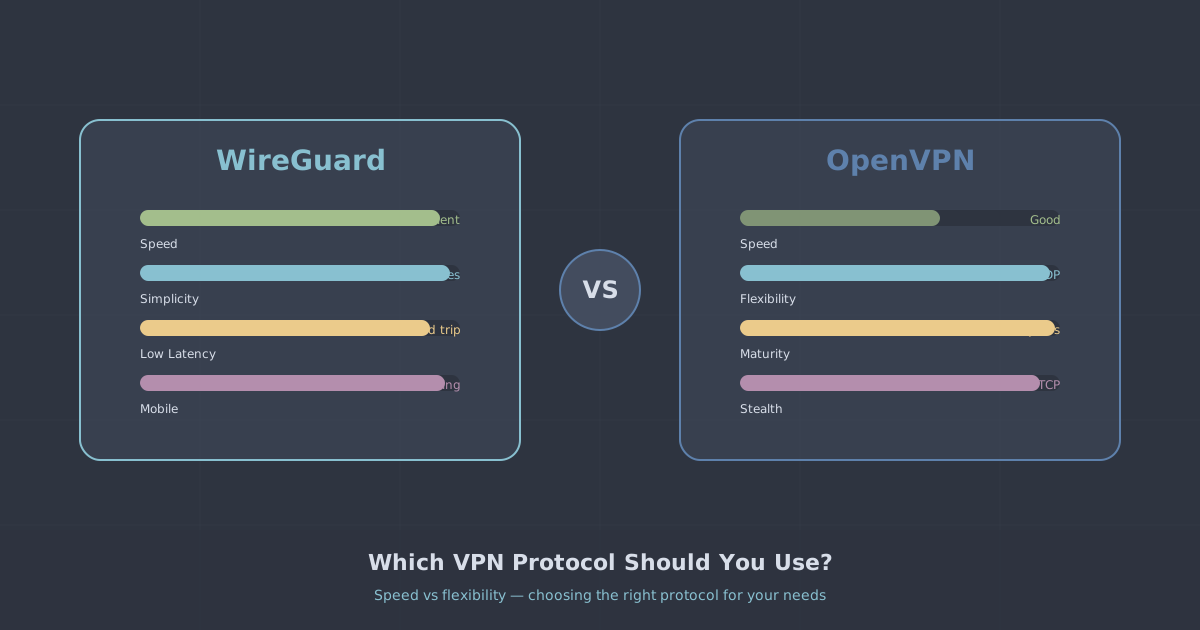
| Feature | WireGuard | OpenVPN |
|---|---|---|
| Speed | ⚡ Excellent — near wire speed | Good — higher overhead |
| Latency | Very low — fast handshakes | Higher — TLS negotiation |
| Codebase | ~4,000 lines | ~100,000+ lines |
| Encryption | ChaCha20, Curve25519, BLAKE2s | AES-256, RSA, SHA-256 (configurable) |
| Stability | Excellent on mobile (roaming) | Can drop on network changes |
| Firewall traversal | UDP only (port 51820) | TCP or UDP (any port, including 443) |
| Maturity | Merged into Linux kernel 2020 | 20+ years of production use |
| Auditability | Easy — small, readable code | Harder — large, complex codebase |
Speed and Performance
WireGuard is significantly faster than OpenVPN in virtually every test scenario. This comes down to two factors: it runs inside the Linux kernel (rather than in userspace like OpenVPN), and it uses more efficient cryptographic primitives.
In real-world usage, WireGuard typically achieves 20–50% higher throughput than OpenVPN on the same hardware. For activities like torrenting, streaming, or large file transfers, this difference is immediately noticeable.
Connection establishment is also faster. WireGuard completes a handshake in a single round trip, while OpenVPN requires a full TLS negotiation that can take several seconds — particularly on high-latency connections.
Security
Both protocols are considered secure, but they approach cryptography differently.
WireGuard uses a fixed set of modern cryptographic primitives: ChaCha20 for symmetric encryption, Curve25519 for key exchange, BLAKE2s for hashing, and SipHash for hashtable keys. You cannot configure or change these. This is intentional — it eliminates the risk of misconfiguration and reduces attack surface.
OpenVPN is highly configurable. You can choose from dozens of cipher suites, key exchange methods, and authentication algorithms. This flexibility is powerful but also risky: a misconfigured OpenVPN server can be running weak encryption without anyone noticing.
WireGuard's codebase is approximately 4,000 lines of code, compared to OpenVPN's 100,000+. A smaller codebase is easier to audit, easier to maintain, and statistically less likely to contain vulnerabilities.
Mobile and Roaming
WireGuard excels on mobile devices. Its design handles network changes gracefully — when you switch from Wi-Fi to mobile data, WireGuard silently re-establishes the connection without dropping. OpenVPN often requires a full reconnect in the same scenario, which can take several seconds.
WireGuard also uses less battery on mobile devices due to its lower computational overhead and the fact that it only transmits when there's actual data to send.
Firewall Traversal
This is OpenVPN's biggest advantage. OpenVPN can run over TCP port 443 — the same port as HTTPS traffic — making it virtually indistinguishable from regular web browsing. This is critical in restrictive networks like corporate firewalls, hotel Wi-Fi, and countries that actively block VPN traffic.
WireGuard only supports UDP, and its traffic pattern is identifiable to deep packet inspection (DPI). In environments where VPN traffic is blocked, WireGuard may not work at all.
At PremierVPN, we solve this with SSLH on port 443, which multiplexes OpenConnect (AnyConnect-compatible) and IKEv2 alongside HTTPS. For restrictive networks, our OpenConnect protocol is the best choice.
When to Use Which
Use WireGuard when:
- Speed is your priority (streaming, torrenting, gaming)
- You're on a mobile device and switch networks frequently
- You want the lowest possible latency
- You're on an unrestricted network
Use OpenVPN/OpenConnect when:
- You're behind a restrictive firewall or in a censored country
- You need TCP support for reliability on poor connections
- You need to disguise VPN traffic as HTTPS
- Port 51820 (WireGuard) is blocked on your network
Our Recommendation
For most users, WireGuard is the better choice. It's faster, simpler, and more efficient. At PremierVPN, all our apps default to WireGuard, and our dedicated VPN servers run WireGuard natively with full port forwarding support.
However, we also provide OpenVPN, OpenConnect (AnyConnect), and IKEv2 on every server — so you always have a fallback when WireGuard isn't an option. The best VPN protocol is the one that works reliably in your specific situation.
PremierVPN supports all major protocols: WireGuard, OpenVPN (TCP/UDP), OpenConnect (AnyConnect), and IKEv2 — all included with every plan at no extra cost.