8 min read
On 9 November 2026, SEGA disclosed that a breach at its third-party newsletter provider, ARARA Co., Ltd., had exposed over 2.1 million customer email addresses across 11 SEGA and SEGA Fave mailing lists. SEGA was quick to reassure customers: no names, passwords, payment details, or dates of birth were taken. Just email addresses.
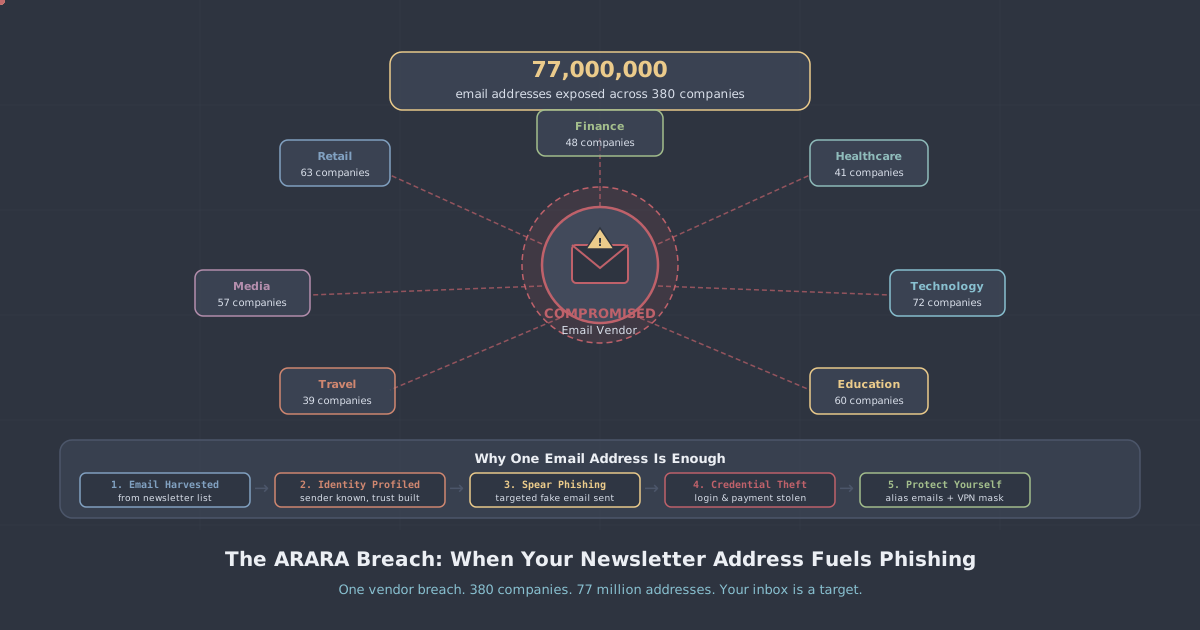
That reassurance, while technically accurate, misses the more uncomfortable point. The root incident at ARARA—which occurred between 28 and 30 October 2026—ultimately swept up roughly 77 million email addresses from up to 380 client companies across 97 servers. Attackers did not stop at harvesting those addresses. Before the breach was even detected, they used ARARA's own sending infrastructure to dispatch approximately 7.13 million phishing emails impersonating credit card companies. The platform built to deliver newsletters became, briefly, a phishing cannon.
This article looks at how that happened, why a bare email address carries more risk than it appears to, and what practical steps you can take to reduce your exposure when third parties you have never heard of are holding your data.
What ARARA Is and Why It Matters
ARARA Co., Ltd. is a Japanese email delivery and marketing platform. Its business model is common across the industry: brands outsource their newsletter infrastructure to a specialist vendor, which manages list storage, sending, analytics, and deliverability on their behalf. The brand gets reliable email delivery without running its own mail servers. The vendor gets a contract—and custody of every subscriber address the brand has ever collected.
ARARA's client list, as exposed by the breach, was substantial. Among the named victims:
- MOS Burger—7.5 million addresses exposed
- Shochiku Multiplex Theatres—3.3 million addresses exposed
- TKC—2.3 million addresses exposed
- SEGA / SEGA Fave—2,196,044 addresses across 11 newsletters
These are four named organisations from a list of up to 380. The 77 million figure covers the full scope of the incident. When a single vendor is compromised, every client's subscriber base is at risk simultaneously—a supply-chain problem that is structurally different from a breach at a single company.
Why "Just Email Addresses" Is Not the Reassurance It Sounds Like
Breach notifications frequently lead with what was not taken—passwords, card numbers, national insurance numbers—to calm affected users. That framing is understandable, but it can obscure what a bare email address actually enables.
An email address harvested from a known brand's newsletter list carries implicit context. If your address appears in SEGA's data, an attacker knows you are a SEGA customer or fan. If it appears in MOS Burger's data, they know you have a relationship with that chain. That context transforms a generic phishing attempt into a targeted one.
Consider the attack ARARA's platform was used to deliver in late October 2026: phishing emails impersonating credit card companies, sent to millions of addresses. The recipients of those emails had not necessarily given their addresses to any credit card company. But they had given them to brands they trusted. An attacker with access to a large, segmented list can craft convincing lures—"Your account associated with this email address requires urgent verification"—that feel plausible precisely because the recipient genuinely uses the brand being spoofed, or a related financial service.
This is sometimes called contextual phishing. The attacker does not need your name or your password. They need to know enough about you to make the bait credible.
The Supply-Chain Dimension
What makes the ARARA incident worth examining beyond its scale is its structure. SEGA did not suffer a breach of its own systems. MOS Burger did not. Each of these organisations made a reasonable commercial decision to use a specialist vendor for email delivery. The risk they accepted when doing so—that the vendor's infrastructure might be compromised—was largely invisible to their customers.
When you sign up to a brand's newsletter, the privacy notice may mention that data is processed by third-party service providers. Few readers click through to understand which vendors those are, what security standards they maintain, or what a breach at one of them would mean in practice. The result is that your email address can end up on dozens of servers operated by companies you have never heard of.
This is not unique to ARARA or to Japan. Email marketing vendors, analytics platforms, customer relationship management tools, and loyalty programme operators all routinely hold subscriber data on behalf of their clients. A compromise at any one of them can expose data aggregated across hundreds of brands at once.
What Attackers Can Do With 77 Million Contextualised Addresses
To understand the risk concretely, it helps to think about the attacker's workflow after a breach of this kind.
Phishing at scale
As demonstrated in the ARARA incident itself, access to a large sending platform plus a large list means phishing campaigns can be launched before the breach is even discovered. The 7.13 million phishing emails sent in late October 2026 went out through ARARA's own infrastructure, meaning they arrived from legitimate-looking sending domains with reasonable deliverability. Spam filters that rely on sender reputation had little basis to block them.
Credential stuffing preparation
Even without passwords, a confirmed-active email address is useful. Attackers combine breach data from multiple incidents. If your SEGA newsletter address matches an address in an older breach that did include a password, that credential pair becomes a candidate for stuffing attacks against other services where you may have reused the same password.
List enrichment and resale
Large, segmented address lists have commercial value in markets that most people would prefer not to think about. A list tagged by brand relationship can be sold, merged with other datasets, and enriched over time as further breaches occur.
Practical Steps to Reduce Your Exposure
You cannot control how a newsletter vendor secures its servers. You can, however, make it harder for attackers to do anything useful with your address if it is taken.
Use unique addresses per service
Many email providers and password managers support address aliasing—generating a unique forwarding address for each service you sign up to. If one alias appears in a breach, you can disable it without affecting anything else. You also know exactly which vendor leaked your address, which is useful information in itself.
Be sceptical of urgent financial emails
The ARARA attackers impersonated credit card companies. This is a common pattern precisely because it works: an unexpected message about your account prompts action before thought. If you receive an email claiming your card or bank account requires urgent attention, navigate to the provider's website directly rather than clicking any link in the email.
Enable multi-factor authentication on financial accounts
Even if an attacker obtains a credential pair that works for one of your accounts, MFA stops them from using it. This is particularly important for email, banking, and any account that can be used to reset other accounts.
Check whether your address has appeared in known breaches
Services that index public breach data allow you to search by email address. If your address appears in the ARARA data once it is indexed, you will know to be especially alert to phishing attempts referencing the brands involved.
Where a VPN Fits In—and Where It Does Not
A VPN does not prevent your email address from being taken in a breach at a third-party vendor. That risk sits entirely with the vendor's server security, and no client-side tool changes it.
What a VPN does address is a related problem: the exposure of your real IP address and browsing behaviour when you interact with websites and services online. When you sign up to a newsletter, your IP address is typically logged alongside your email address. That IP can be used to infer your approximate location, your ISP, and over time your habits. Routing your traffic through PremierVPN means the IP address recorded by the service is a PremierVPN server address, not your own.
More directly relevant to phishing: PremierVPN's PremierVPN Protect browser extension includes filtering designed to block known malicious and tracking domains, which can help intercept phishing infrastructure before it loads in your browser. It is a useful layer, particularly if you are concerned about clicking something you should not have.
If you want to understand the broader relationship between privacy tools and what they protect against, our introduction to VPNs and our comparison of VPNs, proxies, and Tor are good starting points. And if you are interested in what PremierVPN does and does not log about your activity, our no-logs policy explains that in plain terms.
Summary
The ARARA breach is a clear illustration of how supply-chain compromises work. A single vendor held data aggregated from hundreds of brands. Attackers needed to breach one set of servers to access 77 million addresses, and they moved quickly—using ARARA's own infrastructure to launch phishing campaigns before anyone had noticed anything was wrong.
SEGA's disclosure that only email addresses were taken is accurate. It is also incomplete as a risk assessment. Email addresses tied to known brand relationships are actionable intelligence for targeted phishing. The practical response is not panic but preparation: use unique addresses per service where you can, treat unsolicited financial emails with consistent scepticism, and make sure MFA is active on accounts that matter. Those habits do not depend on what any vendor does or does not do with your data—which is exactly why they are worth building.