9 min read
In late May 2026, a threat actor going by the alias Euphoric_Reply_5727 listed what they claimed was a database of approximately 340 million OnlyFans user records on a dark web forum, priced at around 0.313 Bitcoin. OnlyFans reviewed the claim and denied any breach of its own systems. Here is the part that deserves attention: the seller agreed. The dataset, they confirmed, was not obtained by hacking OnlyFans directly. It was assembled by stitching together years of older breach dumps from platforms including Twitter, Instagram, and Spotify, then cross-referencing that data with publicly visible OnlyFans profile information.
No single hack. No zero-day exploit. Just patience, publicly available data, and a pile of old breach files that most people had long stopped thinking about.
This is what security researchers call a data aggregation breach, and it is one of the more insidious privacy threats in circulation precisely because no single incident looks catastrophic on its own. This article explains how cross-breach profiling works, why it is so effective at stripping away anonymity, and what practical steps reduce your exposure.
What is a data aggregation breach?
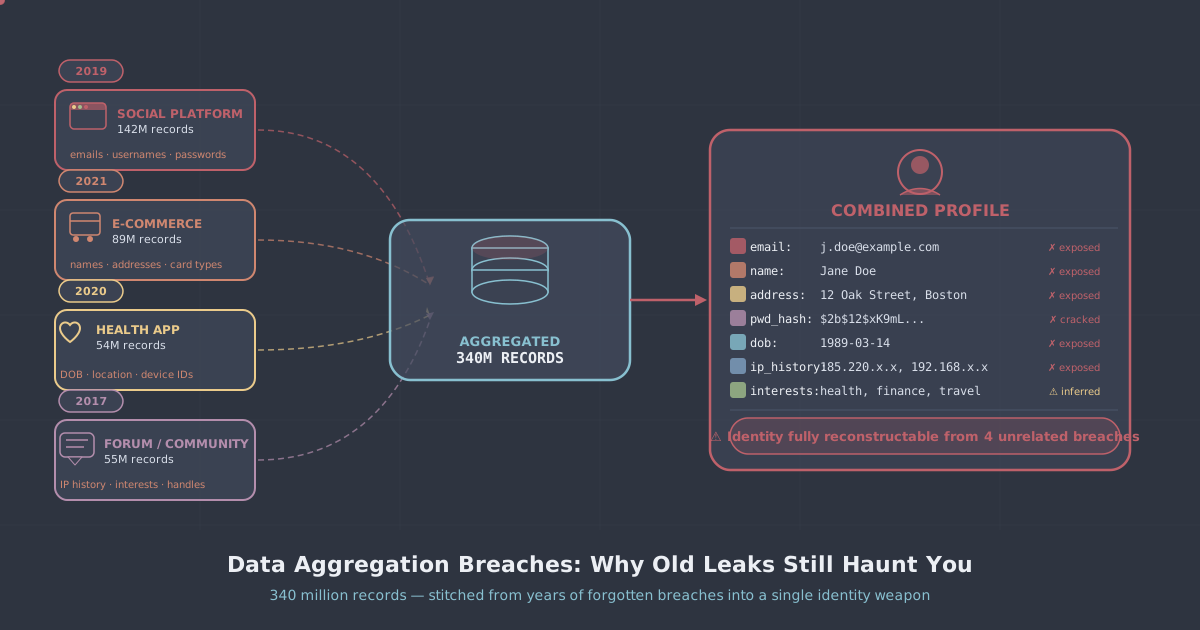
A data aggregation breach does not require an attacker to compromise any one platform successfully. Instead, it relies on combining multiple smaller datasets—each incomplete on its own—into a single, far more revealing whole.
Think of it this way. A breach at Platform A might expose your email address and username. A separate breach at Platform B might expose your phone number and date of birth. A third breach at Platform C might expose your IP address history and browsing habits. None of those incidents alone tells an attacker much. Combined, they build a detailed profile: who you are, where you live, what devices you use, and what services you subscribe to.
In the alleged OnlyFans case, the compiled dataset reportedly includes:
- Email addresses and phone numbers
- Usernames and linked social media accounts
- Account activity metrics
- Partial payment card details
Each of those data types likely came from a different source. The attacker's contribution was not technical sophistication—it was data engineering: matching records across sources to reconstruct identities at scale.
Why people believed they were safe
Many users on platforms like OnlyFans take deliberate steps to separate their activity from their real identity. They register with a secondary email address, choose a pseudonymous username, and never use their real name. On the surface, that sounds like reasonable operational security.
The problem is that anonymity is only as strong as the weakest link across all the services you have ever used with the same credentials. If you registered your pseudonymous email address at a social platform that was subsequently breached, and that breach dump is now sitting in a dark web repository, an attacker can match that email to your OnlyFans username. If your phone number appeared in a different breach tied to your real name, the chain extends further.
This is sometimes called the aggregation problem: individually innocuous data points become identifying when combined. Researchers have demonstrated for years that even anonymised datasets can be re-identified using surprisingly few data points. A 2000 paper by Latanya Sweeney showed that 87% of the US population could be uniquely identified using only postcode, date of birth, and sex—three fields present in countless breach dumps.
The alleged OnlyFans compilation is a practical demonstration of that principle at scale, applied specifically to unmask users of a platform where anonymity carries real consequences.
The long tail of old breaches
One reason data aggregation attacks are so effective in 2026 is the sheer volume of historical breach data in circulation. Major incidents from the early 2010s onwards—covering hundreds of millions of records from social networks, gaming platforms, retail sites, and data brokers—are freely traded or simply downloaded from public repositories. The data is old, but it does not expire.
Every year that passes without you changing an email address or phone number is another year that old breach data remains accurate. If you used the same email to sign up for a music streaming service in 2013 that was later breached, and you still use that address today, the connection is live.
Attackers assembling aggregated databases are not doing this manually. Automated tooling can ingest multiple breach dumps, normalise the fields, and run matching algorithms across tens of millions of records in hours. The technical barrier is low. The datasets are available. The only ingredient an attacker needs is intent.
What the compiled data enables
Once a profile is assembled, several types of harm become practical.
Targeted phishing
A phishing message that addresses you by name, references a service you actually use, and arrives in the correct inbox is far more convincing than a generic scam. Aggregated data gives attackers everything they need to personalise at scale. If the dataset includes partial payment card details, a message impersonating a payment provider becomes even more plausible.
Identity-based harassment
For users of platforms like OnlyFans, the exposure of a link between a pseudonymous account and a real identity can have serious personal consequences. Aggregated data that connects a username to a real name, employer, or home region gives bad actors a toolkit for targeted harassment or coercion.
Credential stuffing
If breach dumps include passwords—even hashed ones—they can be cracked offline and then tested against other services. Reused passwords remain one of the most reliable attack vectors, and aggregated datasets make it trivial to prioritise which accounts to target first.
Profiling and surveillance
Beyond individual attackers, aggregated commercial datasets are used by data brokers, advertisers, and in some jurisdictions, authorities. A dataset that links browsing behaviour, location data, purchase history, and social graph presents a surveillance capability that no single platform would sanction if asked directly.
Practical steps to reduce your exposure
You cannot retroactively remove your data from breaches that have already occurred, but you can significantly reduce the value of future aggregation attempts and limit the damage from current ones.
Compartmentalise your identities
Use a distinct email address for each sensitive or pseudonymous account. Email aliasing services make this manageable—you can generate unique addresses that forward to a single inbox without revealing your real address. The goal is to ensure that a breach at one platform cannot be cross-referenced to a breach at another via a shared email.
Use unique usernames
A username used consistently across platforms is a trivially exploitable link. If your gaming username, social media handle, and pseudonymous account name are all the same, any breach that exposes one of them also exposes the others.
Use a password manager and unique passwords
This limits the damage from credential stuffing. If every service has a distinct password, a breach at one platform provides no leverage over any other.
Audit your old accounts
Services you signed up for and forgot still hold your data. Closing dormant accounts reduces the number of breach sources that could contribute to a future aggregation. You can use haveibeenpwned.com to check which of your email addresses have appeared in known breach dumps—then prioritise changing credentials or closing accounts accordingly.
Mask your network activity
IP address history is one of the data types that can appear in breach dumps and that can reliably link pseudonymous activity to a physical location or ISP account. Routing your traffic through a VPN means that even if a platform logs connection metadata, the IP address recorded is the VPN server's, not yours. Our no-logs policy means PremierVPN does not retain records that could later be subpoenaed or breached themselves.
This is not a complete solution—it addresses one data type among many—but it closes a meaningful gap, particularly for users who rely on network-level anonymity as part of a broader privacy posture. If you want to understand how VPN protection fits into the wider picture alongside proxies and Tor, this comparison covers the trade-offs in detail.
Be sceptical of phishing attempts
If aggregated data about you exists, assume that targeted phishing is possible. Treat any unsolicited message that references personal details as suspicious regardless of how accurate those details appear. Accuracy is no longer evidence of legitimacy.
The broader point about anonymity
The alleged OnlyFans dataset illustrates something that is worth stating plainly: anonymity is not a property of a single account or a single platform decision. It is a property of your entire digital footprint, accumulated across every service you have ever used, every breach that has ever exposed your data, and every connection that can be drawn between them.
A user who took every reasonable precaution on OnlyFans specifically could still have their identity reconstructed from data they handed to a music streaming service a decade ago. That is not a failure of their judgment at the time—it is a structural feature of how personal data accumulates and persists.
The response to that reality is not paralysis. It is a shift from thinking about privacy as a one-time decision to treating it as an ongoing practice: compartmentalising identities, auditing old accounts, using tools that limit the data you expose, and staying alert to the fact that old breach data does not become less useful with age—it becomes more useful as new data arrives to cross-reference against it.
If you are reviewing your current setup, this introduction to VPNs covers the basics of what network-level privacy tools can and cannot do, and our IP leak test is a quick way to verify whether your current configuration is actually protecting your network identity.