8 min read
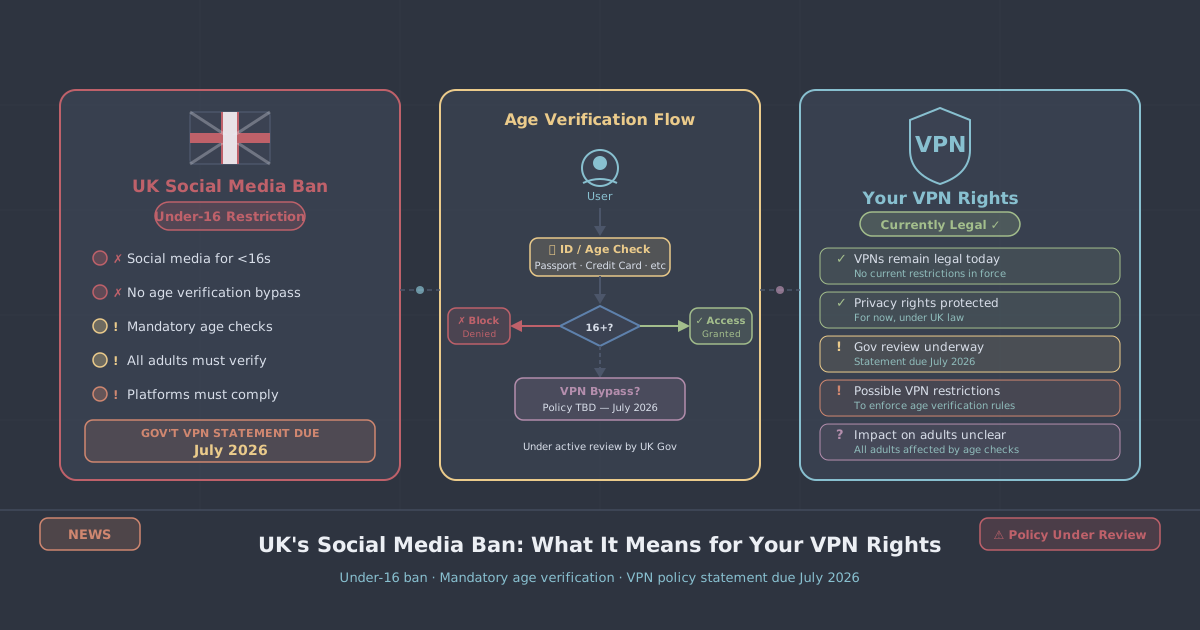
On 15 June 2026, Prime Minister Keir Starmer announced that social media platforms will be legally required to prevent under-16s from creating accounts. The first regulations are due before parliament by the end of 2026, with rules taking effect in Spring 2027. It is a significant policy shift—but for adult internet users, the implications stretch well beyond protecting children.
Because enforcing a blanket age ban requires platforms to verify every user's age, adults will be asked to submit identification, a facial scan, or financial data before they can open a new social media account. That alone raises serious privacy questions. But the story does not stop there: on 16 June 2026, Technology Secretary Liz Kendall confirmed she will bring a statement on VPN restrictions to the House of Commons in July 2026. The UK government is actively researching whether VPNs should be curtailed to shore up age-verification enforcement.
This article explains the legislative background, why VPNs have become politically inconvenient, what a restriction might look like in practice, and what you can do to stay informed and prepared.
The Online Safety Act set the stage
The social media ban builds on groundwork already laid by the Online Safety Act, which introduced mandatory age verification for adult content sites in July 2025. That measure was presented as narrow and targeted. The real-world effect was immediate and measurable: Ofcom recorded UK daily active VPN users roughly doubling to approximately 1.5 million in the wake of those rules. When people encounter a wall asking for their passport or a facial scan, a significant portion look for a way around it—and a VPN is the most accessible tool available.
That spike almost certainly informed the government's decision to commission research specifically into children's use of VPNs. The reasoning is straightforward: if age-verification checks are easily circumvented by teenagers using a VPN, the policy loses much of its stated purpose. From the government's perspective, a social media ban without some answer to VPN workarounds is incomplete.
What Liz Kendall's July statement could contain
No formal proposals have been published yet. The July 2026 statement will be the first indication of what the government is actually contemplating. Based on the trajectory of comparable regulatory discussions elsewhere, the options on the table likely fall into a few broad categories:
- App store restrictions: Requiring Apple and Google to remove VPN applications, or to verify users' ages before allowing downloads.
- ISP-level blocking: Directing UK internet service providers to block known VPN endpoints or protocols, similar to approaches used in more restrictive jurisdictions.
- Ofcom licensing for VPN providers: Requiring VPN services operating in the UK to register with a regulator and comply with age-verification passthrough requirements.
- Platform-side detection: Obliging social media platforms themselves to detect and reject connections originating from known VPN IP ranges.
Each of these carries different implications for privacy, security, and practicality. None of them is straightforward to implement without causing collateral damage to the much larger population of adults who use VPNs for entirely legitimate reasons.
The privacy and security researchers' warning
The government is not operating in an information vacuum. In March 2026, a joint statement signed by 438 security and privacy researchers across 32 countries called for a moratorium on age-assurance deployment. Their objections were specific and technical, not merely ideological:
Age-assurance systems are easily circumvented, privacy-invasive by design, and—critically—build centralised infrastructure that can subsequently be turned to broader censorship purposes.
That last point deserves careful attention. When a government requires platforms to collect and verify identity documents at scale, it creates a database of real identities linked to online behaviour. The stated purpose today is child protection. The infrastructure, once built, can serve other purposes—purposes that may not be announced in advance or subject to the same public debate.
This is not a hypothetical risk invented by privacy advocates. It is a structural consequence of how centralised identity verification works. The researchers' statement reflects a consensus across a wide range of disciplines—cryptography, human rights law, computer science—that the costs of this approach have been underweighted in the political discussion.
What legitimate VPN users stand to lose
VPNs are not primarily used to circumvent age checks. They serve a broad range of purposes that have nothing to do with bypassing content restrictions:
- Remote workers securing connections to corporate networks and sensitive systems
- Journalists and researchers protecting sources and communications
- Travellers accessing UK services while abroad
- Individuals on public Wi-Fi protecting their financial and personal data from interception
- Businesses protecting commercially sensitive traffic
- People in countries with aggressive surveillance using VPNs to communicate safely
A policy designed to stop teenagers from accessing Instagram would, depending on its scope, also affect every adult using a VPN for any of the above. The proportionality question has not been addressed in any public statement so far.
PremierVPN's no-logs policy exists precisely because we believe users' connection data should not be stored, shared, or made available to third parties. Any regulatory framework that requires VPN providers to identify their users would be fundamentally incompatible with that principle—and with the privacy expectations of every legitimate customer.
Age verification's technical limitations
It is worth being precise about what age verification actually checks, because the policy debate often elides this. A platform that verifies a user's age at account creation knows only that someone with a valid ID created the account. It does not know who is sitting at the keyboard five minutes later. A 15-year-old using a parent's verified account faces no additional barrier whatsoever. This is not a fringe scenario—it is the most obvious workaround available and requires no technical knowledge.
VPN usage by minors is a secondary workaround that requires more effort and technical awareness. If the primary workaround (using a family member's verified account) remains trivially available, restricting VPNs addresses a minor vector while imposing significant costs on the majority of adult users who are not attempting to circumvent anything.
The 438 researchers who signed the March 2026 statement made essentially this point: the systems are circumventable by the people they are meant to restrict, while being burdensome and privacy-invasive for everyone else.
What this means for you right now
The July 2026 statement will be a watershed moment. It may propose nothing immediately enforceable, or it may signal the beginning of a legislative process that eventually affects which VPN services can operate in the UK and how. Either way, it is worth understanding where things stand before that announcement lands.
A few practical steps:
- Follow the parliamentary statement. Liz Kendall's July statement will be published via Hansard and covered by the press. Read what is actually proposed rather than relying on headlines.
- Understand what your VPN provider logs. If restrictions do come, they are far more likely to target providers who hold user data than those who do not. Review any provider's logging policy carefully.
- Consider your protocol options. In jurisdictions where VPN traffic is actively blocked—China and Iran being the clearest examples—standard WireGuard or OpenVPN connections are often detectable and blockable. PremierVPN's PremierVPN X uses the VLESS+REALITY protocol, which is specifically designed to resist deep packet inspection. You can read more about how that works in our VLESS+REALITY explainer. If UK ISP-level blocking became a reality, this kind of obfuscation would matter.
- Make your views known. Public consultations matter. If a consultation is launched alongside or following the statement, responding to it is a direct way to put the proportionality argument on record.
The broader pattern
The UK is not alone in reaching for VPN restrictions as an adjunct to age-verification enforcement. Australia, for example, passed an under-16 social media ban in late 2024, and discussions about VPN circumvention followed almost immediately. The political logic is consistent: once you have committed to age verification as the mechanism, anything that allows users to route around it looks like a problem to be solved.
What distinguishes the UK situation is the scale and speed of the public response already visible in the Ofcom data. A doubling of daily active VPN users following the adult content age-verification rules in 2025 is a clear signal that a significant portion of the UK population is unwilling to submit biometric or financial data to access online services. That is a legitimate preference, not a sign of bad intent. Any policy framework that ignores it will face the same circumvention dynamic it is trying to eliminate.
If you are using a VPN for remote work, travel, or general privacy—and want to understand the full range of what a VPN can and cannot protect—our introduction to VPNs is a good starting point. For those whose work involves sensitive communications or who travel to countries with active censorship infrastructure, the remote work and travel pages cover the specific considerations in more detail.
The July 2026 statement is the next concrete moment in this debate. Watch for it, read it carefully, and consider what it implies—not just for teenagers on TikTok, but for the privacy infrastructure that every adult internet user in the UK currently takes for granted.