8 min read
When a VPN provider says it uses "AES-256 encryption", that statement is technically true but almost meaninglessly incomplete. AES-256 is a single algorithm inside a much larger structure—the cipher suite—and the strength of the overall system depends on every component working correctly together, not just one headline number.
This guide unpacks what a cipher suite actually is, what each part does, and how to read an encryption spec without needing a cryptography degree. If you care about whether your traffic is genuinely protected rather than just marketed as protected, this is worth understanding.
What a cipher suite actually is
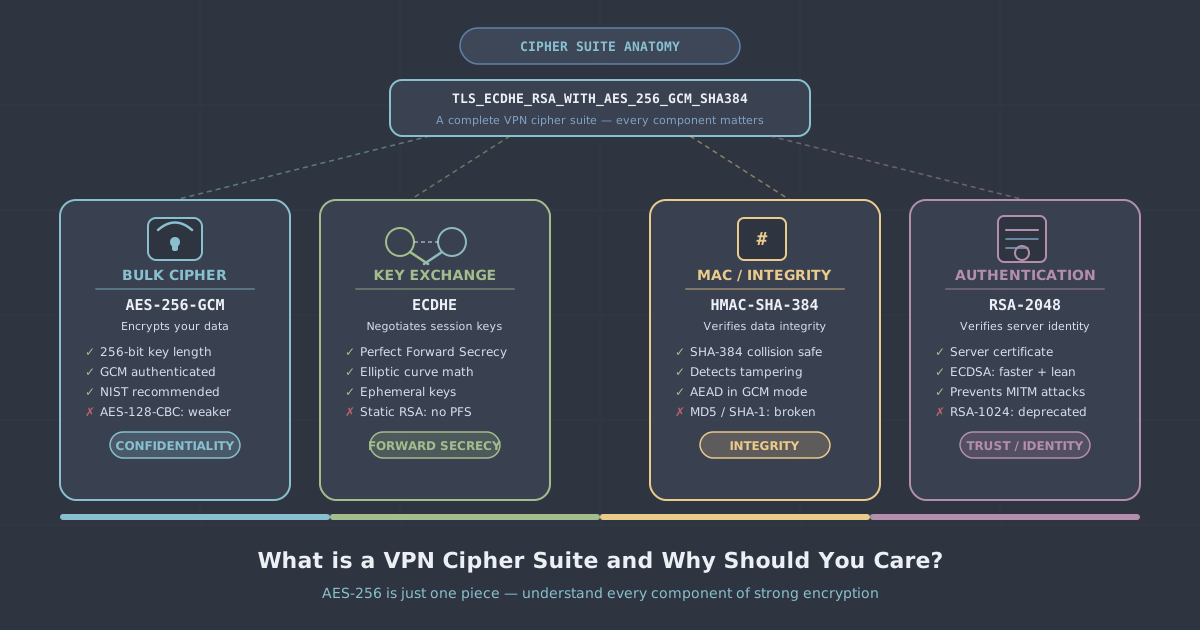
A cipher suite is a named collection of cryptographic algorithms that defines how two systems—your device and a VPN server, for instance—will secure a connection. Rather than a single algorithm doing everything, several distinct algorithms work together, each handling a different job:
- Key exchange — how both sides agree on a shared secret without ever transmitting it directly
- Authentication — how each side proves to the other that it is who it claims to be
- Bulk encryption — how the actual data in transit is encrypted and decrypted
- Message authentication (MAC) — how each party confirms that data has not been tampered with in transit
In TLS (the protocol that underpins HTTPS and is also used in some VPN configurations), cipher suites are written out in a standardised format like this:
TLS_ECDHE_RSA_WITH_AES_256_GCM_SHA384Each segment of that string maps to one of the roles above. Strip away the shorthand and you have a complete description of the encryption contract for that session. Modern protocols like WireGuard bundle these choices into the protocol design itself, so you won't see a suite string—but the same four roles still exist and are still filled by specific algorithms.
Key exchange: the part that makes everything else possible
Before any encrypted data can flow, your device and the VPN server need to agree on a shared encryption key. The problem is they're communicating over a network that could be observed. Key exchange algorithms solve this.
Diffie-Hellman (DH) is the classic approach. You and the server each generate a private value, exchange derived public values, and independently arrive at the same shared secret—without ever sending the secret itself. An observer who recorded the exchange cannot reconstruct the secret from the public values alone (assuming the parameters are strong).
Elliptic Curve Diffie-Hellman (ECDH) achieves the same result using elliptic curve mathematics, which provides equivalent security with much smaller keys. A 256-bit elliptic curve key is broadly comparable to a 3,072-bit traditional DH key. Smaller keys mean faster handshakes and less computational overhead.
ECDHE adds the word "Ephemeral"—meaning a fresh key pair is generated for each session. This is critical. Ephemeral key exchange provides what cryptographers call forward secrecy: if a long-term private key is ever compromised, past sessions cannot be decrypted because each session used a unique throwaway key. Without forward secrecy, a single key compromise could theoretically unravel years of recorded traffic.
WireGuard uses a Curve25519 ECDH exchange and builds forward secrecy in by design—one reason it is considered a well-constructed modern protocol.
Authentication: making sure you're talking to the right server
Key exchange tells you how to agree a secret; authentication tells you who you're agreeing it with. Without authentication, a man-in-the-middle attacker could intercept the handshake and impersonate your VPN server.
In TLS-based VPN configurations, this is typically handled by RSA or ECDSA digital signatures combined with a certificate infrastructure. The server presents a certificate signed by a trusted authority; your client checks the signature and the certificate chain before proceeding.
RSA has been the standard for decades and is well-understood. Its main drawback is that large key sizes (2,048 bits is a minimum; 4,096 is better) create a heavier computational burden.
ECDSA (Elliptic Curve Digital Signature Algorithm) provides equivalent assurance with shorter keys—a 256-bit ECDSA key is considered comparable to 3,072-bit RSA. Faster to compute, smaller in transmission.
WireGuard handles authentication differently, using static Curve25519 public keys that are pre-shared between client and server during setup. There's no certificate authority in the traditional sense; both parties must already possess each other's public key. This simplifies the attack surface but shifts the configuration responsibility to the provisioning stage.
Bulk encryption: AES-256 in context
This is the component most VPN marketing focuses on exclusively. Bulk encryption is the algorithm that actually scrambles your data once the session is established—it operates on every packet you send and receive.
AES (Advanced Encryption Standard) is the dominant symmetric cipher in VPN use. It operates in blocks and comes in 128-bit and 256-bit key variants. The 256-bit variant provides a larger security margin—not because 128-bit is known to be broken, but because 256-bit is more conservative against potential future attacks.
The cipher itself is only part of the picture. The mode of operation determines how AES handles data that is longer than one block:
- CBC (Cipher Block Chaining) — older mode, still secure when implemented correctly, but historically prone to padding oracle attacks in specific implementations. Requires a separate MAC algorithm to detect tampering.
- GCM (Galois/Counter Mode) — an authenticated encryption mode that combines encryption and integrity checking in a single pass. Faster, parallelisable, and less implementation-error-prone than CBC. Strongly preferred for modern systems.
So AES-256-GCM is meaningfully stronger in practice than AES-256-CBC, not because the core cipher differs, but because GCM includes built-in authentication and is less susceptible to certain classes of implementation mistake.
WireGuard uses ChaCha20-Poly1305 rather than AES. ChaCha20 is a stream cipher designed by Daniel J. Bernstein; Poly1305 is the accompanying message authentication code. The combination is an authenticated encryption scheme, like AES-GCM, but it performs particularly well on hardware that lacks dedicated AES acceleration—which includes many mobile processors and lower-end devices. On hardware with AES-NI instructions (most modern Intel and AMD CPUs), AES-GCM and ChaCha20-Poly1305 are roughly comparable in speed; on devices without AES-NI, ChaCha20-Poly1305 is typically faster.
Message authentication: ensuring nothing has been altered
Even encrypted data can be manipulated by an attacker if there is no integrity check—they may not be able to read the plaintext, but they could flip bits in transit and cause unpredictable decryption errors, or craft specific modifications if the cipher mode allows it.
Message authentication codes (MACs) solve this. A MAC is a short tag computed from the message content and a secret key; if anything in the message changes, the tag will not match on the receiving end and the packet is rejected.
HMAC (Hash-based Message Authentication Code) combined with a hash function like SHA-256 or SHA-384 is a common construction in OpenVPN configurations. The hash function must be collision-resistant; SHA-1 is considered inadequate for new systems, while SHA-256 and above remain sound.
In AEAD (Authenticated Encryption with Associated Data) modes like AES-GCM and ChaCha20-Poly1305, the MAC is integrated into the encryption operation itself. There's no separate HMAC step—authentication is built in, which reduces complexity and eliminates a category of implementation mistakes that arise when encryption and authentication are coupled poorly.
How VPN protocols handle cipher suites differently
Different VPN protocols give you varying degrees of control over the cipher suite in use.
OpenVPN
OpenVPN is highly configurable. You can specify cipher, HMAC algorithm, TLS version, and key exchange parameters separately. This flexibility is useful for administrators who need precise control, but it also means a poorly configured OpenVPN deployment can use weak settings. The defaults have improved significantly over the years, but it pays to check. A solid OpenVPN configuration will include --tls-version-min 1.2 or higher, AES-256-GCM as the cipher, and ECDHE for key exchange.
WireGuard
WireGuard takes an opinionated approach: it specifies exactly one set of algorithms and does not allow negotiation. The suite is fixed as Curve25519 for key exchange, ChaCha20-Poly1305 for authenticated encryption, BLAKE2s for hashing, and SipHash24 for hashtable keys. There are no deprecated fallbacks, no negotiation surface for downgrade attacks, and no configuration knobs to misconfigure. The trade-off is that if any component is ever found to be weak, a protocol update is required—but the authors consider this a worthwhile constraint for a cleaner security model.
PremierVPN uses WireGuard as its default protocol, which means the cipher suite is well-defined and not dependent on per-server configuration choices. For situations where WireGuard traffic needs to be disguised—on restrictive networks in countries that deep-packet-inspect—VLESS+REALITY is available via PremierVPN X for Windows and PremierVPN X for macOS, using a different but equally deliberate cryptographic approach.
What to actually look for
When you are trying to assess whether a VPN's encryption is genuinely robust, here is a practical checklist:
- Forward secrecy — does the key exchange use ephemeral keys (ECDHE or equivalent)? If a long-term key is ever exposed, past sessions should remain private.
- Authenticated encryption — is the bulk cipher an AEAD mode (GCM or ChaCha20-Poly1305)? Separate MAC steps that are tacked on after the fact introduce more risk of implementation error.
- No deprecated algorithms — RC4, DES, 3DES, MD5, and SHA-1 have no place in a current VPN. Neither does TLS 1.0 or 1.1.
- Key sizes — for RSA, 2,048-bit is a floor; 4,096-bit is better. For elliptic curve, 256-bit is fine given the mathematical properties. For AES, 256-bit is the conservative choice.
- No negotiation to weaker suites — a protocol or configuration that allows fallback to weaker ciphers for compatibility creates a downgrade attack surface. WireGuard eliminates this entirely by design.
- Protocol transparency — can you find out what protocols and cipher choices are actually in use? Vague marketing language is not a substitute for specifics.
It is also worth checking whether a VPN has a published no-logs policy and undergoes independent auditing. Strong encryption is necessary but not sufficient—if logs are retained, the encrypted tunnel only protects data in transit, not data at rest on a server.
Putting it together
AES-256 is a robust cipher, but it is one instrument in an ensemble. A cipher suite describes the full ensemble: how keys are exchanged, how identities are verified, how data is encrypted, and how tampering is detected. Evaluating a VPN on AES-256 alone is like hiring a builder based solely on the quality of their bricks while ignoring the mortar, the foundation, and the architect's drawings.
The practical upshot: look for forward secrecy, AEAD modes (GCM or ChaCha20-Poly1305), no deprecated algorithms, and a protocol that is either well-audited or deliberately opinionated in its design. WireGuard meets most of these criteria by construction, which is one reason it has become the default choice for well-considered VPN implementations—including PremierVPN's standard service. If you would like to see the server locations that service runs across, the full list is on the server locations page.
Encryption specifications matter, but only when you understand what you're reading. Hopefully this gives you the vocabulary to do that.