9 min read
Most VPN users focus on the obvious things: which protocol to use, whether the provider keeps logs, and how fast the connection is. All of those matter. But there is a quieter, more technical protection working in the background that deserves far more attention—perfect forward secrecy.
The concept is not complicated once you strip away the jargon, and understanding it will change how you think about VPN encryption. It answers a specific question: if someone records your encrypted traffic today and manages to obtain a key later, can they go back and decrypt what they captured? With perfect forward secrecy in place, the answer is no.
This article explains what perfect forward secrecy is, how it works at a technical level, and why it is one of the most important—and most overlooked—properties of a well-designed VPN.
The problem it solves
To understand perfect forward secrecy, you need to understand the threat it guards against. Encryption keys are not permanent. They can be stolen through server breaches, extracted from memory, obtained via legal compulsion, or cracked through advances in computing power. The question is: what damage can a compromised key actually do?
In older or poorly designed encryption schemes, a single long-lived private key is used to derive the session keys that encrypt your traffic. If an attacker has been patiently recording your encrypted data—a technique sometimes called "capture now, decrypt later"—obtaining that private key at any future point hands them the ability to decrypt everything they captured. Every session, every connection, everything.
This is not a hypothetical concern. Passive mass surveillance of encrypted traffic has been documented. Storing encrypted data in bulk is cheap. The threat model is: record everything now, wait for the keys.
What perfect forward secrecy actually means
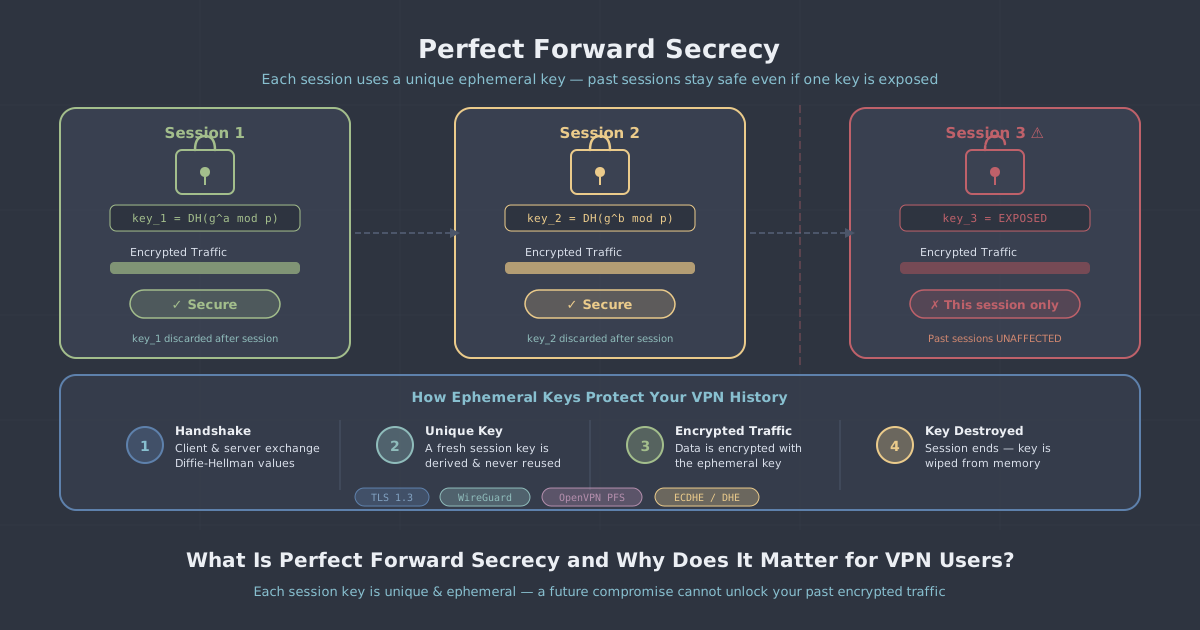
Perfect forward secrecy (PFS) is a property of a key exchange mechanism. When PFS is in use, each session generates its own unique, temporary session key. That key is derived through an ephemeral key exchange—meaning the key material exists only for the duration of the session and is never written to disk or transmitted. Once the session ends, the key is discarded and cannot be reconstructed.
The word perfect here is a technical term. It means that even the server itself could not recover a past session key after the fact—not because of a policy decision, but because the key material no longer exists anywhere. The word forward refers to protection moving forward in time: compromising a key today does not help an attacker decrypt traffic from yesterday.
The practical result is that your traffic is siloed into independent, short-lived encrypted sessions. Compromising one key—even the server's long-term private key—yields nothing from past sessions.
How it works: ephemeral key exchange
PFS is achieved through ephemeral variants of key exchange algorithms. The two most common are:
- DHE (Ephemeral Diffie-Hellman): Each party generates a fresh, temporary Diffie-Hellman key pair for each session. The shared secret is computed, used to derive the session key, and then both ephemeral key pairs are discarded.
- ECDHE (Elliptic Curve Diffie-Hellman Ephemeral): The same principle as DHE but using elliptic curve cryptography, which achieves equivalent security with shorter key lengths and better performance.
The important distinction is between ephemeral and static key exchange. A static key exchange reuses the same key pair across sessions. An ephemeral one generates fresh key material every time. Only ephemeral key exchange provides forward secrecy.
Here is a simplified version of what happens during an ECDHE handshake:
- The client generates a temporary elliptic curve key pair (public + private).
- The server generates its own temporary key pair.
- Each side exchanges their temporary public keys.
- Both sides independently compute the same shared secret using their own private key and the other party's public key.
- That shared secret is fed into a key derivation function to produce the session encryption key.
- Both temporary private keys are deleted. The shared secret is never transmitted.
An observer who records this exchange cannot reconstruct the shared secret without one of the temporary private keys—and those no longer exist after the session ends.
Perfect forward secrecy and VPN protocols
Not all VPN protocols handle this equally. Understanding where PFS appears in the protocols PremierVPN supports is worth knowing.
WireGuard
WireGuard uses a handshake protocol based on the Noise Protocol Framework. It performs an ephemeral key exchange at the start of every session and renegotiates keys periodically during long-lived connections—by default, a new handshake occurs every 180 seconds. This means your session key rotates frequently even within a single VPN session. WireGuard's approach to key management is one of the reasons it is considered a modern, well-designed protocol from a cryptographic standpoint.
OpenVPN
OpenVPN supports PFS through TLS with ECDHE or DHE cipher suites. When configured correctly—using an ephemeral key exchange cipher rather than a static RSA key exchange—OpenVPN provides forward secrecy. The key word is configured correctly: the protocol itself does not enforce PFS, so it depends on how the server is set up. PremierVPN's OpenVPN configuration uses cipher suites that provide forward secrecy.
VLESS + REALITY
The VLESS + REALITY protocol, available through PremierVPN X for macOS and PremierVPN X for Windows, uses TLS 1.3 under the hood. TLS 1.3 mandates ephemeral key exchange—static RSA key exchange was removed entirely from the specification. Every TLS 1.3 session has forward secrecy by design, with no configuration required to enable it.
Why key rotation matters too
Perfect forward secrecy protects past sessions from future key compromise. Key rotation limits the damage within a session. These are related but distinct ideas.
Even if you have PFS between sessions, a very long-lived session that uses the same key for hours exposes more data than one that rotates keys every few minutes. WireGuard's automatic renegotiation every 180 seconds is a good example of combining both properties: each new connection gets a fresh key (PFS between sessions), and keys are rotated during long connections (limiting within-session exposure).
The combination of PFS and frequent key rotation means an attacker who somehow obtains a single session key can decrypt only a small window of traffic—not your entire history.
What PFS does not protect against
It is worth being honest about the limits of perfect forward secrecy, because no single security property solves everything.
- Active interception: PFS protects recorded past traffic. If an attacker is performing an active man-in-the-middle attack during your session—substituting their own keys in real time—PFS does not help. This is why certificate verification and authentication matter alongside PFS.
- Endpoint compromise: If the device you are using is compromised, an attacker can read your plaintext traffic before it is encrypted. PFS cannot protect data that has already been decrypted at the source.
- Metadata: PFS encrypts the content of your sessions. It does not hide the fact that you connected to a VPN server, when, or for how long. For metadata protection, a strict no-logs policy is the relevant safeguard.
- Weak algorithms: PFS implemented with weak Diffie-Hellman parameters (historically, 512-bit or 1024-bit groups) can be broken. The protection is only as strong as the underlying cryptographic parameters. Modern implementations using ECDHE or large DH groups do not have this problem.
How to verify a VPN connection has forward secrecy
If you want to check whether a TLS-based connection is using an ephemeral cipher suite, the cipher suite name is your guide. Look for the letters DHE or ECDHE in the negotiated cipher suite. A suite like TLS_ECDHE_RSA_WITH_AES_256_GCM_SHA384 uses ephemeral key exchange. A suite like TLS_RSA_WITH_AES_256_GCM_SHA384 does not—the RSA key exchange here is static.
On macOS or Linux, you can inspect TLS cipher suites using openssl s_client. For WireGuard connections, forward secrecy is built into the protocol specification—there is no configuration to check because it cannot be disabled.
You can also run a quick check on your VPN connection's DNS handling and IP exposure using the PremierVPN IP leak test, which helps confirm that your traffic is being routed correctly through the VPN tunnel.
The practical takeaway
Perfect forward secrecy is not a feature you toggle on in an app. It operates at the protocol and cryptographic layer, below what most users ever see. But it is one of the most meaningful protections in a VPN's security architecture—specifically because it limits the damage from future key compromise rather than just defending against present threats.
The threat model it addresses is real: passive recording of encrypted traffic, followed by eventual decryption when keys are obtained. That might sound abstract, but it is precisely the kind of long-game attack that targeted surveillance relies on. PFS makes that strategy ineffective.
PremierVPN's default protocol, WireGuard, provides forward secrecy by design with automatic key rotation. The OpenVPN configuration uses ephemeral cipher suites. VLESS + REALITY, built on TLS 1.3, makes PFS mandatory. If you want to understand more about how your traffic is protected end to end, the PremierVPN guide to how VPNs work is a good companion read.
When evaluating any VPN setup, forward secrecy should be on your checklist—not as a buzzword, but as a concrete question: if a key is compromised tomorrow, does it unlock my history? With proper PFS in place, the answer is no.