9 min read
A standard VPN connection encrypts your traffic, but it does not hide the fact that you are using a VPN. To a network operator, ISP, or government firewall, the connection looks distinctly non-ordinary—encrypted, yes, but shaped and labelled in ways that make it identifiable. That is precisely the problem obfuscation is designed to solve.
VPN obfuscation (sometimes called traffic obfuscation or stealth mode) disguises VPN packets so they look like regular HTTPS web traffic. This article explains the mechanics behind that process, the situations where it matters, and the cases where it almost certainly does not.
Why ordinary VPN traffic is identifiable
When you connect to a VPN using a protocol like WireGuard or OpenVPN, your traffic is encrypted—but encryption alone is not camouflage. Network observers can still analyse several properties of the data stream without decrypting a single byte:
- Port numbers. WireGuard uses UDP port 51820 by default. OpenVPN commonly runs on UDP 1194 or TCP 443. These are well-known signatures.
- Packet structure. Each VPN protocol has a characteristic handshake pattern, header format, and timing rhythm. Deep packet inspection (DPI) systems are trained to recognise these fingerprints.
- Traffic behaviour. A VPN tunnel carries all your traffic in a continuous encrypted stream. That pattern—sustained, high-volume, encrypted, to a single IP—is unlike typical browser behaviour.
Sophisticated firewalls, particularly those deployed by state-level censorship systems, use DPI to detect and block VPN connections based on these signatures rather than by decrypting the traffic itself.
What obfuscation actually does
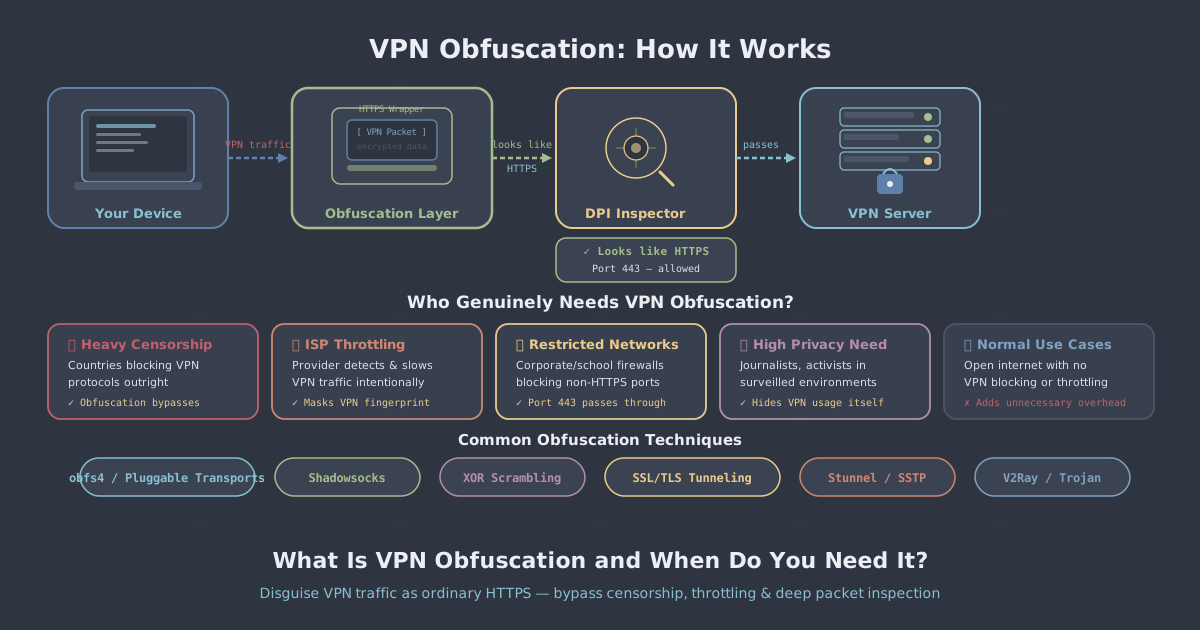
Obfuscation wraps VPN traffic in an additional layer that mimics normal encrypted web traffic—specifically TLS over port 443, which is the same channel your browser uses for HTTPS. From the outside, the connection appears to be routine web browsing.
This is achieved through several techniques, depending on the implementation:
- Packet scrambling. XOR-based obfuscation (used in tools like obfs4) flips bits in the packet headers to remove recognisable byte sequences.
- TLS tunnelling. The VPN traffic is wrapped inside a genuine TLS session, complete with a convincing TLS handshake, so it passes inspection as standard HTTPS.
- Traffic shaping. Packet sizes and timing are adjusted to match the statistical profile of normal web traffic.
- Domain fronting. Requests appear to originate from a trusted CDN or well-known domain, making blocking difficult without collateral damage to legitimate services.
The most robust modern approach combines genuine TLS tunnelling with convincing server-side behaviour. This is the principle behind VLESS+REALITY, a protocol designed specifically for high-censorship environments. Rather than merely wrapping traffic in fake TLS, REALITY uses a real target domain's TLS certificate and handshake, making the connection practically indistinguishable from traffic to that actual site.
You can read more about how that works in our dedicated guide on the VLESS+REALITY protocol.
Who genuinely needs obfuscation
Obfuscation is not a feature most people will ever require. It adds complexity and can reduce throughput, so it is worth being clear about the circumstances where it is actually useful.
People in heavily censored countries
The most clear-cut use case is living in or travelling through a country with aggressive internet censorship. China's firewall is the most technically sophisticated example—it actively probes VPN connections, blocks known VPN IP ranges, and uses DPI to identify and drop obfuscated traffic that does not pass scrutiny. Iran and Russia employ similar, if less comprehensive, blocking systems.
In these environments, a standard WireGuard or OpenVPN connection will frequently fail. Obfuscation—particularly VLESS+REALITY—is often the only reliable way to maintain a working connection. PremierVPN's PremierVPN X for macOS and PremierVPN X for Windows implement VLESS+REALITY specifically for this purpose.
Travellers passing through restrictive networks
You may not live under censorship, but if your work takes you through countries where VPNs are routinely blocked, or if you rely on a VPN for accessing work systems while abroad, obfuscation becomes a practical necessity rather than a luxury. A connection that drops entirely the moment you land is not useful.
If travel connectivity is a concern, it is worth looking at our Travel VPN page alongside the obfuscation options available through PremierVPN X.
Networks that actively block VPN traffic
Some corporate networks, university campuses, and even certain hotel or airport Wi-Fi systems block VPN connections—not for political reasons, but to enforce usage policies or reduce bandwidth. Obfuscation can help in these situations, though it is worth checking whether using a VPN on such a network is permitted before doing so.
ISPs that throttle VPN connections
A small number of ISPs selectively throttle or deprioritise traffic they identify as VPN traffic. Obfuscation removes the identifier, so the traffic is treated like ordinary HTTPS and avoids the throttling queue. This is a narrower use case than censorship circumvention, but it is real.
When you probably do not need it
If you are based in the UK, most of Europe, the United States, or another country with open internet access, and your primary reasons for using a VPN are privacy, security on public Wi-Fi, or accessing geo-restricted content, then a standard WireGuard connection is almost certainly sufficient.
WireGuard is fast, modern, and well-audited. Adding obfuscation when you do not need it means accepting a performance trade-off for no practical benefit. PremierVPN uses WireGuard as its default protocol precisely because it offers the best balance of speed and security for everyday use.
The short version: if your VPN connections work reliably, you do not need obfuscation.
Obfuscation and protocol choice
Not every protocol can be obfuscated equally well. Here is a practical overview of how the protocols available through PremierVPN map onto obfuscation needs:
| Protocol | Obfuscation | Best for |
|---|---|---|
| WireGuard | None (identifiable) | Everyday use, speed, reliability |
| WireGuard Stealth | Basic obfuscation | Networks with light VPN blocking |
| OpenVPN (TCP 443) | Partial—resembles HTTPS but detectable under DPI | Moderately restrictive networks |
| VLESS+REALITY | Strong—genuine TLS camouflage | China, Iran, Russia, aggressive DPI environments |
WireGuard Stealth applies a layer of obfuscation on top of WireGuard that is sufficient for many restrictive networks. VLESS+REALITY, available through PremierVPN X, is the option for environments where even WireGuard Stealth is likely to be detected and blocked.
What obfuscation does not do
It is important to be precise about the limits of obfuscation, because it is sometimes misunderstood as a blanket privacy upgrade.
- It does not strengthen encryption. The underlying VPN tunnel is no more or less encrypted with obfuscation than without it. The encryption quality depends on the protocol, not the camouflage layer.
- It does not make you anonymous. Obfuscation hides the fact that you are using a VPN from network-level observers. It does not prevent a VPN provider from logging your activity, and it does not prevent website-level tracking by fingerprinting or cookies.
- It is not foolproof. State-level censorship systems are actively maintained and improved. A technique that works reliably today may be partly detected tomorrow. VLESS+REALITY is currently among the most resistant options available, but no obfuscation method carries an absolute guarantee.
- It does not bypass every restriction. IP-based blocking—where a server's IP address is simply added to a blocklist—is a separate problem that obfuscation does not address. Obfuscation helps with protocol-based detection, not IP blacklisting.
Using obfuscation with PremierVPN
For most users, the standard Windows, macOS, iOS, and Android apps connect via WireGuard with no additional configuration needed. If you encounter a network that blocks your connection, switching to WireGuard Stealth within the app is the first step.
If you are travelling to China, Iran, or another environment with aggressive VPN blocking, PremierVPN X is the appropriate tool. It is a separate application for macOS and Windows that implements VLESS+REALITY. Setup guides are available for both platforms if you want to get it configured before you travel—always sensible, since downloading and configuring software is far easier before you cross a border than after.
PremierVPN operates a strict no-logs policy, which applies regardless of which protocol or obfuscation method you use. The camouflage layer exists to bypass network-level blocking, not to change what the VPN itself records—and in our case, that is nothing.
Summary
VPN obfuscation disguises VPN traffic as ordinary HTTPS so that firewalls and deep packet inspection systems cannot identify and block it. It matters most in countries with active VPN blocking infrastructure, on networks that enforce VPN restrictions, and occasionally for users whose ISP throttles identified VPN traffic.
For everyday privacy and security use in countries with open internet access, standard WireGuard is the better choice—faster, simpler, and more than adequate. Reserve obfuscation for the situations where it genuinely solves a problem: a dropped connection, a blocked protocol, or a firewall that will not let standard VPN traffic through. When that situation arises, having VLESS+REALITY available makes a significant practical difference.