9 min read
On 6 October 2026, ASOS customers received an unusual push notification through the retailer's own app. It told them, bluntly, that ASOS had been "fully compromised." That message was not from ASOS—it was sent by an attacker who had already gained access to the company's systems and was, in effect, using ASOS's own infrastructure to announce what they had done. ASOS confirmed the breach to the London Stock Exchange the same day and notified the Information Commissioner's Office.
The headlines focused on the obvious: names, home addresses, phone numbers, email addresses, dates of birth, and customer numbers were among the stolen data. All of that is serious. But buried in the list of compromised information was something most coverage moved past quickly—the search terms customers had used on the ASOS website. That detail deserves more attention than it has received.
This article looks at what happened, why search history sits in a different category of sensitivity to your postcode, and what this breach illustrates about how much data retailers quietly accumulate about the people who shop with them.
What We Know About the Breach
The attack followed a pattern that has become depressingly familiar. According to reporting from BBC News, an attacker impersonated a trusted contact and manipulated an ASOS employee into handing over their login credentials. This is social engineering—exploiting human trust rather than a technical vulnerability in software.
The group identifying itself as the Xuanye Group claimed to have accessed ASOS's Snowflake environment, a cloud data warehouse platform used by many large organisations to store and analyse customer data. Snowflake stated that no flaw or misconfiguration on its own platform was involved—a position consistent with several other high-profile incidents involving Snowflake-connected breaches, where the entry point has been compromised credentials rather than a platform vulnerability.
ASOS has not disclosed how many of its 16.5 million active customers across more than 100 markets are affected. Given that the attacker apparently had access to a data warehouse environment, the scope could be substantial.
Why Search History Is Sensitive Data
Most people understand intuitively that their name, address, and date of birth are sensitive. These are the inputs for identity fraud, the details a scammer needs to impersonate you to a bank or a government agency. But search terms feel different—they seem innocuous, almost trivial. You searched for a dress. So what?
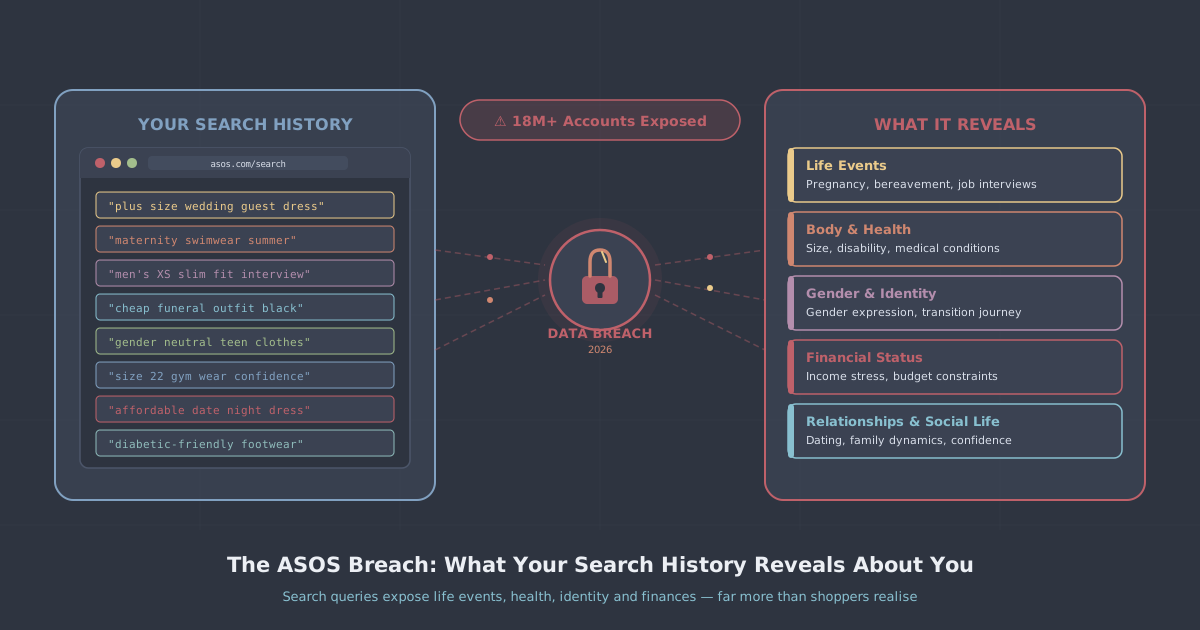
The problem is that search terms are a record of intent and interest at a particular moment in time. On a general-purpose retailer like ASOS, that can reveal a great deal. Consider what a sequence of searches might communicate:
- Searches for maternity clothing suggest a pregnancy, often before it has been announced publicly
- Searches for plus-size or petite ranges reveal body type
- Searches for gender-neutral or opposite-gender clothing may reflect someone's gender identity or expression
- Searches for formalwear, mourning attire, or specific cultural dress may hint at life events or religious or ethnic background
- Searches for medical compression garments or adaptive clothing may indicate a health condition
None of these are things most people would volunteer to a stranger. Yet they were being stored, apparently in a queryable data warehouse, alongside the customer's full name, address, and date of birth. When combined, that creates a profile that is considerably more invasive than any single field suggests.
Under the UK GDPR, special categories of personal data—including health information, data about religious beliefs, and data about sexual orientation or gender identity—attract heightened protections. Search terms can act as a proxy for all of these. Whether the ICO will take that view in its investigation of this breach remains to be seen.
The Gap Between What Retailers Collect and What Customers Expect
There is a significant mismatch between what shoppers assume is being stored and what retailers actually retain. Most people understand that a retailer keeps their order history—that is the obvious transactional record. Fewer appreciate that the path to a purchase, every search query, every product page visited, every filter applied, is also routinely logged.
Retailers store this data for legitimate reasons. Search data helps them improve their recommendation engines, understand demand, identify gaps in their product range, and personalise the experience for returning customers. These are real business benefits. The difficulty is that the same data, when aggregated and held alongside identifying information, becomes a detailed behavioural dossier.
Retailers are generally not required to tell you, prominently and specifically, that your search terms are being stored long-term and associated with your account. This information exists somewhere in a privacy policy, but privacy policies are not a meaningful form of notice for most people. The result is that customers hand over behavioural data continuously, without understanding what is being retained or for how long.
How the Attack Succeeded: The Human Element
It is worth dwelling on how this breach happened, because the mechanism matters for understanding the risk. No sophisticated zero-day exploit was needed. An attacker impersonated someone the employee trusted and convinced them to provide login credentials. That single moment of social engineering unlocked access to systems containing data on potentially millions of customers.
This is not an argument that ASOS's security was careless—social engineering attacks are genuinely difficult to defend against, and they target people rather than software. But it does illustrate a structural problem: large volumes of sensitive customer data, held in centralised analytical environments, are only as secure as the weakest human interaction in the chain of access.
Organisations using cloud data warehouse platforms typically grant broad access to analysts, data scientists, and third-party contractors. Credential-based attacks against these environments have been effective precisely because legitimate credentials do not trigger the same alerts as a technical intrusion. Once inside, an attacker with the right permissions can query customer data at scale.
What This Means for Affected Customers
If you are an ASOS customer, the immediate practical steps are the same as with any breach involving contact details:
- Change your ASOS password if you have not already done so, and ensure you are not reusing it elsewhere.
- Be alert to phishing attempts—attackers who hold your name, email, and phone number can craft convincing messages that reference your ASOS account.
- Watch for unexpected contact from people claiming to be ASOS, your bank, or any other organisation, particularly if they reference personal details to establish credibility.
- Check whether your email address appears in breach databases—services such as the ICO's guidance pages can point you to legitimate checking tools.
The search history component is harder to act on directly—you cannot undo what has already been taken. But it is worth being conscious of going forward that the browsing behaviour you consider private is, on most retail platforms, stored and associated with your identity.
What You Can Do to Limit Behavioural Data Exposure
Preventing retailers from logging your search terms entirely is difficult if you are using their platform while logged in. But there are steps that reduce your exposure over time.
Browse without an account where possible
Search data logged against a guest session is typically harder to associate with you personally than data logged against a named account. If you are browsing to explore rather than to complete a purchase, doing so without logging in limits what can be tied to your identity.
Use a VPN to separate your browsing from your IP address
A VPN does not prevent a retailer from logging your on-site searches, but it does prevent your internet service provider and network-level observers from seeing which retail sites you visit. It also means that data points from multiple sources are harder to correlate against a single IP address. Our Windows app, iOS app, and Android app make this straightforward to maintain as a habit on the devices you shop from most.
Use a browser extension that limits tracking
Our free browser extension, PremierVPN Protect, blocks trackers that follow your activity across sites. This reduces the amount of behavioural data that third-party advertising and analytics networks can accumulate about you—a separate layer of exposure to the data retailers hold directly.
Review privacy settings on accounts you use regularly
Many retailers now offer some degree of data access or deletion request under UK GDPR rights. You have the right to request access to the personal data a company holds about you, and in some circumstances to request deletion. These rights are meaningful, though exercising them requires effort.
The Broader Picture
The ASOS breach is a useful case study because it makes visible something that is otherwise invisible: the scale and intimacy of the data that sits behind a routine shopping experience. The 16.5 million active customer figure ASOS reports is not a list of transaction records—it is a set of detailed profiles, each reflecting months or years of browsing behaviour, life events, preferences, and intentions.
When that data is centralised in a warehouse and protected primarily by credentials rather than architectural controls that limit what any single account can access, a successful social engineering attack against one employee can expose it all. That is a systemic design choice, not an accident.
For shoppers, the lesson is not that online retail is uniquely dangerous—it is that the data being collected is more extensive and more sensitive than the checkout process implies. Search terms are not throwaway noise. They are a record of what you wanted, when, and in what context. They deserve to be treated with the same seriousness as your home address.
If you want to understand more about the types of data that flow around your online activity and how a VPN fits into a broader privacy approach, our guide on what a VPN is and what it does is a practical starting point. And if you want to check whether your connection is currently leaking identifying information, our IP leak test takes under a minute to run.