9 min read
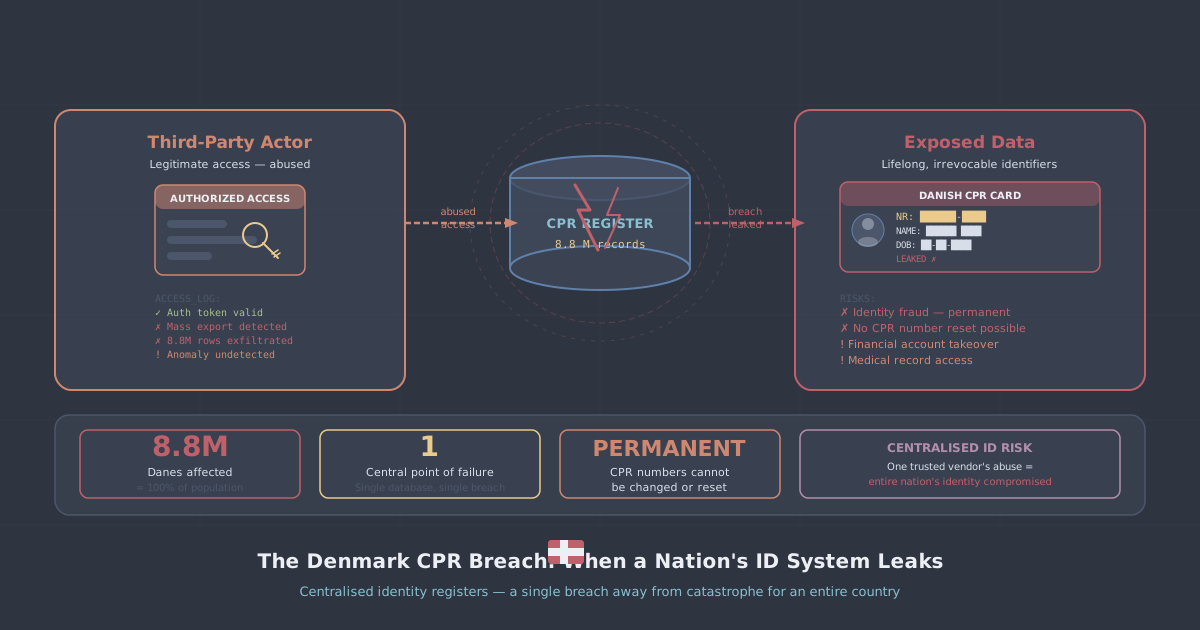
On 5 October 2026, Danish authorities disclosed one of the most consequential data breaches in European history. Unauthorised parties had abused a private company's lawful access to Denmark's Central Person Register—the CPR—to extract the names, addresses and national ID numbers of approximately 8.8 million people. That figure is not a rounding error. It represents essentially the entire registered population of Denmark.
The breach went undetected for roughly ten days before an internal alert, triggered by a surge in automated queries, flagged the activity on 2 October. By then, the damage was done. The implicated company's access has since been revoked, the Danish Data Protection Agency (Datatilsynet) has been notified, and a police investigation is under way. Danish authorities are now advising organisations across the public and private sectors to stop treating a CPR number as proof of identity—an instruction that, if you understand what the CPR number actually is, reveals just how serious this situation is.
This article looks at what happened, why the architecture of a centralised identity register made it possible, and what it tells us about the broader risks of building entire societies on a single, lifelong credential.
What is the CPR number, and why does losing it matter so much?
The CPR number (Det Centrale Personregister) is Denmark's national personal identifier, assigned at birth or upon registration in the country and held for life. It is not a password you can reset. It is not a card you can cancel and reissue. It is a permanent, ten-digit number tied to your legal identity, and it is used across almost every domain of Danish public and commercial life: tax collection, healthcare records, banking and credit, property transactions, digital government services, and more.
That breadth of use is precisely what makes it so valuable to criminals. A stolen credit card number can be cancelled. A stolen CPR number follows you indefinitely. Combined with a name and address—the other two pieces of data taken in this breach—it provides a ready-made profile for identity fraud, account takeover, and targeted phishing. Criminals do not need to guess or brute-force anything. They have the real data, for real people, validated against the most authoritative source in the country.
How the breach actually happened: third-party access abuse
The mechanism here is important, because it was not a conventional hack in the sense of exploiting a software vulnerability. The private company involved had legitimate, lawful access to query the CPR register. Such access is granted to various organisations for valid administrative purposes—verifying identities, checking addresses, confirming records. The abuse was the systematic, automated exploitation of that access at scale over a period of approximately ten days in September 2026.
This is sometimes called a data harvesting attack via authorised channels. The attacker does not break down the door; they walk through it using someone else's key. The technical controls in place were sufficient to permit the access but not to detect its abnormal volume until it was too late. The alert that eventually triggered the response on 2 October was a query-rate anomaly—a spike in automated lookups that exceeded what a legitimate business operation would plausibly require.
By the time the alert fired, the population of an entire nation had already been catalogued.
The single point of failure problem
Centralised identity registers are administratively efficient. A single authoritative source for national ID data means government departments, banks, and hospitals do not need to maintain their own parallel records. Verification is fast and reliable. The register becomes infrastructure in the truest sense—invisible, essential, and assumed to be permanent.
That efficiency is also a concentration of risk. When a register holds the definitive identity records for an entire population, and when access to that register is distributed to dozens or hundreds of third parties for legitimate purposes, the attack surface is not one system—it is every organisation that holds a key to that system. The security of the register becomes only as strong as the weakest access point among all those authorised parties.
There are further structural issues with lifelong, immutable identifiers:
- No revocation: A CPR number cannot be changed. Every person whose number was taken in this breach will carry compromised credentials for the rest of their life.
- Wide reuse: Because the CPR number is used across so many sectors, a single theft enables fraud across all of them simultaneously.
- Implicit trust: Systems that treat possession of a correct CPR number as evidence of identity—rather than as one factor among several—are now fundamentally vulnerable to anyone holding the breached data.
The last point is precisely why Danish authorities have issued guidance telling organisations to stop treating CPR numbers as proof of identity. That guidance is correct. It is also an acknowledgement that the number has lost much of its value as a security credential for an entire generation.
What detection latency reveals about monitoring
Ten days is a long time. The attackers had more than a week of unobserved, systematic access to a national population register before anyone noticed. The eventual detection came not from a security tool designed to catch malicious intent, but from a threshold alert on query volume—essentially, the system noticing that someone was asking too many questions, not that the questions were wrong.
This gap between access and detection is a recurring theme in large-scale data breaches. Perimeter defences—firewalls, authentication controls, access credentials—are designed to keep unauthorised parties out. They are much less effective at identifying when an authorised party is behaving in an unauthorised way. The discipline of behavioural monitoring and anomaly detection at the application layer is less mature and less universally applied than perimeter security, and this breach illustrates the cost of that gap.
A query that asks for one record is legitimate. A query that asks for eight million records, sequentially, over ten days, using the same access credentials, should trigger an alert on day one—or ideally should be architecturally impossible without explicit elevated authorisation for bulk export.
The fraud risk landscape for those affected
For the 8.8 million individuals whose data was taken, the practical risks are long-term and varied. In the near term, the most immediate concerns are:
- Account takeover: Any service that uses CPR number plus basic personal details for identity verification is now a target. Banks, insurers, and government portals that rely on this combination should be implementing additional authentication steps urgently.
- Targeted phishing: Criminals holding verified name, address and CPR data can construct highly convincing communications. An email or letter that gets your full name, correct address and national ID number right is easy to trust.
- Credit fraud: Credit applications in Denmark typically require CPR verification. With complete data available, fraudulent credit applications become straightforward.
- Social engineering: Customer service agents and call centre staff who rely on CPR numbers to confirm caller identity are now dealing with a population of callers who cannot safely be verified this way.
The longer-term risk is subtler. This data does not expire. It will circulate on criminal markets and be incorporated into fraud toolkits for years. The breach happened in 2026; the fraud it enables may still be occurring in 2030.
What this means for digital privacy more broadly
The Denmark CPR breach is not primarily a story about Denmark. It is a case study in what happens when a society concentrates identity verification into a single, immutable, universally reused credential, and then distributes access to that credential across a large ecosystem of third parties.
Many countries operate similar systems. The temptation to build efficient, centralised identity infrastructure is understandable. The administrative benefits are real. But the risk profile of such systems deserves serious scrutiny precisely because the downside scenario—comprehensive population-level data theft—is so severe and so difficult to remediate after the fact.
For individuals, the lesson is uncomfortable: your privacy can be compromised not by anything you did, but by the architectural decisions of the state systems you are enrolled in by default. You had no choice about having a CPR number. You had no say in which third parties were granted access to the register. And you have no ability to change your number now that it has been taken.
This is one of the reasons that limiting the personal data you expose online—through tools like a browser extension that reduces tracking and a VPN with a genuine no-logs policy—matters even when you have done nothing wrong. The question is not just what you share willingly, but what is held about you in systems you cannot control. Understanding your exposure at the network level is one layer of a broader approach to personal data hygiene—one that becomes more relevant, not less, as events like this breach demonstrate how fragile centralised data stores can be.
Practical steps for those affected and for organisations
If you are a Danish resident or hold accounts with Danish institutions, there are reasonable steps to take now:
- Enable stronger authentication everywhere you can. Any account that matters—banking, government portals, email—should have multi-factor authentication active. Do not rely on services that accept CPR plus basic details as sufficient verification.
- Be sceptical of unsolicited contact. If someone contacts you by phone, email or letter claiming to need verification of your details, treat it with suspicion regardless of how much they already seem to know about you.
- Monitor your credit file. Unexplained credit inquiries or new accounts you did not open are early indicators of identity fraud.
- Report suspicious activity promptly. Danish authorities have established reporting channels through this incident. Use them.
For organisations in Denmark and elsewhere that use national ID numbers as identity-verification tools, the guidance from Danish authorities is clear and correct: a static identifier that cannot be changed is not a reliable proof of identity when that identifier has been comprehensively compromised. Treat it as one input among several, and layer additional verification accordingly.
The broader lesson is structural. Centralised identity registers are enormously convenient and enormously fragile. The Denmark CPR breach did not require a sophisticated zero-day exploit or a state-level attacker. It required someone with a legitimate key, the patience to use it systematically, and ten unobserved days. That is a sobering benchmark for what it costs to compromise an entire nation's identity infrastructure—and a strong argument for designing systems where no single breach can achieve that outcome.