7 min read
When you connect to a VPN, a lot happens before your traffic reaches the server. Your device and the VPN server agree on how to establish the tunnel, how to encrypt your data, and how to verify that neither side has been tampered with. The rules governing all of that are the VPN protocol. Choose a different protocol and you get a meaningfully different experience—not just a different badge on a settings screen.
Most people never look at this setting. The app picks a default, the connection works, and that is the end of it. That is often fine—but understanding what your protocol is actually doing helps you make a deliberate choice rather than an accidental one, especially if you are troubleshooting slow speeds, getting blocked on a restrictive network, or trying to minimise battery drain on a mobile device.
This guide covers the protocols that matter in practice: what each one does, where it excels, and where it falls short. No marketing language—just the technical trade-offs.
What a VPN protocol actually controls
A VPN protocol is not just an encryption algorithm. It bundles together several things:
- Handshake mechanism—how your device and the server authenticate each other and agree on session keys.
- Encryption cipher—how your data is scrambled in transit.
- Transport layer—whether the tunnel uses UDP, TCP, or something else, and on which port.
- Key exchange and rotation—how often session keys change and how forward secrecy is maintained.
Different protocols make different decisions in each of these areas. Those decisions produce real-world differences in speed, battery life, reliability across network types, and resistance to detection.
WireGuard
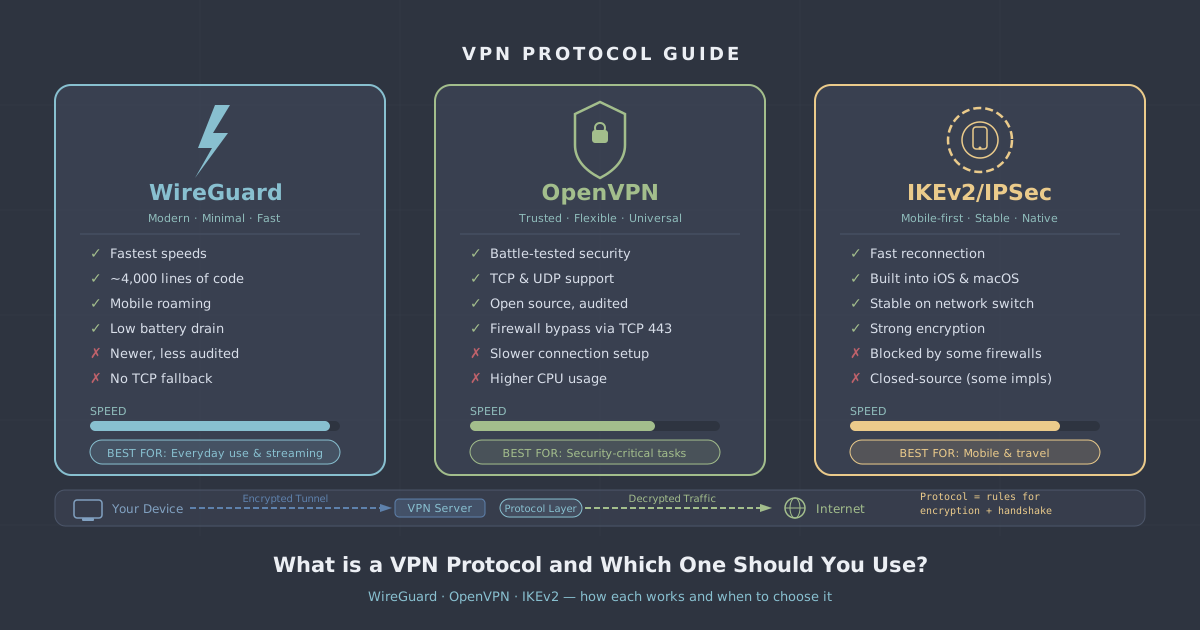
WireGuard is the most modern of the mainstream VPN protocols. Its codebase is around 4,000 lines—compared to hundreds of thousands for older protocols—which makes it far easier to audit and less likely to contain hidden vulnerabilities. It uses a fixed, carefully chosen set of cryptographic primitives: ChaCha20 for encryption, Poly1305 for authentication, Curve25519 for key exchange, and BLAKE2s for hashing.
In practice, WireGuard is fast. The lean codebase means it spends less time in the kernel, and the use of ChaCha20 (rather than AES) is especially beneficial on devices without hardware AES acceleration—most smartphones and budget laptops. Reconnection after a network change (switching from Wi-Fi to mobile data, for example) is almost instant because WireGuard is stateless by design.
There is one frequently cited caveat: WireGuard's original design assigns each client a static IP address on the server side. This creates a potential logging surface. PremierVPN addresses this by not persisting those address assignments—no connection logs are written to disk, consistent with our no-logs policy.
Best for: everyday use, fast speeds, mobile connections, lower battery drain.
WireGuard Stealth
Standard WireGuard traffic has a recognisable signature. A deep packet inspection (DPI) system can identify it and block it—exactly what happens on some corporate networks, in certain countries, and occasionally on hotel or airport Wi-Fi. WireGuard Stealth wraps the WireGuard tunnel in obfuscation so that the traffic looks like ordinary HTTPS from the outside.
The trade-off is a small performance overhead from the obfuscation layer. In most real-world conditions that overhead is negligible, but it is worth knowing it exists. You would not normally choose Stealth on a home broadband connection where nothing is trying to block you—you would switch to it when standard WireGuard is failing to connect.
Best for: networks that block standard VPN traffic, restrictive Wi-Fi environments.
OpenVPN
OpenVPN has been the de facto standard for VPN connections for well over a decade. It is battle-tested, extensively audited, and supported on virtually every platform and router that can run a VPN client. It uses the OpenSSL library, which means it benefits from a wide range of cipher options and a huge amount of accumulated cryptographic scrutiny.
OpenVPN can run over UDP (faster, lower overhead) or TCP (slower, but more reliable across restrictive networks that drop UDP). When run over TCP on port 443—the same port used by standard HTTPS—it is harder for firewalls to block without also breaking normal web browsing. That makes it a reasonable fallback in environments where WireGuard is blocked and Stealth feels like overkill.
The downside is performance. OpenVPN runs in userspace rather than the kernel, which means more context switches and more CPU overhead. On modern hardware with fast connections this is rarely a bottleneck, but on older devices or saturated networks you will notice the difference compared to WireGuard.
Best for: situations requiring a proven, widely compatible protocol; fallback when UDP-based protocols are blocked.
IKEv2 / IPsec
IKEv2 (Internet Key Exchange version 2) is a protocol developed by Microsoft and Cisco and standardised by the IETF. It almost always runs paired with IPsec for the actual data encryption, so you will often see it written as IKEv2/IPsec. It is built into the native network stacks of Windows, macOS, iOS, and Android, which means no third-party software is required to use it—your operating system handles the tunnel natively.
IKEv2 has a feature called MOBIKE (Mobility and Multihoming Protocol) that allows a VPN session to persist across network changes—useful on mobile devices. In practice, WireGuard handles this more elegantly, but IKEv2 was doing it years before WireGuard existed.
The main concern with IKEv2 is not technical—it is about trust. Because it was developed by large corporate and government-adjacent organisations, some privacy-conscious users prefer protocols with a more transparent provenance. That concern is reasonable but not a hard disqualifier. The cryptography itself is sound.
IKEv2 uses UDP ports 500 and 4500. These are well-known VPN ports and are blocked on many restrictive networks, which limits its usefulness in exactly the situations where you most need a working VPN.
Best for: native OS integration, stable corporate network environments, iOS when third-party apps are restricted.
VLESS + REALITY
VLESS+REALITY is a different category of protocol entirely. Rather than wrapping traffic in something that looks like HTTPS, it uses a technique called traffic borrowing: your VPN connection piggybacks on the TLS fingerprint of a legitimate, high-traffic website (the "front" domain). To a DPI system, your connection is indistinguishable from a real TLS handshake with that domain.
This makes VLESS+REALITY significantly more resistant to censorship than any obfuscated WireGuard or OpenVPN variant. It was designed specifically for environments—China, Iran, Russia—where state-level DPI is actively used to identify and block VPN connections. You can read more about how the protocol works in our detailed VLESS+REALITY protocol explainer.
The trade-off is complexity and availability. VLESS+REALITY requires a dedicated server—it cannot run on shared infrastructure the way WireGuard or OpenVPN can. PremierVPN offers it through PremierVPN X for macOS and PremierVPN X for Windows, which are separate apps built specifically for this use case.
Best for: heavily censored networks where all other protocols are blocked; high-risk environments where traffic must not be identifiable as VPN traffic.
How to choose
The honest answer is that for most people in most situations, WireGuard is the right choice. It is fast, modern, and well-audited. If you are on a personal VPN plan and connecting from a normal home or office network, there is little reason to change it.
The situations where you should actively think about your protocol are:
| Situation | Recommended protocol |
|---|---|
| Everyday use, home or office | WireGuard |
| Mobile, switching between Wi-Fi and data | WireGuard |
| Hotel, airport, or school Wi-Fi blocking VPN | WireGuard Stealth or OpenVPN (TCP, port 443) |
| Corporate network with strict firewall | OpenVPN TCP or WireGuard Stealth |
| China, Iran, Russia or similar censorship environments | VLESS+REALITY via PremierVPN X |
| Older device with limited CPU | WireGuard (ChaCha20 performs well without hardware AES) |
| iOS with restricted app installation | IKEv2 (native stack) |
One thing worth understanding: protocol choice does not change your fundamental VPN protections—your IP address is still masked, your traffic is still encrypted, DNS queries still go through the VPN tunnel. What changes is how the tunnel is constructed and how visible it is to outside inspection. Those details matter in specific contexts, but they are not the difference between being protected and unprotected.
A note on "automatic" protocol selection
Many VPN apps—including PremierVPN's—offer an automatic mode that picks the best protocol for your current connection. This works well as a default. The app will typically try WireGuard first, fall back to WireGuard Stealth or OpenVPN if the connection fails, and handle the switching without you needing to intervene.
Manual selection is useful when you already know what your network requires—if you travel to China regularly, you know in advance to reach for PremierVPN X rather than the standard app. If your office blocks UDP, you know to pin OpenVPN TCP before you arrive. Automatic mode is sensible; informed manual selection is better when you have the context to use it.
Summary
VPN protocols are not interchangeable labels. Each one makes distinct engineering choices that affect speed, battery consumption, compatibility, and resistance to blocking. WireGuard is the practical default for most users. OpenVPN and WireGuard Stealth handle restrictive firewalls. VLESS+REALITY handles state-level censorship. IKEv2 has a role where native OS integration matters.
If you are curious about whether you might be experiencing DNS or IP leaks regardless of protocol, PremierVPN's IP leak test is a straightforward way to check. And if you are connecting from a location with active censorship, the China VPN guide and Iran VPN guide go into more detail on what actually works in those environments.