8 min read
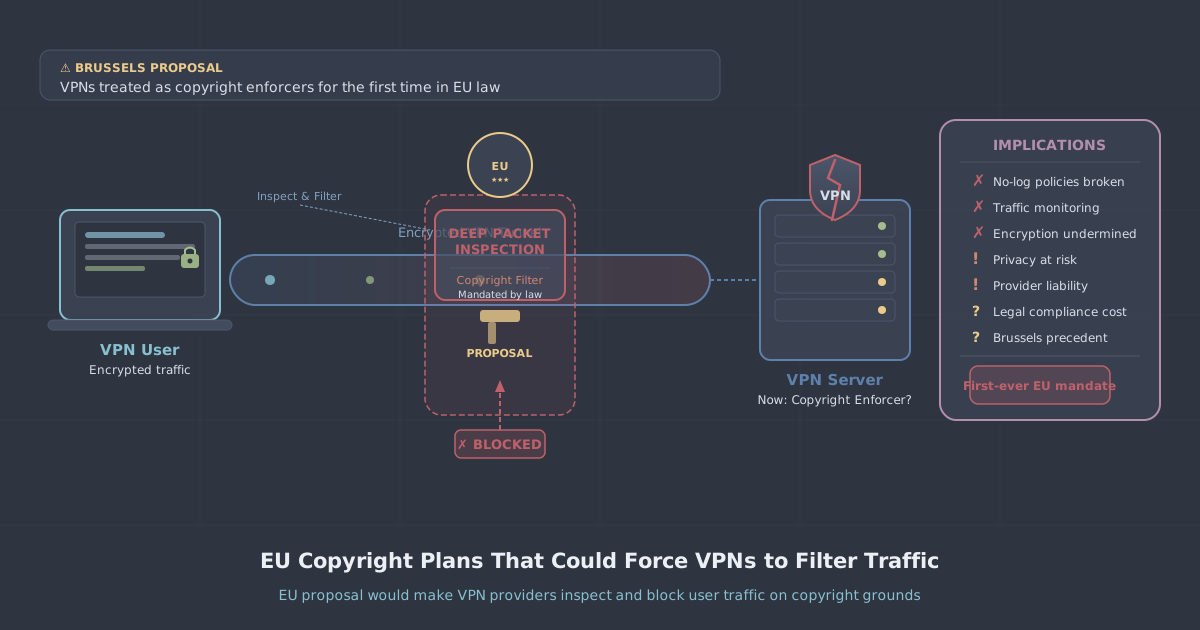
A legislative proposal quietly advancing in Brussels could fundamentally change what a VPN is legally required to do. The European Commission is weighing EU-wide anti-piracy blocking orders as part of a broader Copyright Package expected in Q2 2027—and according to warnings from the tech industry body CCIA's Disruptive Competition Project (DisCo), the system could sweep VPN providers into the role of copyright enforcers for the first time.
This is not a finalised law, and it is not certain to pass in its current form. But the direction of travel matters. If the proposal advances as described, it would represent a significant shift: rather than being treated as neutral infrastructure, VPNs could be compelled to actively check user traffic against blocklists. The public reaction period for the related EU Piracy Watch List closed on 28 October 2026, and the full package is due by mid-2027.
This article explains what is being proposed, how it could work technically, what precedents already exist in EU member states, and why a July 2026 European court ruling—widely reported as a win for VPNs—does not actually protect providers from an injunction-based enforcement system.
What the European Commission Is Considering
The Commission is examining a framework for EU-wide copyright blocking orders—a mechanism that would allow rights holders to obtain injunctions against intermediaries operating across the single market, rather than pursuing separate national cases in each member state. The goal, from a rights-holder perspective, is consistency: a site blocked in one EU country would be blocked across all of them through a single order.
The problem, flagged by DisCo in October 2026, is how broadly "intermediary" might be defined. Blocking orders in existing member-state systems have already reached beyond ISPs and DNS resolvers to include VPN providers. If the EU framework adopts similarly broad language, VPN services operating in or accessible from EU territory could find themselves named in injunctions.
Critically, the proposed mechanism does not necessarily require breaking encryption to function. Enforcement could be achieved by checking destination IP addresses or blocking DNS requests to listed domains—both of which can be done at the network level without decrypting the content of user sessions. That detail matters, because it removes one of the clearest technical objections to the scheme.
France and Spain Have Already Gone There
This is not a hypothetical future problem in every EU country. France and Spain already compel VPN providers to enforce site-blocking orders under national law. Spain's experience in particular offers a cautionary illustration of how these systems perform in practice.
LaLiga, the Spanish football league, has been the driving force behind an aggressive blocking campaign targeting pirate streams of live matches. The collateral damage has been severe: hundreds of thousands of legitimate domains have been taken offline as a side effect of overly broad blocking orders. Services with no connection to copyright infringement have found themselves unreachable in Spain because they shared infrastructure—IP addresses or hosting providers—with blocked targets.
That kind of overblocking is not an edge case. It is a predictable consequence of blocking at the IP or DNS level, where a single address can serve thousands of unrelated domains. An EU-wide system operating on the same principles would export that problem to every member state simultaneously.
Why the July 2026 Court Ruling Doesn't Settle This
In July 2026, the Court of Justice of the European Union ruled that VPN providers are "lawful technical tools" and are not liable for users who use them to bypass geo-restrictions. That ruling attracted considerable attention and was reasonably reported as a positive development for the VPN industry.
However, it does not provide the protection it might appear to. The ruling addressed liability—specifically, whether a VPN provider could be held responsible for what its users do. The answer was no. But an injunction-based blocking system does not require liability. It simply requires that a court order a party to take a particular action, regardless of whether that party has done anything wrong.
The distinction is legally meaningful. A water company is not liable if a tenant uses its pipes to water a cannabis crop, but a court could still order it to cut off supply to that address. The CJEU ruling leaves the injunction route entirely open, and the Commission's proposed framework appears designed to use exactly that route.
What "Filtering" Would Actually Mean for a VPN
To understand the practical implications, it helps to be precise about what traffic filtering at a VPN level could involve.
DNS-based blocking
Many VPN services operate their own DNS resolvers. A DNS blocklist would require the provider to return a null result—or a block page—when a user's device queries a listed domain name. This is technically straightforward to implement and does not require inspecting the encrypted payload of VPN traffic. It does, however, mean the VPN provider is actively deciding which domain names its users can resolve.
IP-based blocking
A VPN provider could also be required to drop or refuse to route traffic destined for listed IP addresses. Again, no encryption needs to be broken—the destination IP is visible in the packet header even inside a VPN tunnel. But as Spain's experience demonstrates, IP blocking causes significant collateral damage because IP addresses are shared resources.
Deep packet inspection
Some blocking regimes go further and require deep packet inspection (DPI), which does involve analysing traffic content. A properly implemented VPN tunnel—using WireGuard, OpenVPN, or similar—resists this. But the presence of DPI requirements in a legislative framework could create pressure to weaken encryption standards or introduce backdoors, even if that outcome is not explicitly stated in the text.
The first two approaches are the more immediate concern, because they are achievable without compromising encryption and are therefore more likely to survive legal and technical scrutiny as proportionate measures.
The Tension with EU Privacy Law
Any VPN filtering requirement would sit in awkward tension with the EU's existing data protection framework. The GDPR imposes strict limits on processing personal data, and a user's browsing destinations—even just the IP addresses they connect to—constitute personal data when they can be linked to an individual.
Implementing and logging compliance with a blocklist requires, at minimum, checking each connection attempt against a list and recording the outcome. Whether that constitutes unlawful processing under GDPR is a question that would need to be resolved, and the answer is not obvious. Rights holders and privacy advocates are likely to argue different sides of it vigorously once concrete legislative text is published.
There is also the question of the EU Charter of Fundamental Rights, which protects privacy and freedom of expression. Courts have previously required that blocking orders be targeted and proportionate. A system that produces the kind of collateral overblocking seen in Spain would face challenge on those grounds.
What Happens Next
The full EU Copyright Package is due in Q2 2027. Between now and then, the Commission will absorb feedback from the Piracy Watch List consultation—which closed on 28 October 2026—and from industry stakeholders across the chain. The eventual legislative proposal will need to pass through the European Parliament and the Council of the EU before it becomes law, a process that typically takes two to four years and during which the text can change substantially.
That timeline means there is genuine opportunity for the proposal to be amended, narrowed, or defeated. But it also means the pressure on VPN providers—particularly those serving EU users—will build steadily as the package progresses.
PremierVPN is a UK-based provider. The UK left the EU and operates under its own copyright enforcement regime, which currently does not impose equivalent obligations on VPN providers. That said, UK law has its own site-blocking mechanisms targeting ISPs, and the regulatory landscape can evolve. We will continue to monitor both the EU process and any parallel UK developments.
Our Position and What You Can Do
We believe a VPN is a privacy tool, not a surveillance or enforcement mechanism. Our no-logs policy reflects a straightforward principle: we do not monitor what our users do, and we should not be required to. Filtering user traffic against a government-mandated blocklist is incompatible with that principle, and we would oppose any requirement to do so.
If you want to understand more about how a VPN works and what it can and cannot protect you from, our introduction to VPNs covers the fundamentals. If you are concerned about your own exposure to DNS leaks or IP leaks regardless of any regulatory change, our IP leak test lets you verify that your connection is behaving as expected.
For users in countries that already operate aggressive blocking regimes—or where internet access is restricted more broadly—our apps support VLESS+REALITY, a protocol designed to resist deep packet inspection on restrictive networks. You can read more about how it works in our VLESS+REALITY overview.
The most useful thing any interested person can do right now is stay informed and, where possible, engage with the legislative process. The European Parliament's committees on civil liberties (LIBE) and legal affairs (JURI) will both have roles in shaping the final text. MEPs respond to constituent correspondence, particularly when it is specific and well-reasoned rather than form-letter submissions.
We will publish a further analysis once the Commission releases draft legislative text. Until then, treat reporting on this topic—including this article—as an account of a proposal in motion, not a settled outcome.