8 min read
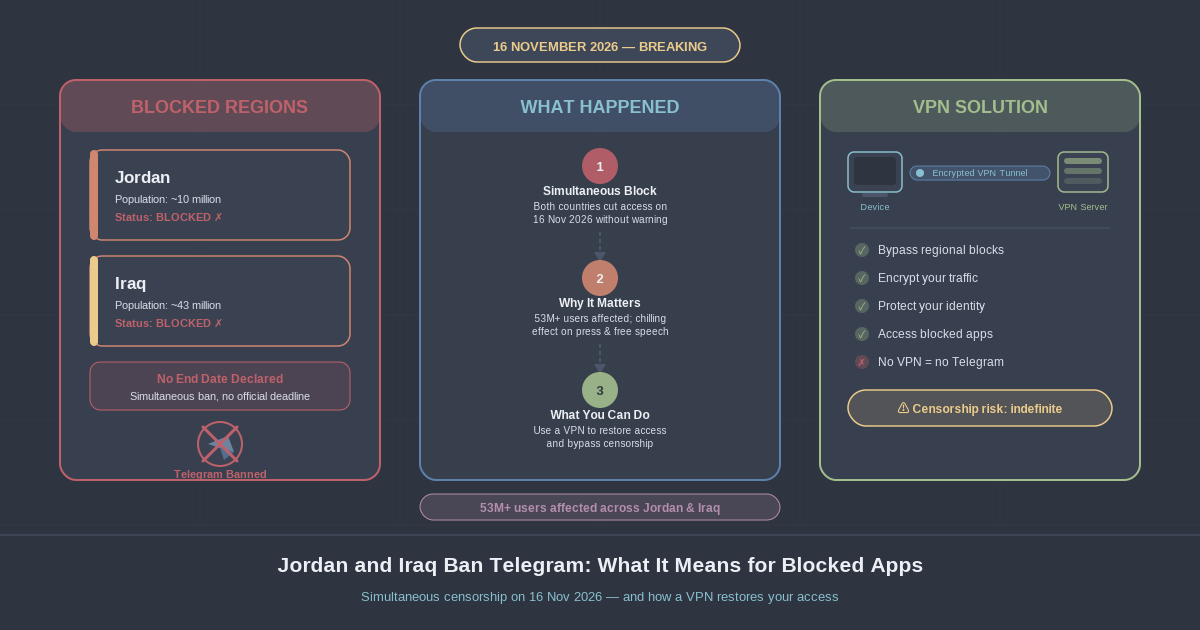
On 16 November 2026, two countries blocked Telegram on the same day. Jordan's Public Security Directorate announced a nationwide ban, citing cybercrime, extortion, and extremism concerns linked to a deadly attack on a Greek Orthodox church in Karak the previous October that killed nine people. Hours later, Iraq's Communications and Media Commission issued its own order, citing Telegram's failure to comply with national laws on extremism and hate speech.
Neither government has announced a timeline for lifting the blocks, nor what conditions Telegram would need to meet for access to be restored. Millions of people in both countries lost access to a messaging platform they relied on for personal communication, work, and news—with no warning and no clear path back.
This article looks at what happened, what the data shows about how people responded, and why having a VPN already set up before a block happens makes a significant practical difference.
What Happened on 16 November 2026
Jordan's block came directly from the Public Security Directorate, framing it as a law enforcement and national security measure. The October attack in Karak gave the decision an immediate political context, though Telegram has been a persistent concern for Jordanian authorities for some time before that. Iraq's order came from its Communications and Media Commission, which has previously threatened Telegram with restrictions over content moderation disputes.
The blocks were implemented at the ISP level, meaning Telegram's servers became unreachable from within both countries regardless of which carrier a user was on. The app itself still works; the connection to it is severed at the network layer.
Telegram has not, as of publication, made a public statement indicating it will negotiate with either government to restore access. This matters because it suggests the blocks may remain in place for an extended period—possibly indefinitely.
The Surge in VPN Sign-Ups Tells Its Own Story
When app blocks land, people look for workarounds fast. One provider's censorship observatory recorded a 450% spike above baseline in VPN sign-ups in Jordan in the immediate aftermath of the announcement. In Iraq, the figure was even sharper: a 1,200% spike above baseline.
These numbers are striking, but they also point to a problem. A surge in VPN sign-ups after a block is announced means people are trying to install and configure a VPN at the exact moment when doing so is most difficult. App stores can become temporarily inaccessible. VPN provider websites are sometimes blocked in the same sweep as the target platform. Download speeds slow as network demand spikes.
The people best placed to keep using Telegram in Jordan and Iraq on 16 November were those who had already installed a VPN before the ban. Everyone else faced a scramble.
Jordan Has Done This Before
This is not Jordan's first abrupt digital block. Discord was blocked in October 2025. TikTok was banned in December 2022. Each time, the pattern was the same: a sudden government order, no prior public consultation, an unspecified duration, and an immediate rush to find VPN access.
The pattern suggests that in certain countries, app blocks are not exceptional events—they are part of a recurring policy toolkit. If you live in or travel regularly to a country with a history of platform restrictions, that history is a reasonable basis for taking precautions.
It is also worth noting that the targets vary. TikTok, Discord, and Telegram serve quite different purposes. The common thread is not the specific platform but the government's willingness to act quickly and unilaterally when it decides a platform poses a problem. That means no particular category of app is safe from restriction.
Why "I'll Install a VPN If I Need One" Doesn't Work
The obvious response to events like these is to plan ahead. But the planning step that matters most is often skipped: actually installing and testing the VPN before you need it.
When a block goes live, several things can happen simultaneously:
- VPN provider websites may themselves be inaccessible from inside the affected country, making it impossible to sign up or download the app.
- Apple's App Store and Google Play can restrict VPN apps in certain regions, meaning the app you want may not be listed in the local store at all.
- Even if you can reach the download, server capacity on VPN networks surges as thousands of people connect at once.
- Configuration takes time—especially for protocols that work reliably in restrictive network environments, which are not always the default setting.
None of these obstacles are insurmountable, but they are all avoidable if the app is already installed and you have already confirmed it connects successfully.
What Makes a VPN Work in Restrictive Networks
Standard VPN protocols—WireGuard and OpenVPN being the most common—are effective in most circumstances, but deep packet inspection (DPI) used by some governments can identify and block them. When that happens, the solution is a protocol designed to disguise VPN traffic as ordinary HTTPS web browsing.
PremierVPN's apps include several options for exactly this situation:
- WireGuard Stealth—obfuscates WireGuard traffic to make it harder to detect and block.
- VLESS+REALITY—a modern protocol that routes traffic through what appears to be a legitimate HTTPS connection. It was built specifically for networks that actively try to suppress VPN use. PremierVPN includes this in its main apps for Windows, macOS, iOS, Android, and Ubuntu.
If you are in a country with active DPI—or travelling to one—it is worth switching to one of these before you arrive, confirming the connection works, and then leaving that setting in place. For more detail on how VLESS+REALITY works, see our protocol overview.
Practical Steps to Take Now
If you are in Jordan, Iraq, or any country where platform blocks have happened before, here is what is worth doing today rather than the day a block is announced:
- Install the app now. Download PremierVPN for your platform—Android and iOS are most relevant for mobile users who rely on messaging apps. The Windows and macOS apps cover desktop use.
- Connect once and confirm it works. A VPN you have installed but never tested is not a contingency—it is a file taking up space. Connect, check your IP address changes using our IP leak test, and disconnect. That's the baseline you need.
- Test WireGuard Stealth or VLESS+REALITY. Switch protocol in the app settings and confirm you can still connect. This takes two minutes when you are relaxed; it is significantly more stressful when you are trying to do it after a block has just landed.
- Keep the app updated. Protocol support and obfuscation techniques improve over time. An outdated app may not have the latest capabilities.
A Note on What VPNs Don't Fix
A VPN restores access to blocked services by routing your traffic through a server in a country where the service is not blocked. It does not change the legal situation in the country you are in. In some jurisdictions, using a VPN to circumvent a government-mandated block may itself carry legal risk. That is a local legal question, not a technical one, and it is worth being aware of the distinction.
It is also worth being clear about what PremierVPN's no-logs policy means in this context: we do not retain records of which sites or services you connect to. That matters when you are using a VPN in a sensitive environment, because there is nothing logged on our end that could be requested or compelled.
The Bigger Picture
The simultaneous blocks on Telegram in Jordan and Iraq on 16 November 2026 are a sharp illustration of how quickly digital access can change. Telegram had hundreds of millions of users globally and significant adoption in both countries. It disappeared from both networks in the space of a government announcement.
The lesson is not specific to Telegram, and it is not specific to Jordan or Iraq. Any platform, in any country, is potentially one policy decision away from becoming inaccessible. The practical response to that reality is straightforward: install a VPN, test that it connects, and familiarise yourself with the settings before you need them under pressure.
If you are unsure which plan suits your needs, the Personal VPN covers the essential use case described in this article. For travellers moving between countries with different levels of restriction, the Travel VPN page outlines what to consider.