8 min read
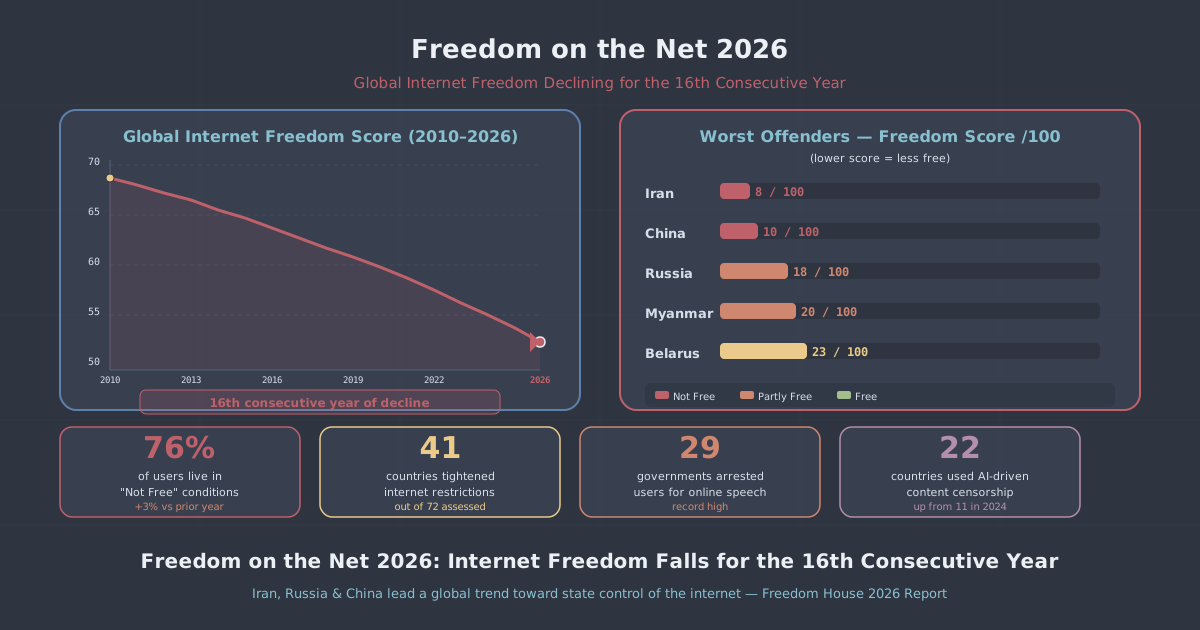
On 22 October 2026, Freedom House published its annual Freedom on the Net report, subtitled Seismic Shifts on the Global Internet. The headline finding is stark: global internet freedom has declined for the 16th consecutive year. This is not a blip or a statistical quirk—it is a long, unbroken trend of governments restricting, surveilling, and weaponising the internet against their own populations.
The report assessed 38 countries, covering events between June 2025 and May 2026. Of those, conditions deteriorated in 16 and improved in only 8. For anyone who takes online privacy seriously, the details behind those numbers are worth understanding—not to induce panic, but to make informed decisions about how you protect yourself online.
This article unpacks the key findings: which countries are driving the decline, what new threats are emerging, and why a trustworthy VPN remains one of the most practical tools available to ordinary people navigating an increasingly restricted internet.
Iran: The Sharpest Single-Year Drop on Record
Iran recorded the most dramatic deterioration of any country assessed this year. Its score fell from 13 to just 9 out of 100, placing it alongside China and Myanmar at the very bottom of the rankings. To put that in context, a score of 9 out of 100 means almost total absence of internet freedom by Freedom House's methodology.
The most alarming specific finding concerns a nationwide internet shutdown that Freedom House describes as approximately 88 days in duration—the longest it has ever recorded in the history of the report. An 88-day blackout does not merely inconvenience people; it cuts off access to news, communication with family abroad, banking, medical information, and the tools citizens use to document what is happening around them.
Iran has long been one of the most restrictive environments for internet users. If you are looking for guidance on using a VPN in Iran, our dedicated article on the best VPN for Iran covers the specific challenges and what to look for in a tool capable of operating under those conditions. PremierVPN supports VLESS+REALITY, a protocol specifically designed to resist the kind of deep packet inspection that Iran and similar states rely on to identify and block VPN traffic.
Russia: Building Walls Around Its Population
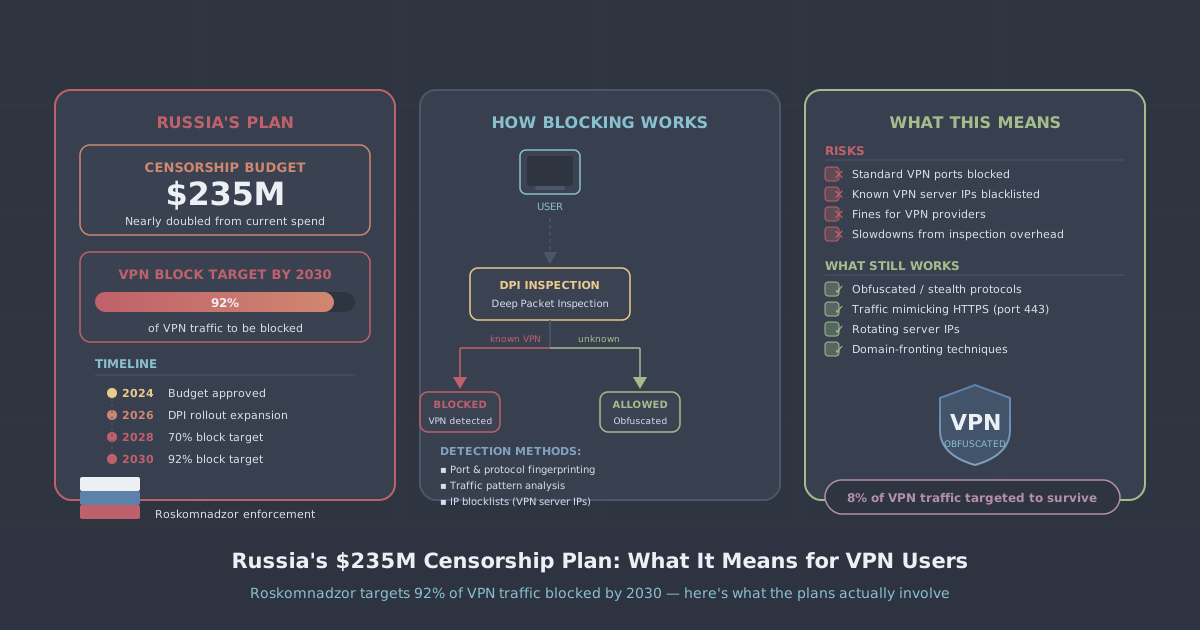
Russia features prominently in the 2026 report, and the picture is one of systematic, infrastructure-level control rather than ad hoc censorship. Authorities expanded internet shutdowns across at least 38 regions during the assessment period, and they have been steadily consolidating control over internet service providers as part of a broader strategy to isolate Russian users from the global internet.
This is worth dwelling on. Blocking individual websites or throttling specific services is one thing. Restructuring the ISP ecosystem so that the state can flip a switch and disconnect entire regions is a fundamentally different level of control. It reflects a deliberate, long-term project—and the 38-region figure suggests it is well advanced.
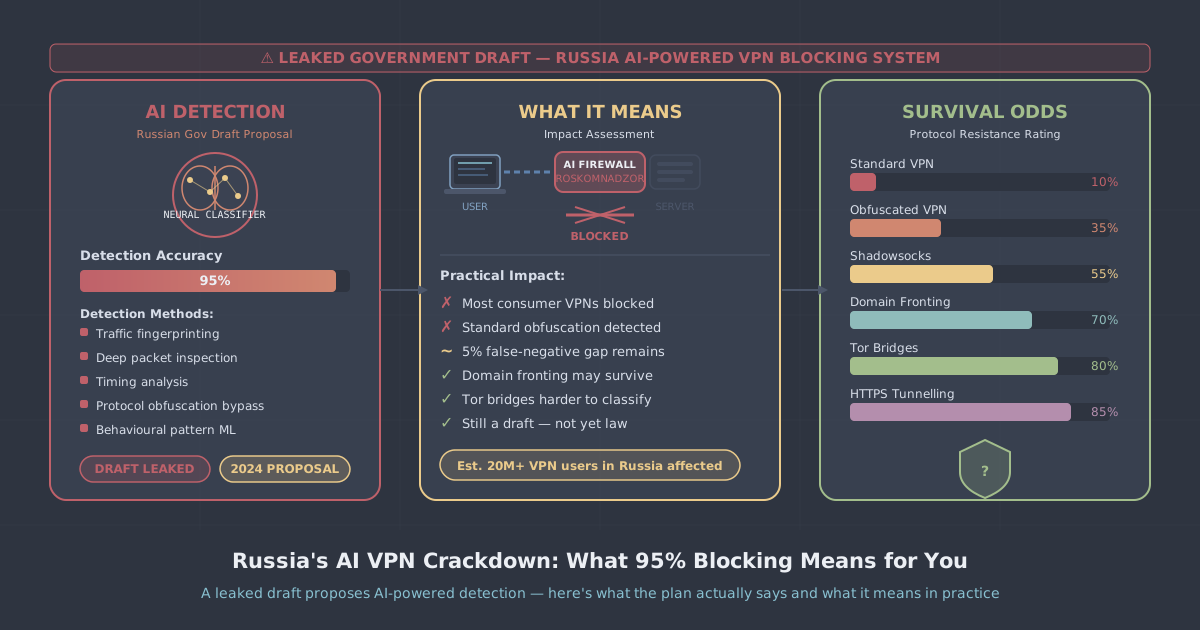
For Russian internet users, the implications are severe. For anyone outside Russia who communicates with people there, travels there, or simply monitors what is happening there, it is a reminder that access to an open internet is not a given. PremierVPN's VLESS+REALITY support is directly relevant here; the protocol was designed to be indistinguishable from ordinary HTTPS traffic, making it considerably harder to detect and block than conventional VPN protocols.
China and Myanmar: Permanent Fixtures at the Bottom
China and Myanmar remain at the very bottom of the rankings alongside Iran. China's position will surprise no one who has followed internet policy in recent years—the country operates the most extensive censorship infrastructure in the world, commonly referred to as the Great Firewall. If you are planning to travel there or need a reliable tool for use within the country, our article on the best VPN for China sets out the practical realities in detail.
Myanmar's continued placement at the bottom reflects the military junta's aggressive use of internet shutdowns and surveillance since the 2021 coup. The pattern across all three countries is consistent: authoritarian governments treat the internet primarily as a threat to be managed rather than an infrastructure to be maintained for the benefit of their populations.
A New Threat: Age Verification Laws and Surveillance by the Back Door
One of the most significant sections of the 2026 report addresses a trend that is not confined to authoritarian states. Age-verification laws—typically framed as child-protection measures requiring identity checks before accessing social media—are identified as a growing new threat to internet freedom globally.
The concern is specific and credible. To verify a user's age, platforms must collect sensitive personal data: facial images, government-issued ID documents, or both. Freedom House warns that repressive governments are actively seeking to exploit such requirements to expand surveillance capabilities. The logic is straightforward: once a legal framework exists that compels platforms to collect and store identity documents, those governments have a ready-made mechanism to demand access to that data.
This matters even in democratic countries, because the data collected under one legal regime does not stay neatly within that regime's borders. Centralised identity databases are attractive targets—for state actors, for criminal hackers, and for governments whose policies may change over time. The report's warning about age-verification laws is a reminder that surveillance infrastructure built for ostensibly benign purposes rarely stays benign indefinitely.
Why VPNs Remain a Practical Response
It would be dishonest to suggest that a VPN is a complete solution to state-level internet restriction. In countries like China and Iran, authorities are sophisticated enough that a poorly chosen or poorly configured VPN will fail. That said, a well-designed VPN with the right protocol support is still one of the most effective tools available to ordinary users—and the Freedom on the Net findings reinforce rather than undermine that conclusion.
Here is what a VPN concretely does in these contexts:
- Encrypts your traffic so that your ISP—which may be state-controlled—cannot read what you are doing or where you are going.
- Masks your IP address, replacing it with one from a server in a different jurisdiction, making it harder to build a profile of your browsing behaviour.
- Routes around blocks by tunnelling through restrictions that operate at the DNS or IP level.
- With the right protocol—such as VLESS+REALITY—disguises VPN traffic itself, making it harder for deep packet inspection systems to identify and block the connection.
PremierVPN supports WireGuard (the default for most users, offering excellent speed and security), WireGuard Stealth, OpenVPN, and VLESS+REALITY, all built into the main apps. If you are using a restrictive network—whether a national firewall, a corporate network, or a hotel system—you can switch protocols within the app without needing separate software.
For a broader explanation of how VPNs work and what they actually protect, our introduction to VPNs is a good starting point. And if you want to understand how VPNs compare to other privacy tools, our piece on VPNs vs proxies vs Tor covers the trade-offs honestly.
The Bigger Picture: 16 Years and Counting
Sixteen consecutive years of decline is not an accident. It reflects a structural shift in how governments view the internet—from something that happened to exist and that they tolerated, to something that poses a direct challenge to their authority and that they are now actively working to bring under control.
The tools and techniques vary: outright shutdowns in Iran and Myanmar, ISP consolidation in Russia, deep filtering in China, surveillance-enabling legislation in more open societies. But the direction of travel is consistent across all of them.
Freedom House's data covers 38 countries. The world has roughly 195. The report's findings almost certainly understate the global picture.
What You Can Do
The Freedom on the Net report is sobering, but it is not a counsel of despair. Understanding the landscape is the first step to navigating it sensibly. Here are some practical actions worth considering:
- Use a no-logs VPN that does not store records of your activity. PremierVPN's no-logs policy means there is nothing to hand over even if someone asks.
- Choose the right protocol for your context. WireGuard is fast and secure for everyday use. VLESS+REALITY is the right choice if you are in or travelling to a country with active VPN blocking.
- Check for leaks. A VPN that leaks your real IP address offers little protection. Use our IP leak test to verify your connection is actually secure.
- Be cautious about age-verification requirements. Before submitting identity documents to any platform, consider what data is being collected, where it is stored, and under which legal jurisdiction it sits.
- Stay informed. The Freedom on the Net report is published annually and is freely available. Reading it takes an hour and provides a grounded, evidence-based picture of how internet freedom is changing.
The trajectory documented in this year's report is concerning. But the response to a more restricted internet is the same as it has always been: use good tools, understand their limits, and make deliberate choices about your digital life rather than leaving them to chance.