8 min read
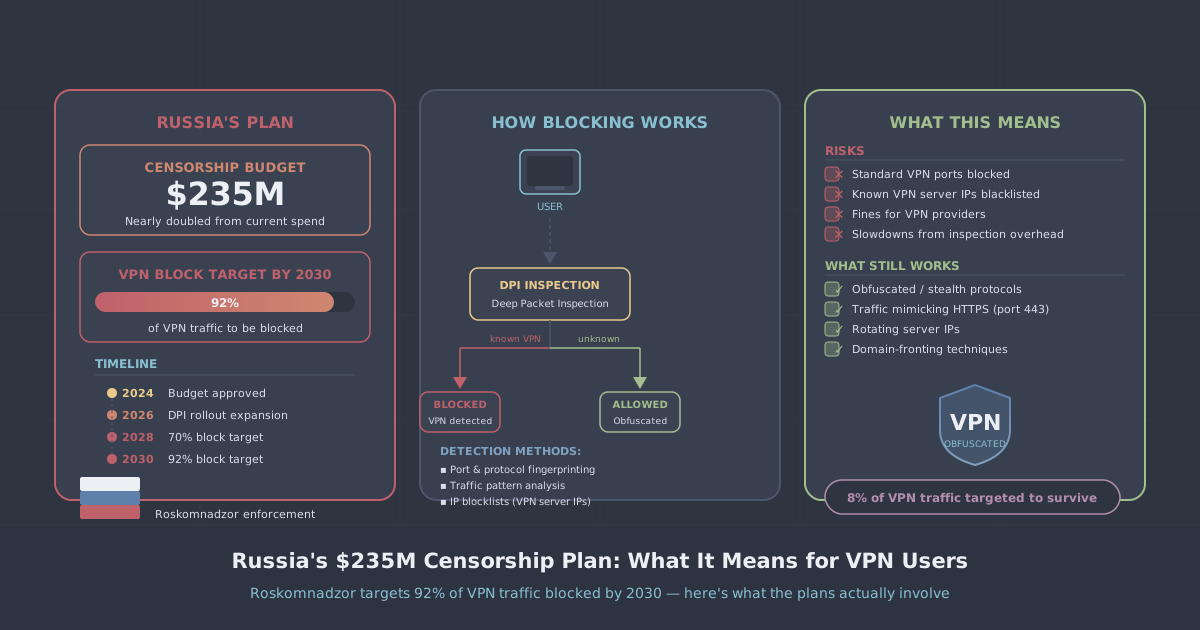
Russia has published what is, by some margin, the most detailed and well-funded anti-VPN roadmap any government has ever put in writing. A draft federal budget for 2027, uncovered by independent outlet Verstka and corroborated by The Moscow Times, reveals that funding for the country's core internet filtering infrastructure is set to nearly double—rising from 9.87 billion rubles to 19.87 billion rubles, roughly $235 million for that year alone. Total censorship infrastructure spending across the 2027–2029 period is projected at close to 60 billion rubles.
This is not a vague political signal. It is a line-item budget allocation, with a specific technical target attached: Roskomnadzor, Russia's telecommunications regulator, has been set a formal goal of achieving 92% VPN-blocking efficiency by 2030. For anyone living in or travelling to Russia, or anyone who studies how governments suppress open internet access, this deserves careful attention.
This article breaks down what Russia is actually building, how it plans to block VPN traffic, what the 92% figure really means, and what technical approaches remain viable given the trajectory of these measures.
The ASBI system and what doubling its budget buys
The funding is directed at Russia's Automated System for Ensuring the Security of the Internet, known by its Russian acronym ASBI. This is the technical backbone of Russia's sovereign internet project—the infrastructure that allows Roskomnadzor to intercept, inspect, throttle, and block traffic at the network level, independently of individual ISPs.
The revised budget is intended to increase ASBI's throughput capacity by 2.5 times, bringing it to 954 Tbit/s. To put that in context, this is not a system designed to block a handful of websites. It is infrastructure built to perform deep packet inspection (DPI) at a scale that covers the entire Russian internet, in real time, across all carriers simultaneously.
DPI at this scale is what allows authorities to identify VPN traffic not by destination IP address—which can be changed easily—but by the statistical fingerprint of the traffic itself: packet timing, size distributions, handshake patterns, and protocol behaviour. A WireGuard tunnel looks different from HTTPS browsing at the packet level, and modern DPI equipment is designed to spot that difference.
The 92% target: what it means in practice
The explicit goal of blocking 92% of VPN traffic by 2030 is notable precisely because it is a percentage rather than an absolute number. It implies that Russian authorities are not expecting—or even attempting—to achieve total VPN suppression. They appear to be targeting the mainstream: the standard WireGuard, OpenVPN, and commercial VPN protocols that the majority of users rely on.
The remaining 8% is likely to represent traffic that is either indistinguishable from ordinary HTTPS or uses active-probe-resistant obfuscation techniques. This is an important distinction. It means that the risk is not evenly distributed across all VPN technology. Standard, unobfuscated VPN protocols are the primary target. Protocols specifically designed to resist fingerprinting—and to mimic legitimate traffic convincingly—sit in a fundamentally different category.
Russia has already blocked over 250 VPN services inside the country. ISPs have also shifted tactics in recent years, moving away from hard blocks toward targeted throttling: deliberately degrading VPN connection speeds to the point where the service becomes functionally unusable, without triggering the kind of public backlash that an outright block might cause.
The data surcharge and 'Anti-Fraud 3.0'
Beyond the technical infrastructure, Russia is pursuing two additional levers that deserve attention.
A financial penalty for heavy international traffic
The government is discussing a financial surcharge on users who consume more than 50GB of international traffic on 5G networks. This measure is explicitly aimed at deterring heavy VPN use, since VPN traffic is typically routed through servers outside Russia and therefore counts as international data. The proposal treats volume as a proxy for VPN usage—crude, but potentially effective as a deterrent for casual users.
Anti-Fraud 3.0 and the hosting ban
A proposed legislative package referred to as 'Anti-Fraud 3.0' would prohibit domestic Russian hosting providers from serving any client that hosts VPN services or proxies—with potential bans of up to a year for non-compliance. This targets the supply side of the VPN infrastructure equation. If Russian-registered hosting companies cannot legally support VPN infrastructure, it becomes significantly harder to operate VPN servers with Russian IP addresses, which some users rely on for specific access requirements.
How this compares to what China has built
China's Great Firewall is the obvious reference point, and the comparison is instructive. China has spent decades iterating on DPI-based VPN detection, and it remains the most technically sophisticated censorship system in the world. It has not achieved 100% VPN blocking—not even close—because obfuscation technology has kept pace with detection capability. What it has achieved is making unobfuscated VPN use unreliable enough that casual users give up.
Russia appears to be pursuing the same outcome by the same method, but on an accelerated timeline backed by substantial funding. The 92% target by 2030 maps almost exactly onto the practical reality China has achieved: mainstream protocols blocked or throttled into uselessness, while traffic that looks like ordinary HTTPS continues to pass through.
For a deeper look at how to approach VPN use in high-restriction environments, see our guide to VPN use in Iran and our dedicated article on VPN use in China, both of which cover the specific obfuscation requirements these environments demand.
Which VPN protocols are most at risk
Not all VPN protocols carry the same level of risk under a DPI-heavy regime. The distinction matters.
| Protocol | Fingerprinting risk | Notes |
|---|---|---|
| WireGuard (standard) | High | Distinctive handshake; easily identified by DPI |
| OpenVPN (standard) | High | Well-known TLS fingerprint; commonly targeted |
| WireGuard Stealth | Medium | Obfuscates WireGuard traffic; harder to fingerprint |
| VLESS+REALITY | Low | Mimics genuine TLS to a real domain; highly resistant to active probing |
VLESS+REALITY is specifically designed to defeat the type of DPI and active-probe detection that well-funded censorship systems rely on. Rather than simply encrypting or scrambling traffic, it impersonates a real TLS connection to a legitimate domain. A censor inspecting the traffic sees what appears to be an ordinary HTTPS session. This is why it is the recommended protocol for users in China, Iran, and increasingly Russia.
PremierVPN supports VLESS+REALITY natively within its main apps—no separate configuration or third-party tools required. You can read more about how the protocol works in our VLESS+REALITY explainer.
What this means if you are travelling to Russia or connecting from there
If you are planning to travel to Russia, or you have colleagues, family, or business operations there, the practical implications are straightforward.
- Standard VPN configurations will become increasingly unreliable. Throttling is already being used against mainstream protocols, and ASBI's expanded capacity will make this more systematic.
- Download and configure your VPN before you arrive. App stores may restrict VPN applications once you are on a Russian network. Having the app installed and tested in advance removes this risk.
- Switch to VLESS+REALITY as your default protocol in Russia. This is available in the PremierVPN apps for Windows, iOS, and Android, among others, and can be selected from the protocol settings without any manual configuration.
- Be aware of the proposed data surcharge. It has not been enacted yet, but if the 50GB international traffic threshold becomes law, heavy VPN users on 5G networks may face additional costs.
The broader picture
Russia's plan is significant not just for what it will do to internet access inside Russia, but for what it signals more broadly. A government publishing a specific, funded, multi-year roadmap for blocking 92% of VPN traffic by a defined date is a different order of seriousness from vague statements about internet sovereignty. This is procurement, engineering, and legislation working in concert.
It also confirms something that has been true of censorship systems for years: the arms race between DPI-based blocking and obfuscation-based circumvention is ongoing, and the outcome depends heavily on which protocols users actually have access to. Governments with the resources to deploy sophisticated DPI can suppress standard protocols at scale. They have consistently struggled with traffic that genuinely resembles ordinary HTTPS—and Russia's own 92% target implicitly acknowledges that the remaining 8% is expected to remain out of reach.
If you are assessing your options for accessing the open internet from Russia, the immediate practical step is to ensure you have a VPN configured with VLESS+REALITY before you need it. Our no-logs policy means PremierVPN retains no records of your activity, connection times, or IP addresses—which matters considerably when operating in an environment where surveillance infrastructure is expanding at this pace.