8 min read
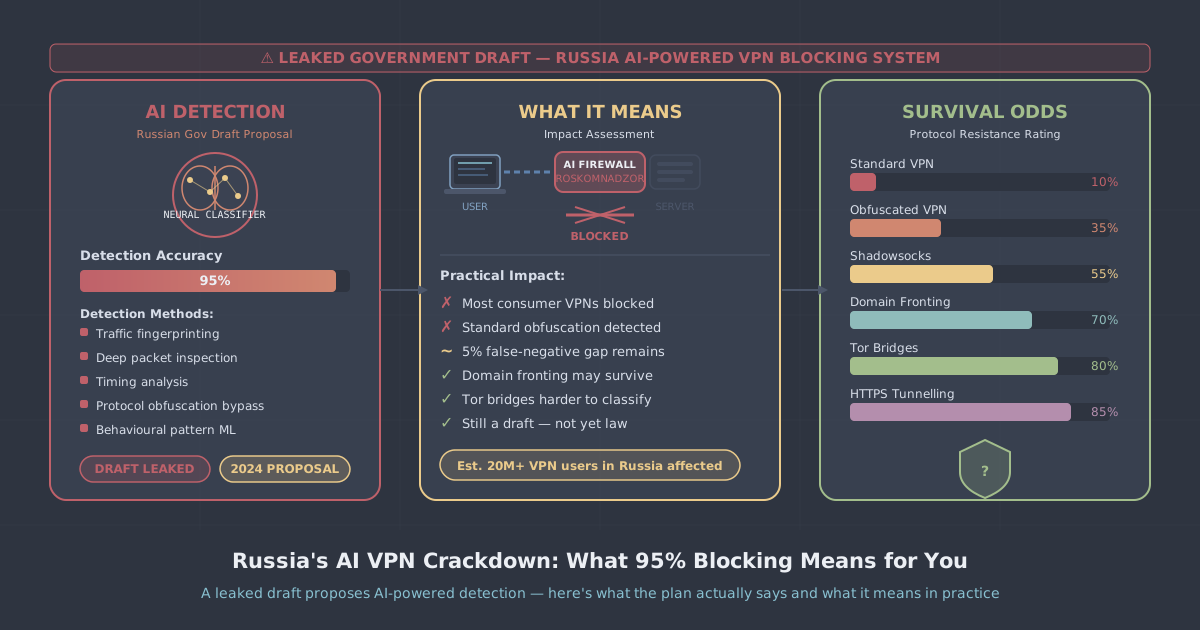
On 16 October 2026, Russian business daily Kommersant reported on a leaked draft of Russia's national AI development plan through 2030. Buried inside it was a proposal that will concern anyone using a VPN to access the open internet from Russia: the use of artificial intelligence to identify and block VPN traffic, with drafters claiming up to 95% effectiveness. It is the most technically ambitious censorship proposal Russia has put in writing so far.
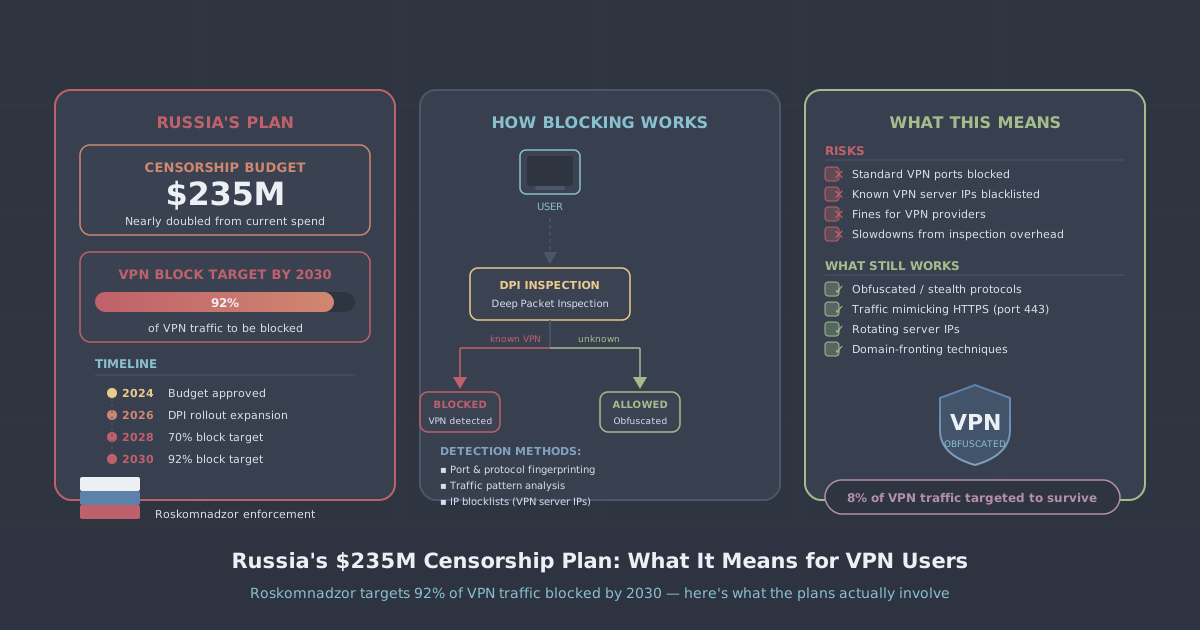
Russia's Digital Development Ministry subsequently told Kommersant that this specific measure does not appear in the current version of the draft. That is worth noting, but it does not make the proposal irrelevant. The fact that it was drafted at all, and that it sits alongside a separately announced plan to double Russia's internet censorship budget to $235 million in 2027, tells you a great deal about the direction of travel.
This article explains what the proposed system would actually do, how realistic the 95% claim is, and what it means for the protocols and tools that matter most when a network is actively trying to identify your VPN traffic.
What the draft plan actually proposes
The leaked draft described an AI system that would analyse the traffic characteristics of 70% of VPN services targeted for censorship. The signals it would evaluate include:
- Packet size and timing—the distribution of packet lengths and the intervals between them
- Session duration—how long connections last and whether they follow patterns typical of VPN tunnels
- Traffic ratios—the balance between upload and download volumes within a session
- Neighbouring IP addresses—whether the IPs surrounding a connection are associated with VPN infrastructure
Taken together, these are the core inputs for a technique called deep packet inspection (DPI) combined with traffic fingerprinting. DPI is not new to Russia—Roskomnadzor has been deploying DPI hardware since at least 2019. What the draft proposes is applying machine learning on top of existing DPI infrastructure to improve classification accuracy and reduce the manual rule-writing that current systems require.
The draft claimed 95% effectiveness. Industry sources quoted by Kommersant were sceptical, warning that deploying AI at this scale would likely produce significant false positives—legitimate traffic being misclassified and blocked. That is a real and well-documented problem with traffic classification systems, and one that becomes politically awkward when it starts interrupting ordinary business communications.
How traffic fingerprinting works—and where it struggles
Every protocol leaves a pattern. Standard HTTPS connections have one shape; a WireGuard tunnel has another; an OpenVPN connection over UDP has another still. Traffic fingerprinting attempts to match observed patterns against known signatures. It works reasonably well when the VPN is making no effort to disguise itself.
The difficulty arises when a VPN protocol is specifically designed to look like something else. Modern obfuscation techniques can reshape packet sizes, introduce artificial timing variation, and make a VPN tunnel's traffic profile closely resemble ordinary HTTPS or even noise. This is exactly what protocols such as VLESS+REALITY are built to do. VLESS+REALITY was developed in response to China's censorship apparatus—arguably the world's most advanced—and it works by borrowing the TLS fingerprint of a real, high-traffic domain. To an observer performing DPI, the connection looks indistinguishable from a legitimate visit to that domain.
This is why the 95% figure in the Russian draft deserves scrutiny. That number likely applies to VPN protocols that make no attempt at obfuscation: standard WireGuard, standard OpenVPN, commercial VPN services that use predictable port ranges and known server IP blocks. Against purpose-built obfuscation, the accuracy drops substantially—and trying to improve it risks the false positive problem the industry sources flagged.
The infrastructure behind the ambition
The AI proposal does not exist in isolation. Russia has already announced plans to expand its traffic-filtering infrastructure 2.5-fold, reaching a capacity of 954 terabits per second by 2030. That is a significant engineering commitment and suggests the intent is to process a much larger proportion of Russian internet traffic in real time than current systems can handle.
Kommersant's sources also confirmed that non-AI intelligent algorithms for traffic analysis are already in use today. The AI proposal is therefore best understood as an upgrade to an existing system, not a hypothetical future one. The foundation is already being built.
Doubling the censorship budget to $235 million in 2027 provides the financial context. This is a serious, sustained infrastructure investment, not a symbolic policy announcement. Whether the AI component makes it into the final plan or not, the underlying capability expansion is real.
What this means for protocol choice
If Russia were to deploy effective AI-based VPN detection, the protocols most at risk are the ones that are easiest to identify. Standard WireGuard, for example, has a distinctive handshake and uses UDP in a way that stands out on a network where most encrypted traffic travels over TCP port 443. That does not make WireGuard a bad protocol—it is excellent for speed and reliability in environments that are not actively hostile—but it was not designed for stealth.
The protocols that hold up better under traffic analysis are those designed to blend in. VLESS+REALITY is the most sophisticated option currently available in PremierVPN's apps, built specifically for networks like China's and Iran's where advanced DPI is already operational. WireGuard Stealth, PremierVPN's obfuscated WireGuard variant, wraps the tunnel to make it less identifiable. OpenVPN over TCP port 443 is an older approach but still useful because it resembles standard HTTPS traffic at the port level.
The general principle is straightforward: the harder your traffic is to classify, the less useful a classification system becomes—regardless of whether that system uses AI or conventional rule sets.
The false positive problem—and why it matters politically
One detail in the Kommersant report deserves more attention than it has received: industry sources warned that AI-based blocking at scale would likely generate significant false positives. This is not a minor technical footnote.
Traffic fingerprinting cannot inspect encrypted payload content—it can only observe patterns. Many legitimate services produce traffic patterns that resemble VPN tunnels. Corporate remote access tools, certain gaming platforms, video conferencing systems, and content delivery networks can all trigger false positives under aggressive classification rules. When a government system starts blocking those services, the political pressure to dial back the sensitivity increases quickly.
China has navigated this tension for years by maintaining a list of approved services that receive explicit exemptions. Russia would face the same challenge if it attempted aggressive AI-based classification. The 95% accuracy figure implies a 5% error rate—and at the scale of Russian internet traffic, that 5% represents a very large number of incorrectly blocked connections.
What to do now if you use a VPN in Russia
The AI proposal is not yet law, and Russia's Digital Development Ministry has distanced itself from it. But the underlying infrastructure expansion is proceeding, and non-AI traffic analysis is already active. The practical response is the same whether or not the AI component is ever deployed: use a protocol that is built for adversarial networks.
PremierVPN's apps include VLESS+REALITY specifically for this purpose. It is available in the Windows, macOS, iOS, and Android apps without any separate configuration. If you are in Russia—or travelling there—and finding that standard VPN connections are being interrupted, switching to VLESS+REALITY in the app settings is the most effective step you can take. Our guide to VPN use in restrictive networks covers the same principles in detail, as does our China-specific guide, since the technical environment Russia is building increasingly resembles what has existed in China for years.
For a broader overview of how VPN protocols compare to other privacy tools under censorship conditions, the VPN vs proxy vs Tor guide is worth reading. Each approach has different strengths against traffic analysis, and understanding the trade-offs helps you make a more informed choice.
Summary
Russia's leaked AI censorship proposal is the most technically detailed VPN-blocking plan the country has published. The 95% effectiveness claim is plausible against unobfuscated protocols, less so against purpose-built obfuscation. The infrastructure investment surrounding the proposal is real and already underway, regardless of whether the AI component is formally adopted.
The practical implication is this: if you need reliable access to the open internet from Russia, your protocol choice matters more than it did two years ago, and it will matter more still by 2030. Obfuscated protocols that resist traffic fingerprinting are the most robust option available today. If you are using PremierVPN, VLESS+REALITY is already in your app—it requires no separate setup, just a setting change.